


The Chinese Communist Party (CCP) last year disciplined 983,000 party and government officials, a record high during Chinese President Xi Jinping’s (習近平) tenure, according to a report by the National Security Bureau (NSB).
The report was sent to the Legislative Yuan ahead of NSB Director-General Tsai Ming-yen’s (蔡明彥) scheduled address to a legislative committee tomorrow.
Among those whose titles the CCP revoked last year were eight top researchers, including Liu Cangli (劉倉理), former director of the China Academy of Engineering Physics, the country’s main institution for research, development and testing of nuclear weapons and related technologies, the report showed.
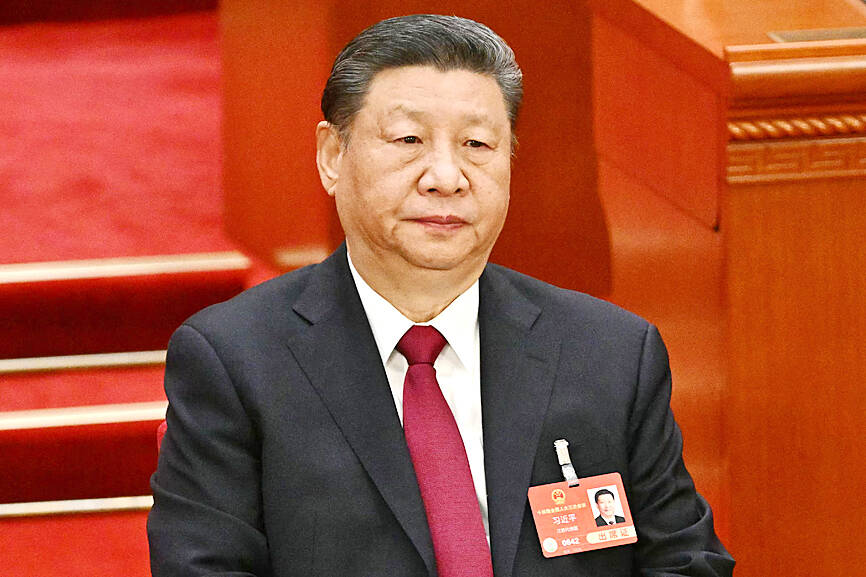
Photo: AFP
The removals might have been linked to the CCP’s sale of military equipment to countries such as Venezuela that have performed poorly in conflict scenarios in the past few years, it said.
Since the beginning of this year, the CCP has investigated many senior officials, including two high-level CCP officials — Central Military Commission Vice Chairman Zhang Youxia (張又俠) and Liu Zhenli (劉振立), chief of the commission’s Joint Staff Department — as well as politburo member Ma Xingrui (馬興瑞), Chongqing Mayor Hu Henghua (胡衡華) and 17 centrally managed cadres, the NSB said.
China’s economic growth slowed each quarter last year, amid weak consumption and negative investment growth, the NSB report showed.
At China’s annual “two sessions” meetings this year, the CCP lowered its economic growth target to 4.5 to 5 percent, reflecting a cautious outlook and placing greater emphasis on expanding domestic demand, it said.
China’s economy was also being affected by US tariffs of about 30 percent, as well as US strikes on China’s strategic partners Venezuela and Iran, affecting the nation’s energy supply security and the deployment of its Belt and Road Initiative, it said.
The US and China have postponed a meeting between US President Donald Trump and Xi, with geopolitical competition between the countries showing no sign of easing and no indications of compromise in economic and trade negotiations, the report said.
As a result, any meeting between Trump and Xi would produce limited results, it said.
However, despite pressures from a domestic economic slowdown, geopolitical competition and other governance risks, China continues to carry out acts of military intimidation, “gray zone” harassment and other forms of hybrid threats against Taiwan, while expanding efforts internationally to weaken Taiwan’s sovereignty in the international community, it said.
The bureau said it would adjust its intelligence collection on China, closely monitor developments and provide early-warning intelligence on threats to Taiwan.
In response to “gray zone” harassment at sea, the bureau would use cross-ministerial coordination mechanisms and international exchanges to share maritime domain awareness technologies and experience, improving shared operational awareness and early-warning response capabilities, it said.

UPGRADE: The Kang Ding-class frigate is replacing its Chaparall missiles with Tien Chien II and Hua Yang VLS, which would provide it with long-range, 360° air defense Taiwan plans to produce 1,200 to 1,376 Hai Chien II missiles (海劍二, Sea Sword II) — also known as TC-2N — to serve as the standard air defense system of the navy’s surface combatant fleet, a source said yesterday. Last week, the Hai Chien II, the naval version of the Tien Kung II missile (天劍二, Sky Sword II), completed a live-fire test in waters off the National Chungshan Institute of Science and Technology’s Jiupeng facility (九鵬) in Pingtung County’s Manjhou Township (滿州). The MIM72 Chaparral and other dated air defense missiles that currently arm Taiwanese ships have inadequate range to combat Chinese

REASONS FOR TRAVEL: An assistant professor said that proposed amendments to penalize drivers if they used drugs overseas would not deter people from traveling People who operate a motor vehicle under the influence of marijuana would have their driver’s license revoked, even if they used the substance while overseas, the Ministry of Transportation and Communications said yesterday, citing proposed amendments to the Road Traffic Management and Penalty Act (道路交通管理處罰條例). The amendments would also authorize the government to revoke the licenses of people determined to have used Category 1 or Category 2 narcotics, even if they were not operating a vehicle while under the influence of drugs, as well as ban them from taking the license test for three years, the ministry said. People aged 18 or
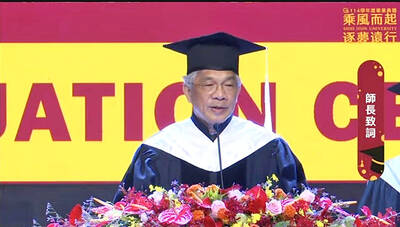
Shih Hsin University President Chen Ching-he (陳清河) yesterday issued a public apology for comments made in his commencement speech last week, stating that he has asked the school to suspend his duties and halt his wages for two months as a show of contrition. At the commencement ceremony on May 30, Chen said, “If you don’t manage your time well, or your own emotions, or your health, then I am telling every one of you — put a quick end to ‘you,’ because the world has no need for ‘you.’” The comments have sparked significant controversy online, and Chen through an open

Johanne Liou (劉喬安), a Taiwanese woman who shot to unwanted fame during the Sunflower movement protests in 2014, returned to Taiwan last night after being deported from the US. She is to stand trial in Taiwan for charges involving embezzlement, fraud and drug crimes. The Criminal Investigation Bureau (CIB) said it took her into custody at Taiwan Taoyuan International Airport and would first question her before transferring her to the New Taipei District Prosecutors’ Office. She was arrested upon disembarking a flight from San Francisco that landed shortly before 7pm. Liou absconded to the US in 2019 after jumping bail


 RSS
RSS