


The Chinese Communist Party (CCP) is enhancing its “push and pull” strategy against Taiwan, using transnational repression to “punish” Taiwanese independence advocates and promoting a “Taiwan Retrocession Day” to mislead countries about Taiwan’s status, a National Security Bureau (NSB) report said.
The CCP also seeks to entice high-tech Taiwanese firms, particularly those in artificial intelligence (AI) and semiconductors, to establish manufacturing facilities in China, according to the report, which has been submitted to the Legislative Yuan.
NSB Director-General Tsai Ming-yen (蔡明彥) is to discuss the report at a legislative meeting tomorrow.

Photo: Liao Chen-huei, Taipei Times
The CCP has invoked regulations such as the Schengen Borders Code to pressure EU nations into prohibiting Taiwanese officials’ entry, and has demanded that Lithuania change the name of the Taiwanese Representative Office, the NSB report said.
During Chinese Minister of Foreign Affairs Wang Yi’s (王毅) visit to Africa in January, the CCP orchestrated support from pro-China nations — including Somalia, Ethiopia and Lesotho — to voice a distorted interpretation of UN Resolution 2758 to shape a global narrative of Beijing’s “one China” principle, it said.
The resolution, adopted in 1971 to address China’s representation at the UN, makes no mention of Taiwan, nor does it state that it is a part of the People’s Republic of China (PRC).
Building on China’s World War II narratives, the CCP this year ramped up efforts to promote a “Taiwan Retrocession Day” at the Chinese National People’s Congress and Chinese People’s Political Consultative Conference, the report said.
The declaration would promote a narrative of “the return of Taiwan” to the PRC to mislead international audiences, it said.
The CCP is also employing a “differentiated” strategy, using forums and sponsored visits to attract more Taiwanese from different sectors to visit China, with exchanges aimed at promoting Beijing’s Taiwan policies and accelerate “integration and unification,” it said.
The CCP over the past few years has introduced a series of measures to “punish” people it deems as pro-Taiwanese independence, including threatening extraterritorial law enforcement, the NSB report said.
Through transnational repression, the CCP seeks to incite panic and division within Taiwan, and create a false impression of Chinese “governance” over Taiwan to undermine its national sovereignty, it said.
The CCP’s “punishment” methods for Taiwanese independence advocates include establishing a reporting mechanism, offering bounties and issuing “wanted” notices for certain Taiwanese, the bureau said.
The CCP also utilizes local collaborators to spread controversial information about efforts to “unify by force” to sow fear, and also sends personnel to Taiwan to engage in harassment campaigns and “on-the-ground threats,” it said.
China is also targeting defense and other confidential government data, while using investment opportunities, business deals or direct cash incentives to lure retired personnel into soliciting active-duty service members to engage in espionage, the report said.
The CCP also uses digital platforms to recruit military personnel who are facing financial hardship, it said
In exchange for debt relief or cash, the personnel are coerced into handing over classified data or producing video clips or recordings of them pledging loyalty to the CCP, it said.
From last year to last month, 58 people have been indicted in CCP-linked espionage cases, including 32 active or retired military personnel, the NSB report showed.
In alignment with its “15th Five-Year Plan,” the CCP is intensifying efforts to pressure or entice high-tech companies in Taiwan — specifically those involved in AI, semiconductors and precision machinery — to maintain or expand operations in China, the report said.
The CCP is conducting aggressive talent poaching, engaging systematic theft of trade secrets and using front companies to illicitly acquire controlled goods and advanced chips from Taiwan, the NSB said.

Actor Darren Wang (王大陸) was sentenced to six months in prison, commutable to a fine, by the New Taipei District Court today for contravening the Personal Data Protection Act (個人資料保護法) in a case linked to an alleged draft-dodging scheme. Wang allegedly paid NT$3.6 million (US$114,380) to an illegal group to help him evade mandatory military service through falsified medical documents, prosecutors said. He transferred the funds to Chen Chih-ming (陳志明), the alleged mastermind of a draft-evasion ring, although he lost contact with him as he was already in detention on fraud charges, they said. Chen is accused of helping a

SECURITY: Starlink owner Elon Musk has taken pro-Beijing positions, and allowing pro-China companies to control Taiwan’s critical infrastructure is risky, a legislator said Starlink was reluctant to offer services in Taiwan because of the nation’s extremely high penetration rates in 4G and 5G services, the Ministry of Digital Affairs said yesterday. The ministry made the comments at a meeting of the legislature’s Transportation Committee, which reviewed amendments to Article 36 of the Telecommunications Management Act (電信管理法). Article 36 bans foreigners from holding more than 49 percent of shares in public telecommunications networks, while shares foreigners directly and indirectly hold are also capped at 60 percent of the total, unless specified otherwise by law. The amendments, sponsored by Chinese Nationalist Party (KMT) Legislator Ko
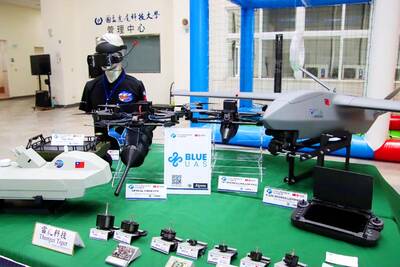
NON-RED SUPPLY: Boosting the nation’s drone industry is becoming increasingly urgent as China’s UAV dominance could become an issue in a crisis, an analyst said Taiwan’s drone exports to Europe grew 41.7-fold from 2024 to last year, with demand from Ukraine’s fight against Russian aggression the most likely driver of growth, a study showed. The Institute for Democracy, Society and Emerging Technology (DSET) in a statement on Wednesday said it found that many of Taiwan’s uncrewed aerial vehicle (UAV) sales were from Poland and the Czech Republic. These countries likely transferred the drones to Ukraine to aid it in its fight against the Russian invasion that started in 2022, it said. Despite the gains, Taiwan is not the dominant drone exporter to these markets, ranking second and fourth

The eastern extension of the Taipei MRT Red Line could begin operations as early as late June, the Taipei Department of Rapid Transit Systems said yesterday. Taipei Rapid Transit Corp said it is considering offering one month of free rides on the new section to mark its opening. Construction progress on the 1.4km extension, which is to run from the current terminal Xiangshan Station to a new eastern terminal, Guangci/Fengtian Temple Station, was 90.6 percent complete by the end of last month, the department said in a report to the Taipei City Council's Transportation Committee. While construction began in October 2016 with an


 RSS
RSS