


The number of households composed of only people aged 65 or older in the north is now almost double that of the south, the latest data from the Ministry of the Interior’s Real Estate Information Platform showed.
In the fourth quarter of last year, the number of elderly-only households in Taipei, New Taipei City and Taoyuan was 370,600, compared to just 187,600 across Tainan and Kaohsiung.
There are therefore 97.55 percent more elderly households in the north compared to the south, and when encompassing Taichung, the north still has 35.55 percent more than the southern and central municipalities.
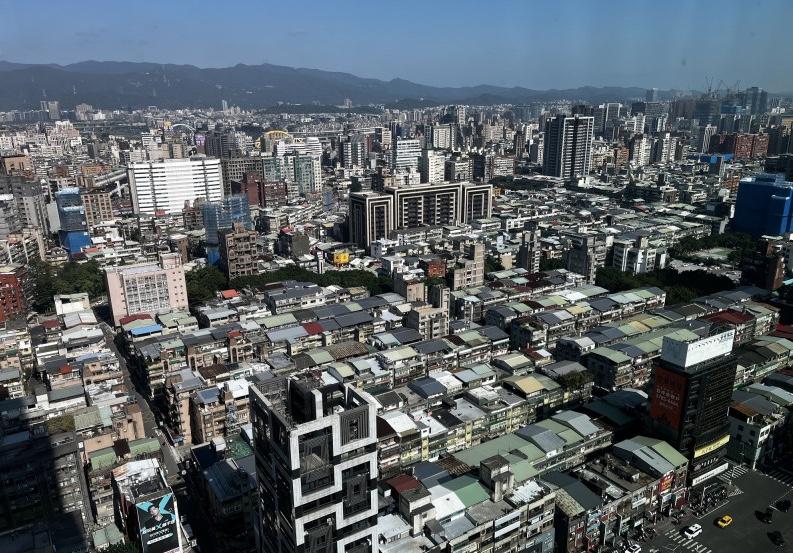
Photo: Hsu Yi-ping, Taipei Times
Many young Taiwanese from the south migrate northward for job opportunities, which in theory should leave many households in the south with only elderly residents, real-estate experts said.
However, it is speculated that many of those who rent property in the north keep their household registration in the south, meaning they may not be counted in the statistics, they said.
Meanwhile, the higher proportion of elderly living in the north may be due to children emigrating or living separately after marriage, they added.
Those households in the north are comprised not only of the local elderly, but are also the result of industrialization and urbanization, as those who formerly migrated north for work are now aging, Colliers International Taiwan director Huang Shu-wei (黃舒衛) said.
They may then choose to remain in the north for retirement, which challenges the long-held assumption that most people return to their hometowns in old age, he added.
Of the 370,600 households of only elderly people in the north, about 288,800, or 77.93 percent, were single-occupant elderly households, data show.
In recent years, the government has been promoting house-for-pension schemes and reverse mortgages, which allow senior homeowners to mortgage their house in exchange for payments to cover their daily needs while still maintaining property rights, Xin Chuan Real Estate Think Tank chief executive officer Ho Shih-chang (何世昌) said.
Therefore, the number of elderly leveraging property ownership for pension benefits has increased, with the scheme a significant contributor to the large number of elderly households in the north, he added.
Single-resident elderly households are a common occurrence and a result of the rural-urban divide, Sinyi Realty research center manager Tseng Ching-te (曾敬德) said.
Of the elderly people who live alone in the north, many likely have children who also live in the north and can therefore access care and emotional support, he said.
In contrast, for those who stay in the south, their children may have had their own families living in the north and would therefore be more isolated and have limited access to care, he said.
Taiwan should look to Japan, which is battling its own aging population crisis, to find potential solutions to the gap in caregiving, he added.

The Centers for Disease Control (CDC) yesterday reported the first case of a new COVID-19 subvariant — BA.3.2 — in a 10-year-old Singaporean girl who had a fever upon arrival in Taiwan and tested positive for the disease. The girl left Taiwan on March 20 and the case did not have a direct impact on the local community, it said. The WHO added the BA.3.2 strain to its list of Variants Under Monitoring in December last year, but this was the first imported case of the COVID-19 variant in Taiwan, CDC Deputy Director-General Lin Ming-cheng (林明誠) said. The girl arrived in Taiwan on

South Korea is planning to revise its controversial electronic arrival card, a step Taiwanese officials said prompted them to hold off on planned retaliatory measures, a South Korean media report said yesterday. A Yonhap News Agency report said that the South Korean Ministry of Foreign Affairs is planning to remove the “previous departure place” and “next destination” fields from its e-arrival card system. The plan, reached after interagency consultations, is under review and aims to simplify entry procedures and align the electronic form with the paper version, a South Korean ministry official said. The fields — which appeared only on the electronic form

The Ministry of Foreign Affairs (MOFA) is suspending retaliation measures against South Korea that were set to take effect tomorrow, after Seoul said it is updating its e-arrival system, MOFA said today. The measures were to be a new round of retaliation after Taiwan on March 1 changed South Korea's designation on government-issued alien resident certificates held by South Korean nationals to "South Korea” from the "Republic of Korea," the country’s official name. The move came after months of protests to Seoul over its listing of Taiwan as "China (Taiwan)" in dropdown menus on its new online immigration entry system. MOFA last week

A bipartisan group of US senators has introduced a bill to enhance cooperation with Taiwan on drone development and to reduce reliance on supply chains linked to China. The proposed Blue Skies for Taiwan Act of 2026 was introduced by Republican US senators Ted Cruz and John Curtis, and Democratic US senators Jeff Merkley and Andy Kim. The legislation seeks to ease constraints on Taiwan-US cooperation in uncrewed aerial systems (UAS), including dependence on China-sourced components, limited access to capital and regulatory barriers under US export controls, a news release issued by Cruz on Wednesday said. The bill would establish a "Blue UAS


 RSS
RSS