


Italian priest Gian Carlo Michelini, founder of the Lan Yang Dancers troupe and a longtime promoter of arts and culture in northeastern Taiwan, died yesterday at the age of 91, Saint Mary’s Hospital Luodong said.
Born in 1935, Michelini came to Taiwan from Italy in 1964 and spent more than six decades in Yilan County, dedicating his life to cultural development.
In 1966, he founded the Lan Yang Youth Catholic Center and later the Lan Yang Dancers, aiming to showcase local culture through dance.

Photo courtesy of the Saint Mary’s Hospital Luodong via CNA
Dance is the best way to express the unique character of Yilan, Michelini once said, explaining why he chose to promote the art form.
In 1974, at a time when Taiwan was diplomatically isolated from the international community, Michelini was able to organize a tour of Italy for the troupe, where they performed in front of Pope Paul VI and brought Taiwanese folk art to the world stage.
Michelini also played a key role in promoting the Yilan International Children’s Folklore and Folkgame Festival, inviting performing groups from around the world to Taiwan.
In 2017, he obtained Republic of China citizenship in recognition of his cultural contributions, calling it “the best birthday gift” and adding: “I still want to do many things for Taiwan.”
He was also named an honorary citizen of Yilan County last year for his lifelong contributions to local arts and culture.

SECURITY: Starlink owner Elon Musk has taken pro-Beijing positions, and allowing pro-China companies to control Taiwan’s critical infrastructure is risky, a legislator said Starlink was reluctant to offer services in Taiwan because of the nation’s extremely high penetration rates in 4G and 5G services, the Ministry of Digital Affairs said yesterday. The ministry made the comments at a meeting of the legislature’s Transportation Committee, which reviewed amendments to Article 36 of the Telecommunications Management Act (電信管理法). Article 36 bans foreigners from holding more than 49 percent of shares in public telecommunications networks, while shares foreigners directly and indirectly hold are also capped at 60 percent of the total, unless specified otherwise by law. The amendments, sponsored by Chinese Nationalist Party (KMT) Legislator Ko

The military has spotted two Chinese warships operating in waters near Penghu County in the Taiwan Strait and sent its own naval and air forces to monitor the vessels, the Ministry of National Defense (MND) said. Beijing sends warships and warplanes into the waters and skies around Taiwan on an almost daily basis, drawing condemnation from Taipei. While the ministry offers daily updates on the locations of Chinese military aircraft, it only rarely gives details of where Chinese warships are operating, generally only when it detects aircraft carriers, as happened last week. A Chinese destroyer and a frigate entered waters to the southwest

The eastern extension of the Taipei MRT Red Line could begin operations as early as late June, the Taipei Department of Rapid Transit Systems said yesterday. Taipei Rapid Transit Corp said it is considering offering one month of free rides on the new section to mark its opening. Construction progress on the 1.4km extension, which is to run from the current terminal Xiangshan Station to a new eastern terminal, Guangci/Fengtian Temple Station, was 90.6 percent complete by the end of last month, the department said in a report to the Taipei City Council's Transportation Committee. While construction began in October 2016 with an
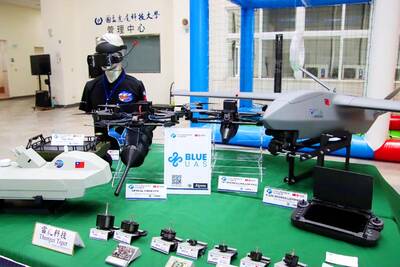
NON-RED SUPPLY: Boosting the nation’s drone industry is becoming increasingly urgent as China’s UAV dominance could become an issue in a crisis, an analyst said Taiwan’s drone exports to Europe grew 41.7-fold from 2024 to last year, with demand from Ukraine’s fight against Russian aggression the most likely driver of growth, a study showed. The Institute for Democracy, Society and Emerging Technology (DSET) in a statement on Wednesday said it found that many of Taiwan’s uncrewed aerial vehicle (UAV) sales were from Poland and the Czech Republic. These countries likely transferred the drones to Ukraine to aid it in its fight against the Russian invasion that started in 2022, it said. Despite the gains, Taiwan is not the dominant drone exporter to these markets, ranking second and fourth


 RSS
RSS