


The Chinese Nationalist Party (KMT) and the Taiwan People’s Party (TPP) have announced that they would not be recommending candidates for the Control Yuan.
The term of the sixth-term members of the Control Yuan expires on July 31. The Presidential Office has sent letters to political parties requesting their recommendations for new members.
KMT spokeswoman Yin Nai-ching (尹乃菁) yesterday criticized the Control Yuan, saying that, under the Democratic Progressive Party’s (DPP) rule, it has effectively become a tool of the ruling party, with largely ceremonial oversight powers.
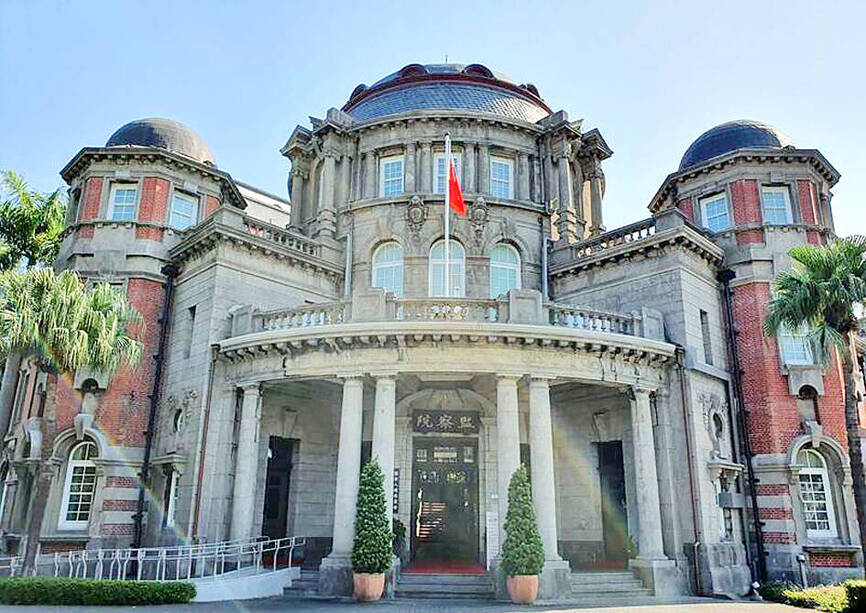
Photo: Hsieh Chun-lin, Taipei Times
Former Control Yuan president Chen Chu (陳菊) was allowed to take leave for more than a year, despite promises to clean up its own ranks, Yin said.
The legislature repeatedly delayed action in dealing with allegations of Control Yuan members misusing government vehicles, with the Taipei District Prosecutors’ Office closing the case and allowing officials to emerge unscathed, she said.
“Once tasked with upholding government ethics, the Control Yuan now risks undermining public trust, leaving frontline civil servants disillusioned,” she said.
Yin said the KMT supports keeping the Control Yuan, but “will not participate in the Presidential Office’s vague and symbolic moves,” citing a lack of concrete details on candidate recommendations.
She said the KMT has decided not to nominate any members at this time.
“If the Presidential Office is serious, it can formally request nominations, specifying how many candidates the KMT is entitled to propose under party proportionality. The KMT will consider the request and respond accordingly,” she added.
As for the TPP, as early as last month TPP Chairman Huang Kuo-chang (黃國昌) had declined to submit any recommendations.
He added that the TPP caucus has gained approval for the establishment of a constitutional amendment committee, “with aims to put into practice the DPP’s long-standing call to abolish the Control Yuan.”
DPP caucus chief executive Chuang Jui-hsiung (莊瑞雄) yesterday said that, while the DPP has long advocated abolishing the Examination Yuan and the Control Yuan, the Control Yuan remains a constitutional body until the Constitution is formally amended.
The president has the legal authority to nominate members, and the Legislative Yuan is obligated to review them, he said.
“If the legislature passively withholds consent, preventing the Control Yuan from functioning, it could raise constitutional concerns,” he said, urging opposition parties to pursue reforms through proper constitutional amendments, rather than letting government inaction stall the nation.

SECURITY: Starlink owner Elon Musk has taken pro-Beijing positions, and allowing pro-China companies to control Taiwan’s critical infrastructure is risky, a legislator said Starlink was reluctant to offer services in Taiwan because of the nation’s extremely high penetration rates in 4G and 5G services, the Ministry of Digital Affairs said yesterday. The ministry made the comments at a meeting of the legislature’s Transportation Committee, which reviewed amendments to Article 36 of the Telecommunications Management Act (電信管理法). Article 36 bans foreigners from holding more than 49 percent of shares in public telecommunications networks, while shares foreigners directly and indirectly hold are also capped at 60 percent of the total, unless specified otherwise by law. The amendments, sponsored by Chinese Nationalist Party (KMT) Legislator Ko

The military has spotted two Chinese warships operating in waters near Penghu County in the Taiwan Strait and sent its own naval and air forces to monitor the vessels, the Ministry of National Defense (MND) said. Beijing sends warships and warplanes into the waters and skies around Taiwan on an almost daily basis, drawing condemnation from Taipei. While the ministry offers daily updates on the locations of Chinese military aircraft, it only rarely gives details of where Chinese warships are operating, generally only when it detects aircraft carriers, as happened last week. A Chinese destroyer and a frigate entered waters to the southwest
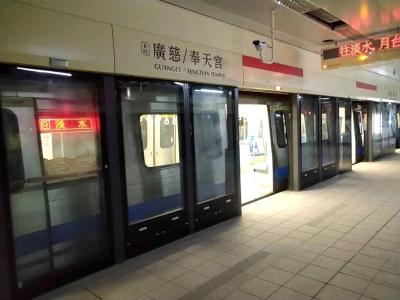
The eastern extension of the Taipei MRT Red Line could begin operations as early as late June, the Taipei Department of Rapid Transit Systems said yesterday. Taipei Rapid Transit Corp said it is considering offering one month of free rides on the new section to mark its opening. Construction progress on the 1.4km extension, which is to run from the current terminal Xiangshan Station to a new eastern terminal, Guangci/Fengtian Temple Station, was 90.6 percent complete by the end of last month, the department said in a report to the Taipei City Council's Transportation Committee. While construction began in October 2016 with an
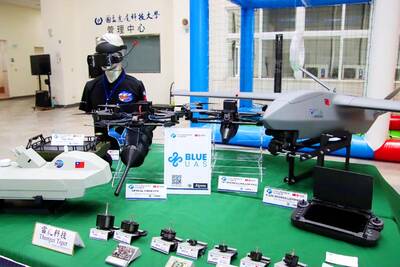
NON-RED SUPPLY: Boosting the nation’s drone industry is becoming increasingly urgent as China’s UAV dominance could become an issue in a crisis, an analyst said Taiwan’s drone exports to Europe grew 41.7-fold from 2024 to last year, with demand from Ukraine’s fight against Russian aggression the most likely driver of growth, a study showed. The Institute for Democracy, Society and Emerging Technology (DSET) in a statement on Wednesday said it found that many of Taiwan’s uncrewed aerial vehicle (UAV) sales were from Poland and the Czech Republic. These countries likely transferred the drones to Ukraine to aid it in its fight against the Russian invasion that started in 2022, it said. Despite the gains, Taiwan is not the dominant drone exporter to these markets, ranking second and fourth


 RSS
RSS