


Inspections would be increased to curb human trafficking and forced labor at sea, the Fisheries Agency said on Thursday in response to calls to end to labor exploitation in the distant-water fisheries industry.
At a news conference earlier in the day, rights advocates urged legislative reforms to protect distant-water fisheries workers, citing the case of Sunoto, an Indonesian fisher who was allegedly abused to death on the Da Wang (大旺) — a Taiwanese-owned fishing vessel.
The US Customs and Border Protection in 2020 issued a withhold release order barring the Da Wang from unloading at US ports and in 2022 issued a formal finding against the vessel for committing all 11 of the forced labor indicators of the International Labour Organization, the rights advocates said.
Photo: Screen grab from the agency’s Web Site
The Kaohsiung District Prosecutors’ Office in 2022 indicted nine people, including the ship’s owner and captain, over the case, but it has not been resolved, they said.
Manny, a Filipino fisher who was on the vessel with Sunoto, sought asylum in Taiwan in 2020 after Sunoto died in 2019.
He has been listed as a witness in the case and has been assisting with judicial proceedings without traveling home to the Philippines for the past few years, they added.
“If I leave [Taiwan], Sunoto’s death could be forgotten. I stay for the Taiwanese legal system to recognize that migrant workers’ lives matter as well,” Manny said.
Greenpeace Taiwan ocean campaigner Kuo Pei-hsien (郭珮嫻) said that the Office of the US Trade Representative last month initiated a Section 301 investigation of potential forced labor practices in major economies, including Taiwan, following the signing of the Agreement on Reciprocal Trade between the US and Taiwan.
The Executive Yuan should promptly put forward a draft directive on corporate sustainability due diligence that includes high-risk industries such as distant-water fisheries to translate human rights compliance into international trade competitiveness, thereby ensuring the annual NT$40 billion (US$1.25 billion) output from distant-water fisheries exports, Kuo said.
She cited Sari Heidenreich, a Greenpeace senior human rights adviser based in Washington, as saying that systemic deficiencies exist in Taiwan’s policies and law enforcement regarding distant-water fisheries.
Distant-water fishery workers are not protected by the Labor Standards Act (勞動基準法) and the definition of human trafficking in Taiwan’s laws does not align with international standards, leading to workers being isolated at sea and lacking access to effective remedies, Kuo said.
The Fisheries Agency said that the Da Wang in 2022 was dismantled in Busan, South Korea.
Kaohsiung prosecutors earlier that year had flagged the vessel over alleged contraventions of the Human Trafficking Prevention Act (人口販運防制法), it said.
The agency has been promoting a fisheries and human rights action plan since 2022 to enhance labor rights at sea, including improving labor checks and setting explicit limits on flag of convenience fishing vessels funded or operated by Taiwanese.
Working conditions for foreign crew members hired by such vessels are required to be in line with the standards of Taiwanese-flagged distant-water fishing vessels, it said.
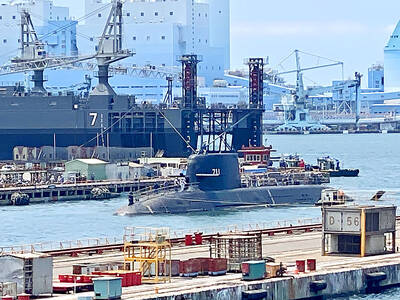
AGING: While Japan has 22 submarines, Taiwan only operates four, two of which were commissioned by the US in 1945 and 1946, and transferred to Taiwan in 1973 Taiwan would need at least 12 submarines to reach modern fleet capabilities, CSBC Corp, Taiwan chairman Chen Cheng-hung (陳政宏) said in an interview broadcast on Friday, citing a US assessment. CSBC is testing the nation’s first indigenous defense submarine, the Hai Kun (海鯤, Narwhal), which is scheduled to be delivered to the navy next month or in July. The Hai Kun has completed torpedo-firing tests and is scheduled to undergo overnight sea trials, Chen said on an SET TV military affairs program. Taiwan would require at least 12 submarines to establish a modern submarine force after assessing the nation’s operational environment and defense

Yangmingshan National Park authorities yesterday urged visitors to respect public spaces and obey the law after a couple was caught on a camera livestream having sex at the park’s Qingtiangang (擎天崗) earlier in the day. The Shilin Police Precinct in Taipei said it has identified a suspect and his vehicle registration number, and would summon him for questioning. The case would be handled in accordance with public indecency charges, it added. The couple entered the park at about 11pm on Thursday and began fooling around by 1am yesterday, the police said, adding that the two were unaware of the park’s all-day live
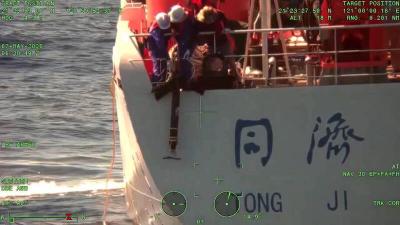
The coast guard today said that it had disrupted "illegal" operations by a Chinese research ship in waters close to the nation and driven it away, part of what Taipei sees a provocative pattern of China's stepped up maritime activities. The coast guard said that it on Thursday last week detected the Chinese ship Tongji (同濟號), which was commissioned only last year, 29 nautical miles (54km) southeast of the southern tip of Taiwan, although just outside restricted waters. The ship was observed lowering ropes into the water, suspected to be the deployment of scientific instruments for "illegal" survey operations, and the coast

A former soldier and an active-duty army officer were yesterday indicted for allegedly selling classified military training materials to a Chinese intelligence operative for a total of NT$79,440. The Taipei District Prosecutors’ Office indicted Chen Tai-yin (陳泰尹) and Lee Chun-ta (李俊達) for contravening the National Security Act (國家安全法) and the Anti-Corruption Act (貪污治罪條例). Chen left the military in September 2013 after serving alongside then-staff sergeant Lee, now an army lieutenant, at the 21st Artillery Command of the army’s Sixth Corps from 2011 to 2013, according to the indictment. Chen met a Chinese intelligence operative identified as “Wang” (王) through a friend in November


 RSS
RSS