


An interdisciplinary research team on childhood development yesterday called for a shift in Taiwan’s child welfare policies from economic subsidies toward strengthening family relationships to improve children’s well-being.
Suggested measures include issuing “family bonding vouchers” for parent-child activities and offering special public transportation discounts for families, researchers from the Kids in Taiwan: National Longitudinal Study of Child Development and Care (KIT) said.
The recommendations were presented at a news conference marking the 10th anniversary of KIT’s longitudinal database, alongside the release of its latest survey on children’s well-being.
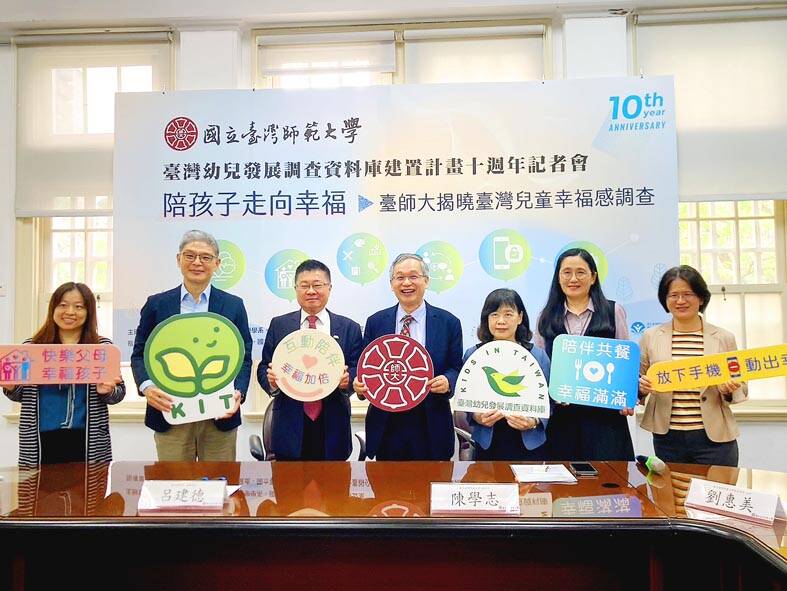
Photo: Yang Mien-chieh, Taipei Times
The survey — which tracks children born from April 2013 to March 2014 who are now in fifth grade — found an average self-reported well-being score of 8.19 out of 10. However, 13.5 percent of respondents rated their well-being as below six.
Researchers identified several key factors influencing children’s well-being.
Family environment played a central role, the researchers said, adding that children whose parents showed fewer depressive symptoms reported higher levels of well-being.
At the same time, more positive parent-child interactions, including shared activities and communication during mealtimes, were also associated with better outcomes, they said.
Life experiences and social connections were also important. Frequent outdoor activities, interactions with friends and family, and exposure to nature were all positively correlated with well-being, as were strong peer relationships.
Physical activity was another contributing factor, with children who exercised at least once a week reporting higher well-being, a trend that became more pronounced with age.
In contrast, increased time on digital devices was associated with lower well-being, particularly among older children, the researchers said.
The team recommended incorporating parenting resources into short videos and other visual content to promote childcare knowledge and communication skills.
They also called for better coordination among communities, schools and social services to identify families in high-stress situations and provide timely support.
Most public parent-child centers in Taiwan cater to children under age six, leaving older children with limited access to safe and engaging spaces, they said, urging the government to establish multipurpose facilities that can accommodate families with children of all ages.
Funded by the National Science and Technology Council, KIT program is conducted by National Taiwan Normal University’s Department of Human Development and Family Studies in collaboration with experts from multiple disciplines.
The study tracks 2,526 children, examining their health; language, social, emotional and cognitive development; family and school environments; and experiences.

NATIONAL SECURITY: Authorities are working to confirm the identities of the military personnel involved and investigating possible illegal conduct and regulatory violations Authorities are probing possible national security implications after Kinmen police and immigration officers on Sunday found a Chinese woman allegedly posing as a tourist while engaging in prostitution involving more than 10 military personnel. The woman, surnamed Chen (陳), has since been deported, authorities said, adding that investigators are still working to confirm the identities of those implicated, as the records only listed code names and aliases. The case stemmed from a report received by the Kinmen District Prosecutors’ Office on Friday last week from the Jinhu Precinct of the Kinmen County Police Bureau. On Sunday, police, along with the National Immigration

GLOBALGIVING: ‘ Caving to external pressure is not acceptable for an organization that has cultivated justice reform and human rights for 30 years,’ one NGO said A slew of non-government organizations (NGOs) have withdrawn from the GlobalGiving fundraising platform after it announced it would use “Chinese Taipei” instead of “Taiwan” from next month. The Taiwan Good Rice Association wrote on Facebook on Friday that it was informed on April 28 via a teleconference call of the change, which was made because the platform wanted to operate in China. Taiwan Good Rice is to terminate all cooperative relationships with GlobalGiving in response to the platform’s “unilateral and non-negotiable” decision to remove references to Taiwan, the NGO said. “Taiwan is in the official name of Taiwan Good Rice Association and the

HEAVY WEATHER: Typhoon Jangmi is due to crash straight into the Ryukyus as airlines look to shift flights to larger aircraft or cancel flights to Okinawa entirely Taiwan’s international air carriers announced flight adjustments over the weekend as Typhoon Jangmi is forecast to hit the Ryukyu Islands today and tomorrow. The Central Weather Administration (CWA) upgraded Jangmi from a tropical storm to a typhoon at 8am yesterday, with the eye located 580km south of Naha city. It was moving north at 19kph. Today, China Airlines’ CI-120, CI-121, CI-122 and CI-123 flights between Taoyuan and Naha, Okinawa, have been canceled as well as CI-132 and CI-133 between Kaohsiung and Naha. EVA Air’s BR-112, BR-113, BR-186 and BR-185 flights between Taoyuan and Naha are also canceled. Low-cost carrier Tigerair Taiwan canceled IT-230,

Chinese Nationalist Party (KMT) Chairwoman Cheng Li-wun (鄭麗文) yesterday briefed her party’s Central Standing Committee regarding her scheduled visit to the US between Monday next week and June 16, saying that her purpose would be to persuade the US that the Republic of China (ROC) Constitution was a “one China” constitution that would foster stable and peaceful cross-strait relations. The ROC Constitution is the most important defense for all Taiwanese citizens, as it upholds our democracy and has contributed to our robust economy, which aligns with international and US interests, she said. “We would not be troublemakers and drag the US under,”


 RSS
RSS