


The Taipei City Government is investing NT$2 billion (US$62.74 million) to renovate the Zhoumei Elementary School in Beitou-Shilin Technology Park, the city government said during the inauguration of the school’s prepatory office on Saturday.
The school would focus on bilingual education, artificial intelligence (AI) and sustainability, it added.
The school was closed in 2015 due to rezoning for the park, but is now being prepared to reopen in 2031, Taipei Mayor Chiang Wan-an (蔣萬安) said during the ceremony, which was attended by the school’s former principals and alumni, and community members.
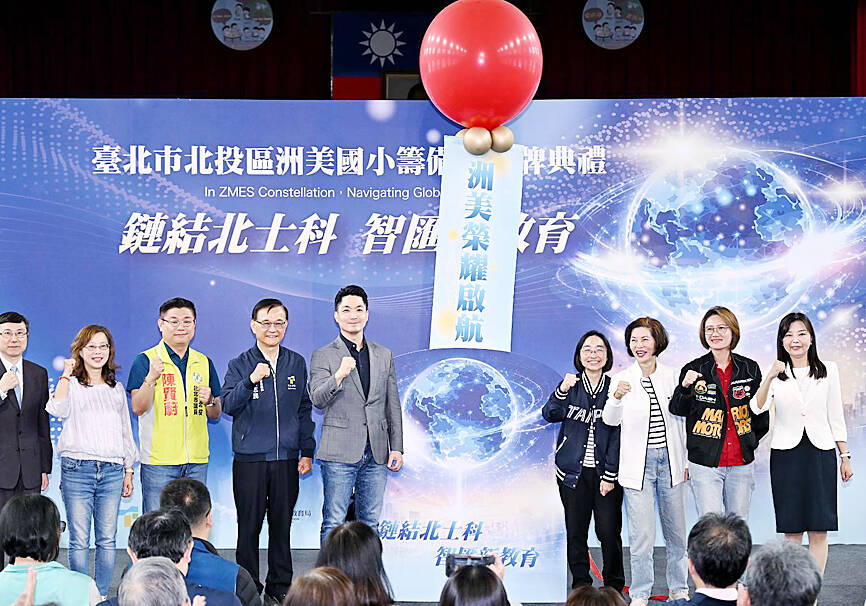
Photo: Fang Pin-chao, Taipei Times
The Taipei city government plans to reopen the school to provide future generations with an education that integrates technology and the humanities while cultivating innovative thinking, global perspectives and cross-disciplinary skills, Chiang said.
Taipei signed a deal with Nvidia last month — which is expected to bring in more than 10,000 jobs, as the company invests NT$40 billion into the Beitou-Shilin Technology Park — ushering in a golden era for the Beitou and Shilin districts, he said.
Taipei is not only planning to rebuild the Zhoumei Elementary School, but also establish a Zhoumei Junior High School and set up a local education alliance with the Wenlin Elementary School, Mingde Junior High School and Zhong Zheng Senior High School, Chiang said.
Integrating resources across schools would build a comprehensive technology education system from elementary through high school, cultivating globally completive AI talent, Chiang added.
The city plans to invest more than NT$2 billion to complete the Zhoumei Elementary School campus by 2031, the Department of Education said.
The preliminary plan calls for 12 standard classes, two overseas talent classes, two sports classes, two special education classes and five kindergarten classes, the department said.
The curriculum would focus on AI innovation, bilingual education, holistic wellness and sustainability, it said, adding that the school would become a model for advancing educational innovation and urban development in Taipei.
The school would promote an open campus, and partner with the community and local schools to build a more connected, student-centered learning system, it said.
The campus would also feature smart buildings, green energy, and advanced monitoring and safety systems, combining education, technology and sustainability, it added.
The school is a key part of the city’s vision for educational innovation, community learning and sustainability, the department said.
The city would continue to promote high-quality campus development, aligning education with urban growth, and providing students with an innovative, smart and sustainable learning environment, it said.

FUKUOKA SITUATION: Japanese media reported that the pathogen is expected to be identified by the summer, while the CDC downplayed the idea that it was hMPV A “mysterious cold-like illness” reported in Japan’s Fukuoka Prefecture does not seem to be a new disease, but Japanese authorities have been asked about the situation, the Centers for Disease Control (CDC) said yesterday. The Fukuoka Prefectural Medical Association on Wednesday told a news conference that a “mystery cold” that has become a hot topic on social media is “highly likely to be caused by some kind of viral infection,” Japan’s KBC News reported. “Many people are experiencing symptoms starting with a sore throat, followed by a runny nose, phlegm and a severe cough,” KBC News reported, citing association officials. Health authorities are

Nvidia Corp CEO Jensen Huang (黃仁勳) arrived in Taiwan yesterday ahead of upcoming AI and technology events, saying he plans to meet with clients and Taiwan Semiconductor Manufacturing Co Chairman C.C. Wei (魏哲家) during his visit. After landing at Taipei Songshan Airport, Huang posed for photos with fans and handed out Yakult drinks to reporters and supporters waiting at the scene, saying he has “a lot to do” during the trip. Asked about reports that Nvidia’s planned headquarters site in Taipei’s Beitou Shilin Technology Park could break ground on May 27, Huang said that if the company holds an event, he would

The Ministry of Finance this afternoon announced the winning numbers for the March-April uniform invoice lottery. The winning number for the NT$10 million (US$318,060) special prize is 19531471, and the winning number for the NT$2 million grand prize is 85941329. Three numbers were drawn for the NT$200,000 first prize: 07225810, 20231230 and 83518781. Those with receipts matching the last seven digits of any of the first-prize numbers will win the NT$40,000 second prize, while those matching the last six digits will win the NT$10,000 third prize. Those whose receipts match the last five digits of the first-prize numbers can claim the NT$4,000 fourth prize,

SIX SUBSIDIES: The monthly allowance for older farmers is to increase to NT$10,000, and NT$5,000 is to be given to homemakers under the national pension system, Lai said The government is to implement major welfare policies for disadvantaged groups, including raising the monthly allowance for older farmers to NT$10,000 and providing homemakers with NT$5,000 per month, President William Lai (賴清德) said yesterday. Lai made the remarks during a visit to Wangling Temple in Chiayi County, saying that the planned increases were being introduced amid economic growth and an increase in tax revenue. Touting a policy, in which the government plans to provide a monthly allowance of NT$5,000 for every child under the age of 18 in a bid to address Taiwan’s low birthrate, Lai said that if received for the


 RSS
RSS