


The US supports a comprehensive special defense budget because it focuses on two core objectives — building a “non-red supply chain” and building redundancy for “logistics and replenishment,” a defense analyst said yesterday.
Deliberations over the special defense budget hit a stalemate last week as the opposition parties insisted on removing the line items related to “consignment production” and “commercial procurement,” preventing a cross-party consensus from being reached.
As the deadline to pay for the initial installments for US arms, including HIMARS rocket artillery, M109A7 self-propelled howitzers, and Javelin and TOW missiles, is today, failure to make the payments on time could delay subsequent contract negotiations until the end of the year.
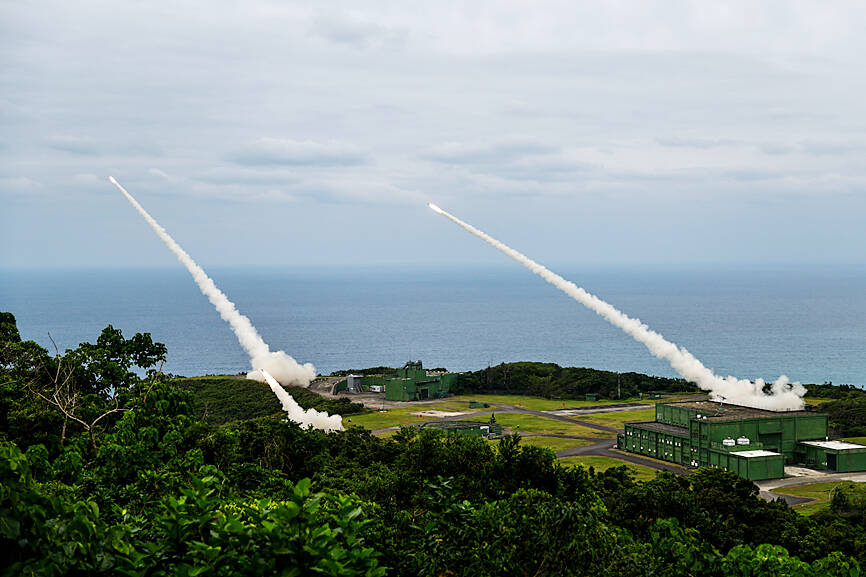
Photo: EPA
Regarding the “consignment production” and “commercial procurement” items that the opposition parties insist on removing, Shen Ming-shih (沈明室), a research fellow at the Institute for National Defense and Security Research, said yesterday these items actually carry deep implications for future Taiwan-US cooperation.
They should be seen through the perspective of growing the national defense industry and logistics and supply, he said, adding that they are not only part of a military strategy, but also economic opportunities for the private sector.
Shen said the US is pushing to eliminate the “red supply chain” and Taiwan could consolidate some of its own military supply sources, so collaborative production with the US can achieve a win-win outcome.
First, it ensures that co-produced products are safe and reliable. Second, it encourages US investment in Taiwan, driving profits for the local defense industry and expanding its market scale, he said.
“This is highly beneficial for Taiwan, the US, the defense industry and the combat capabilities of the armed forces,” Shen said, adding it is perplexing to see the budget get cut due to political interference when there is no evidence of illicit gains or corruption.
He went on and said Taiwan could become an ammunition supply hub in the Indo-Pacific region after it spins up its own production lines.
He said the US is working to improve integrated deterrence across the First Island Chain, such as the collaborative production of Patriot missiles with Japan, because the Russia-Ukraine War showed that there is a massive demand for 155mm rounds, but global supply remains insufficient.
The Ministry of National Defense announced plans to build 14 new ordnance production lines to establish local production capacity in Taiwan, he said.
From a logistics and supply perspective, once a conflict erupts, ammunition on the front lines would be consumed extremely fast and it would be difficult to sustain defense operations without local production capacity, he added.
If Taiwan can build up this capacity, it can meet its own needs during peacetime and serve as a supply hub for allied nations in the Indo-Pacific or East Asian regions during wartime, Shen said.
During the 2003 Iraq War, when the US faced a shortage of small arms ammunition, Taiwan stepped in as a supplier, he recalled, adding it proved that Taiwan has potential to become a critical link in the regional defense supply chain.
Su Tzu-yun (蘇紫雲), director of the Institute for National Defense and Security Research’s Defense Strategy and Resources Division, yesterday warned that delays in payments for US arms purchases first affect political credibility.
Since US price quotes are time-sensitive, any delays would force the Defense Security Cooperation Agency to go through the US Department of Defense and have suppliers and contractors re-estimate prices for the next 90 days, he said.
Su pointed out that there is high demand for HIMARS batteries in Europe. If Taiwan’s process is delayed, the delivery schedule would be pushed back, with other countries receiving priority, he said, adding this could severely impact Taiwan’s military buildup and the integrity of its force development.
Su expressed concern that if Beijing’s influence comes into play, any perception of Taiwan’s lack of commitment to the purchase could give US “red team” factions — pro-China groups or those opposed to arms sales to Taiwan — an opportunity to block the deal.

NATIONAL SECURITY: Authorities are working to confirm the identities of the military personnel involved and investigating possible illegal conduct and regulatory violations Authorities are probing possible national security implications after Kinmen police and immigration officers on Sunday found a Chinese woman allegedly posing as a tourist while engaging in prostitution involving more than 10 military personnel. The woman, surnamed Chen (陳), has since been deported, authorities said, adding that investigators are still working to confirm the identities of those implicated, as the records only listed code names and aliases. The case stemmed from a report received by the Kinmen District Prosecutors’ Office on Friday last week from the Jinhu Precinct of the Kinmen County Police Bureau. On Sunday, police, along with the National Immigration

GLOBALGIVING: ‘ Caving to external pressure is not acceptable for an organization that has cultivated justice reform and human rights for 30 years,’ one NGO said A slew of non-government organizations (NGOs) have withdrawn from the GlobalGiving fundraising platform after it announced it would use “Chinese Taipei” instead of “Taiwan” from next month. The Taiwan Good Rice Association wrote on Facebook on Friday that it was informed on April 28 via a teleconference call of the change, which was made because the platform wanted to operate in China. Taiwan Good Rice is to terminate all cooperative relationships with GlobalGiving in response to the platform’s “unilateral and non-negotiable” decision to remove references to Taiwan, the NGO said. “Taiwan is in the official name of Taiwan Good Rice Association and the

HEAVY WEATHER: Typhoon Jangmi is due to crash straight into the Ryukyus as airlines look to shift flights to larger aircraft or cancel flights to Okinawa entirely Taiwan’s international air carriers announced flight adjustments over the weekend as Typhoon Jangmi is forecast to hit the Ryukyu Islands today and tomorrow. The Central Weather Administration (CWA) upgraded Jangmi from a tropical storm to a typhoon at 8am yesterday, with the eye located 580km south of Naha city. It was moving north at 19kph. Today, China Airlines’ CI-120, CI-121, CI-122 and CI-123 flights between Taoyuan and Naha, Okinawa, have been canceled as well as CI-132 and CI-133 between Kaohsiung and Naha. EVA Air’s BR-112, BR-113, BR-186 and BR-185 flights between Taoyuan and Naha are also canceled. Low-cost carrier Tigerair Taiwan canceled IT-230,

Chinese Nationalist Party (KMT) Chairwoman Cheng Li-wun (鄭麗文) yesterday briefed her party’s Central Standing Committee regarding her scheduled visit to the US between Monday next week and June 16, saying that her purpose would be to persuade the US that the Republic of China (ROC) Constitution was a “one China” constitution that would foster stable and peaceful cross-strait relations. The ROC Constitution is the most important defense for all Taiwanese citizens, as it upholds our democracy and has contributed to our robust economy, which aligns with international and US interests, she said. “We would not be troublemakers and drag the US under,”


 RSS
RSS