


Taiwan is developing civil-government interoperability as an antidote to China’s new attempts to dislocate the nation’s political institutions and erode its society, Deputy Minister of the Interior Ma Shih-yuan (馬士元) said yesterday.
He made the remarks at the Civil Defense Convention in Taipei hosted by civic organizations.
The Chinese Communist Party is launching new forms of “dislocation warfare” and “erosion warfare” on top of its traditional tactics — public opinion, psychological and legal warfare — to throw the nation’s democratic system and government functions into disarray, Ma said.
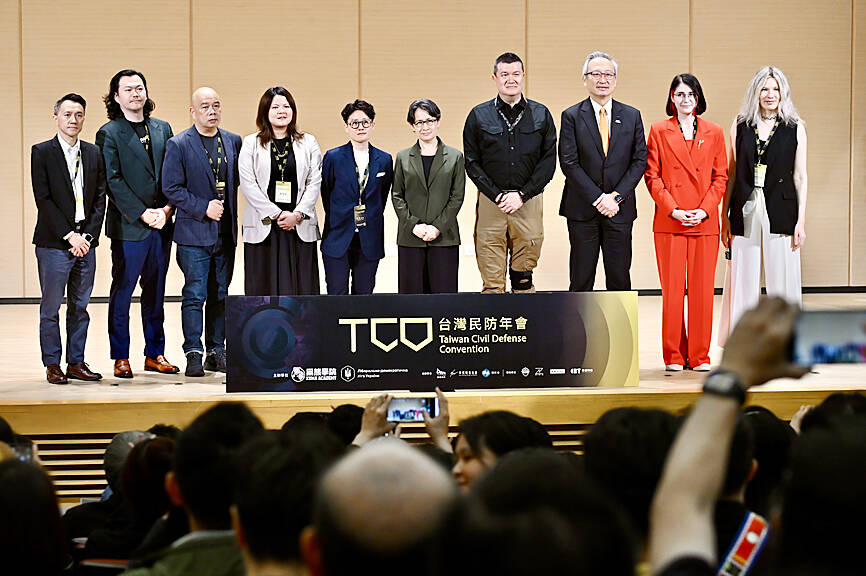
Photo: George Tsorng, Taipei Times
The deadlock in the legislature is an example of Beijing’s dislocation tactics, aimed at the workings of the government, while erosion is typified by China’s covert influence and meddling operations.
Taiwan would remain vulnerable to such tactics if the armed forces, police, firefighters and civil defense capabilities work separately, with no communication or cooperation, he said.
In response to that, the Ministry of the Interior has been promoting interoperability since Russia’s invasion of Ukraine in 2022, he added.
Taiwanese society must come together, and make it clear that the nation is taking the steps necessary to protect its democratic way of life and to ensure the continuation of political, economic and religious freedoms, he said.
Working together with other democracies and being prepared to confront the threat of authoritarianism lies at the heart of President William Lai’s (賴清德) policy of peace through strength, he added.
Vice President Hsiao Bi-khim (蕭美琴) said Russia had shattered the post-Cold War global order by invading Ukraine and that Taiwan should learn from the conflict.
Freedom is not “free” and it takes all of society’s might to safeguard democracy, she said.
The Cabinet’s special defense budget is crucial to building up Taiwan’s resilience and ensuring continued peace, she added.
Defense capabilities come from tangible investments in defense technologies, not statements sent online via keyboards, Hsiao said.
Taiwan needs a vast range of weapons platforms, and sea, air, land, cyberspace and space systems, which would be impossible to obtain if efforts to develop a domestic technological capabilities do not get funded, she said.
Measures bolstering societal resilience is also urgently needed to confront geopolitical tensions with China, and overcome challenges such as earthquakes and extreme climate conditions, she added.
Deputy Minister of Foreign Affairs Francois Wu (吳志中) said Taiwan is improving its defenses not out of fear, but to safeguard democracy and freedom.
Taiwan would continue to support Ukraine and show the international community that democratic nations must remain united and be prepared in the face of authoritarian threats, he said.
Liberal Democratic League of Ukraine East Asian Office head Mariia Makarovych said that everyday civil defense not only protects the homeland, but also builds deterrence, making foreign adversaries think twice before taking rash actions.
Kuma Civil Defense Education Association chair Liu Wen (劉文) said that nearly 100,000 Taiwanese participated in the academy’s civil defense training since 2021, coalescing grassroots efforts to defend the nation against foreign aggression.
Taiwan has much to learn from Ukraine in countering China’s military might and geopolitical strategy, she said, adding that the association believes that resilience is the best deterrent, and that promoting civil defense education is key to building a confident and united nation.

NATIONAL SECURITY: Authorities are working to confirm the identities of the military personnel involved and investigating possible illegal conduct and regulatory violations Authorities are probing possible national security implications after Kinmen police and immigration officers on Sunday found a Chinese woman allegedly posing as a tourist while engaging in prostitution involving more than 10 military personnel. The woman, surnamed Chen (陳), has since been deported, authorities said, adding that investigators are still working to confirm the identities of those implicated, as the records only listed code names and aliases. The case stemmed from a report received by the Kinmen District Prosecutors’ Office on Friday last week from the Jinhu Precinct of the Kinmen County Police Bureau. On Sunday, police, along with the National Immigration

GLOBALGIVING: ‘ Caving to external pressure is not acceptable for an organization that has cultivated justice reform and human rights for 30 years,’ one NGO said A slew of non-government organizations (NGOs) have withdrawn from the GlobalGiving fundraising platform after it announced it would use “Chinese Taipei” instead of “Taiwan” from next month. The Taiwan Good Rice Association wrote on Facebook on Friday that it was informed on April 28 via a teleconference call of the change, which was made because the platform wanted to operate in China. Taiwan Good Rice is to terminate all cooperative relationships with GlobalGiving in response to the platform’s “unilateral and non-negotiable” decision to remove references to Taiwan, the NGO said. “Taiwan is in the official name of Taiwan Good Rice Association and the

HEAVY WEATHER: Typhoon Jangmi is due to crash straight into the Ryukyus as airlines look to shift flights to larger aircraft or cancel flights to Okinawa entirely Taiwan’s international air carriers announced flight adjustments over the weekend as Typhoon Jangmi is forecast to hit the Ryukyu Islands today and tomorrow. The Central Weather Administration (CWA) upgraded Jangmi from a tropical storm to a typhoon at 8am yesterday, with the eye located 580km south of Naha city. It was moving north at 19kph. Today, China Airlines’ CI-120, CI-121, CI-122 and CI-123 flights between Taoyuan and Naha, Okinawa, have been canceled as well as CI-132 and CI-133 between Kaohsiung and Naha. EVA Air’s BR-112, BR-113, BR-186 and BR-185 flights between Taoyuan and Naha are also canceled. Low-cost carrier Tigerair Taiwan canceled IT-230,

Chinese Nationalist Party (KMT) Chairwoman Cheng Li-wun (鄭麗文) yesterday briefed her party’s Central Standing Committee regarding her scheduled visit to the US between Monday next week and June 16, saying that her purpose would be to persuade the US that the Republic of China (ROC) Constitution was a “one China” constitution that would foster stable and peaceful cross-strait relations. The ROC Constitution is the most important defense for all Taiwanese citizens, as it upholds our democracy and has contributed to our robust economy, which aligns with international and US interests, she said. “We would not be troublemakers and drag the US under,”


 RSS
RSS