


Alleged contact between Xu Chunying (徐春鶯) — a resident of Taiwan by marriage since 1998 and director of the Taiwan New Immigrant Development Association — and Chinese officials have raised fresh concerns about Beijing’s attempts to influence Taiwan’s politics.
Prosecutors yesterday indicted Xu on suspicion of involvement in Beijing-directed election interference.
An investigation by prosecutors allegedly showed that Xu had, as early as November 2023, messaged Yang Wentao (楊文濤), director of cross-strait marriage affairs at the Chinese Ministry of Civil Affairs, regarding the Taiwan People’s Party (TPP) schedule for legislator rotation, the Chinese-language Liberty Times (sister paper of the Taipei Times) wrote in an exclusive report.
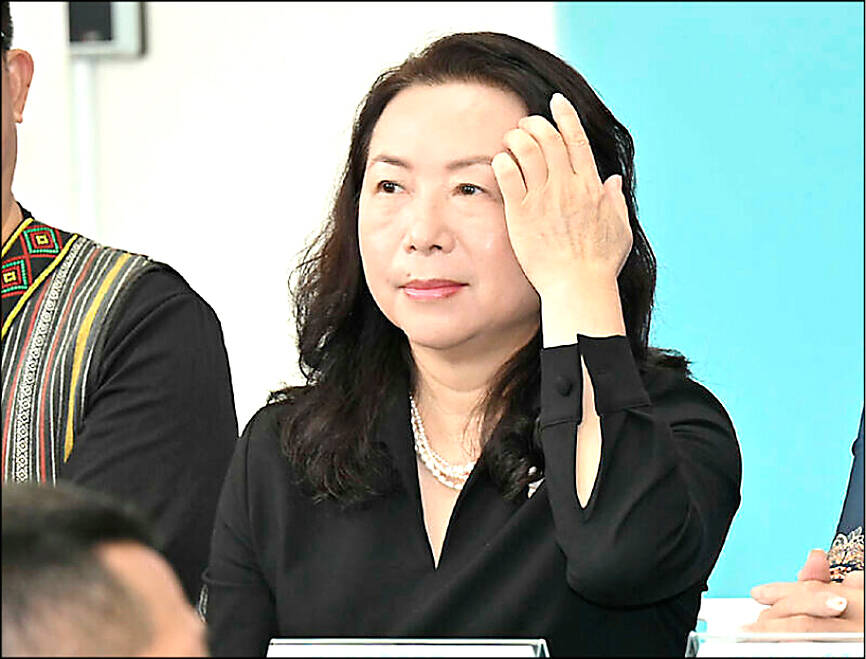
Photo: Yang Hsin-hui, Taipei Times
Xu in January 2024 told Yang that the TPP would prove crucial, as no party has a legislative majority, the report said.
She also shared plans to use Chinese spouses in Taiwan as political candidates, which could enable Beijing to cultivate influence within Taiwan’s political system, it said.
On March 18, 2024, Xu forwarded personal information about then-TPP legislator-at-large nominee Li Zhenxiu (李貞秀) to Sun Xian (孫憲), deputy director of the Shanghai chapter of the Council for the Promotion of Peaceful National Reunification, as well as developments in local politics, the Liberty Times reported.
In November 2024, Sun asked Xu whether the TPP would consider Li as a legislator-at-large nominee, with Xu replying that she would meet with TPP officials a week later to discuss the issue, it reported.
In August last year, Sun suggested that the TPP should nominate Li regardless of her election prospects, then publicly claim that the Mainland Affairs Council had blocked her from taking office to create an issue regarding Chinese spouses being elected, the report said.
Democratic Progressive Party spokesman Justin Wu (吳崢) said that the case raised serious concerns about the TPP’s ties to Xu and Li, accusing the party of undermining Taiwan’s legal framework and autonomy.
Xu claimed to have been a Chinese state official and described herself as “pro-China,” indicating alignment with the Chinese Communist Party (CCP), Wu said.
Li’s nationality has been the subject of debate even before she was sworn in as a legislator-at-large on Feb. 3, mainly due to doubts over her eligibility to serve, as the government contends that she failed to meet several qualifying conditions to take office — including formally renouncing her Chinese citizenship.
Xu’s alleged actions serve the CCP’s goal to sow dissent in Taiwan, Wu said, adding that the links between TPP candidates and Beijing were a major concern.
National Cheng Kung University professor of political science Wang Hung-jen (王宏仁) said that the law might be insufficient to counter such infiltration.
If Li is allowed into the legislature, it could pose a security risk regardless of the TPP’s intentions, Wang said.
Beijing could attempt to frame such situations as discrimination against Chinese married to Taiwanese, but the issue concerns legal compliance, not identity, he said.
Citizen Congress Watch director Chang Hung-lin (張宏林) said that political participation by immigrants should be supported if conducted lawfully, adding that the TPP must adequately vet its candidates.
The party must clarify its position to address public concerns about possible links with China, Chang said.

The Ministry of Finance this afternoon announced the winning numbers for the March-April uniform invoice lottery. The winning number for the NT$10 million (US$318,060) special prize is 19531471, and the winning number for the NT$2 million grand prize is 85941329. Three numbers were drawn for the NT$200,000 first prize: 07225810, 20231230 and 83518781. Those with receipts matching the last seven digits of any of the first-prize numbers will win the NT$40,000 second prize, while those matching the last six digits will win the NT$10,000 third prize. Those whose receipts match the last five digits of the first-prize numbers can claim the NT$4,000 fourth prize,

SIX SUBSIDIES: The monthly allowance for older farmers is to increase to NT$10,000, and NT$5,000 is to be given to homemakers under the national pension system, Lai said The government is to implement major welfare policies for disadvantaged groups, including raising the monthly allowance for older farmers to NT$10,000 and providing homemakers with NT$5,000 per month, President William Lai (賴清德) said yesterday. Lai made the remarks during a visit to Wangling Temple in Chiayi County, saying that the planned increases were being introduced amid economic growth and an increase in tax revenue. Touting a policy, in which the government plans to provide a monthly allowance of NT$5,000 for every child under the age of 18 in a bid to address Taiwan’s low birthrate, Lai said that if received for the
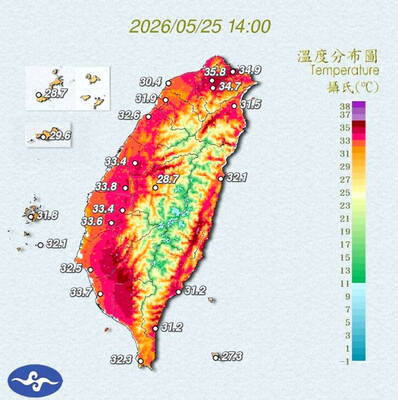
STAY COOL: The HPA recommended that people stay hydrated, use air-conditioning or fans while indoors, wear loose-fitting clothes and walk in the shade while outdoors Employers must implement measures such as installing cooling equipment, and providing drinking water and rest breaks for outdoor workers starting from Monday next week, the Taipei Department of Labor said on Sunday. Employers who fail to comply could face fines of NT$30,000 to NT$300,000 under the Occupational Safety and Health Act (職業安全衛生法), the department said. Businesses in Taipei employing fewer than 100 workers, as well as registered self-employed workers with labor insurance coverage, could receive on-site assessments and guidance from occupational safety consultants to help them apply for central government subsidies to implement or improve heat-protection measures, it said. Under the Ministry of
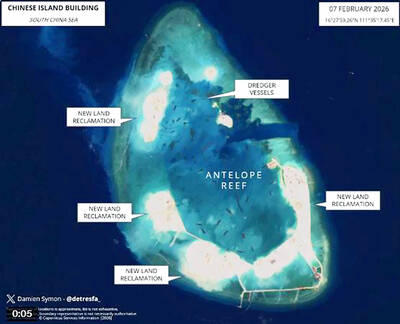
ISOLATION: The outposts would serve as support and backup bases, forcing US forces to either face China head-on or reroute, increasing travel time and operational costs China’s outposts in the South China Sea could be used to delay and constrain foreign forces during a conflict in the Taiwan Strait, giving Beijing a critical window to carry out amphibious landing and blockade operations, a report said. The Chinese Communist Party’s (CCP) forward operating bases on islands and reclaimed features in the South China Sea could delay foreign forces long enough for the Chinese People’s Liberation Army (PLA) to secure a key 48-to-72-hour window in the Taiwan Strait, a report commissioned by the Mainland Affairs Council found. The report, conducted by the Institute for National Defense and Security Research, examined


 RSS
RSS