


A child died last week from enterovirus infection, the first death this year from the disease, while a rare case of severe enterovirus infection was reported in a man in his 30s, the Centers for Disease Control (CDC) said yesterday.
The child, who died in southern Taiwan and was younger than 10, did not have underlying health conditions, CDC physician Lin Yung-ching (林詠青) said.
She saw a doctor due to vomiting on March 11 and was diagnosed with acute gastroenteritis, but later developed symptoms including headache, diarrhea and general weakness, he said.
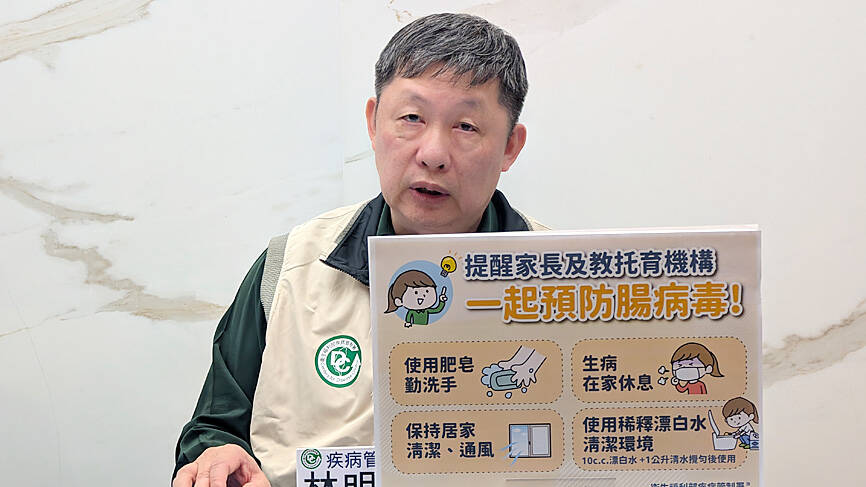
Photo: CNA
On the fourth day after the onset of symptoms, she lost consciousness and was rushed to a hospital, during which her heart temporarily stopped, Lin said.
After resuscitation, she was in severe cardiogenic shock with multiple organ failure, and was put on life support and admitted to an intensive care unit (ICU), he said.
Further examinations confirmed she was infected with rotavirus and coxsackievirus A4, he said.
Her condition rapidly worsened and she died of fulminant myocarditis (sudden and severe cardiac inflammation) on the seventh day from the onset of symptoms, he said.
Regarding the man with enterovirus, infections predominantly affect children, making the severe infection of a person in their 30s rare, Lin said.
When the man, who has a record of a malignant tumor, was hospitalized for treatment in northern Taiwan on March 2, he was diagnosed with a fever and pneumonia, and continued to have a fever and difficulty breathing while in hospital, he said.
Tests confirmed that the man had fungal and enterovirus D68 infections.
The man also experienced convulsions, altered consciousness, low blood oxygen levels and neurological symptoms on the 10th day after his hospitalization, which his doctor deemed as enterovirus-induced encephalitis, Lin said.
The man is still in an ICU, he said.
Hospitals reported 3,009 emergency visits for enterovirus infection last week, CDC Epidemic Intelligence Center Deputy Director Lee Chia-lin (李佳琳) said.
Virus surveillance data showed that the dominant enterovirus strain in the past four weeks was coxsackievirus A — mainly A6, followed by A16 and A4, she said.
Enterovirus activity typically increases after Lunar New Year and rapidly rises after Tomb Sweeping Day — which is this year on April 5 — before reaching a peak near Dragon Boat Festival, CDC Deputy Director-General and spokesman Lin Min-cheng (林明誠) said.
Enterovirus activity usually slows during summer, and begins to increase again after school starts in early fall, he said.
That trend is likely to be the same this year, with weekly cases remaining about the same or gradually increasing before Tomb Sweeping Day, and growing faster afterward, Lin Min-cheng said.
As young children are at higher risk of developing severe complications from enterovirus infection, parents and educators should remind children to practice good hand hygiene — washing hands with soap, as alcohol-based sanitizers are ineffective in killing enterovirus — and also disinfect contaminated surfaces with diluted bleach, he said.
Parents should also keep infected children at home to rest and avoid direct contact with other children, while paying close attention to signs of severe complications, including sleepiness, altered consciousness, limb weakness, convulsions, rapid heartbeat, convulsions, shortness of breath and persistent vomiting, and seek immediate treatment if they occur, he said.

The Ministry of Finance this afternoon announced the winning numbers for the March-April uniform invoice lottery. The winning number for the NT$10 million (US$318,060) special prize is 19531471, and the winning number for the NT$2 million grand prize is 85941329. Three numbers were drawn for the NT$200,000 first prize: 07225810, 20231230 and 83518781. Those with receipts matching the last seven digits of any of the first-prize numbers will win the NT$40,000 second prize, while those matching the last six digits will win the NT$10,000 third prize. Those whose receipts match the last five digits of the first-prize numbers can claim the NT$4,000 fourth prize,

SIX SUBSIDIES: The monthly allowance for older farmers is to increase to NT$10,000, and NT$5,000 is to be given to homemakers under the national pension system, Lai said The government is to implement major welfare policies for disadvantaged groups, including raising the monthly allowance for older farmers to NT$10,000 and providing homemakers with NT$5,000 per month, President William Lai (賴清德) said yesterday. Lai made the remarks during a visit to Wangling Temple in Chiayi County, saying that the planned increases were being introduced amid economic growth and an increase in tax revenue. Touting a policy, in which the government plans to provide a monthly allowance of NT$5,000 for every child under the age of 18 in a bid to address Taiwan’s low birthrate, Lai said that if received for the
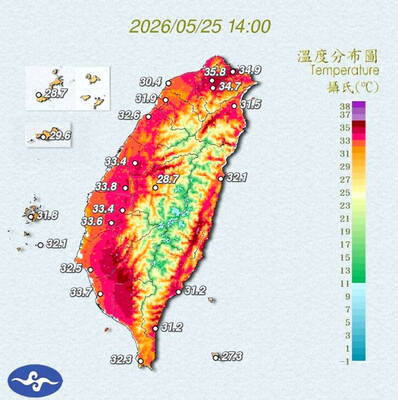
STAY COOL: The HPA recommended that people stay hydrated, use air-conditioning or fans while indoors, wear loose-fitting clothes and walk in the shade while outdoors Employers must implement measures such as installing cooling equipment, and providing drinking water and rest breaks for outdoor workers starting from Monday next week, the Taipei Department of Labor said on Sunday. Employers who fail to comply could face fines of NT$30,000 to NT$300,000 under the Occupational Safety and Health Act (職業安全衛生法), the department said. Businesses in Taipei employing fewer than 100 workers, as well as registered self-employed workers with labor insurance coverage, could receive on-site assessments and guidance from occupational safety consultants to help them apply for central government subsidies to implement or improve heat-protection measures, it said. Under the Ministry of

NATIONAL SECURITY: Authorities are working to confirm the identities of the military personnel involved and investigating possible illegal conduct and regulatory violations Authorities are probing possible national security implications after Kinmen police and immigration officers on Sunday found a Chinese woman allegedly posing as a tourist while engaging in prostitution involving more than 10 military personnel. The woman, surnamed Chen (陳), has since been deported, authorities said, adding that investigators are still working to confirm the identities of those implicated, as the records only listed code names and aliases. The case stemmed from a report received by the Kinmen District Prosecutors’ Office on Friday last week from the Jinhu Precinct of the Kinmen County Police Bureau. On Sunday, police, along with the National Immigration


 RSS
RSS