


Opportunities exist for mutually beneficial cooperation on space between the US and Taiwan, given the complementary nature of each side's strengths, the director-general of Taiwan's space agency said in Washington yesterday.
Speaking at a virtual discussion hosted by the Center for Strategic and International Studies, Taiwan Space Agency (TASA) Director-General Wu Jong-shinn (吳宗信) said that the US has a leading edge in space technology, while Taiwan has robust manufacturing capabilities.
US companies could leverage Taiwan's strengths to accelerate and industrialize the space sector and related infrastructure, with both sides able to quickly finalize a cooperation framework, Wu said.
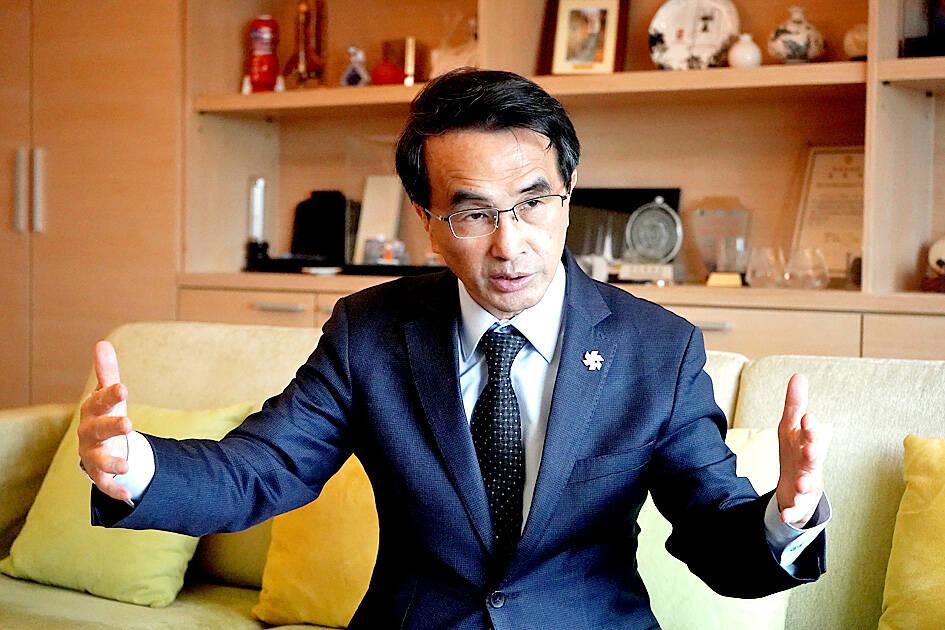
Photo: CNA
Taiwan's globally recognized strengths in electronics, semiconductors and precision manufacturing are already supporting several space projects, including a planned lunar data center and equipment for NASA's Perseverance Mars mission, he said.
Wu said his visit to Washington was aimed at enhancing ties with US industry, positioning Taiwan as a reliable player in the global space supply chain and exploring new opportunities for Taiwan-US commercial and technological cooperation.
Improved space capabilities are crucial for deterrence and resilience, he said, adding that if undersea cables were cut in an emergency, Taiwan's communications would need to rely on space systems.
That would require it to quickly be able to leverage international resources — especially US commercial space capabilities, Wu said.
"It is vital for national security," he said.
The government has increased investment and public awareness of the sector's importance, Wu said, adding that the space agency would continue advancing economic and security objectives.
He also highlighted the economic potential of Taiwan's space industry, saying that it has inspired the younger generation and would play an important role in economic growth, much like the semiconductor sector.
A bill that last month made it through the US House of Representatives Committee on Science, Space and Technology by a 37-0 vote, known as the Taiwan and American Space Assistance Act, could advance the type of cooperation Wu described.
If passed, the bill would facilitate partnerships between NASA, the National Oceanic and Atmospheric Administration and TASA, including in areas such as satellite, space exploration, and atmospheric and weather programs.
The virtual discussion, titled "Taiwan's Space Ambitions and the Future of US-Taiwan Cooperation," explored Taiwan's evolving space priorities, opportunities for Taiwan-US collaboration, and the broader implications for security, resilience and innovation in the Indo-Pacific.
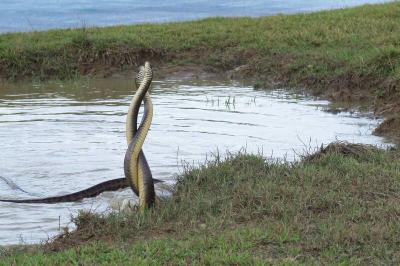
Kenting National Park service technician Yang Jien-fon (楊政峰) won a silver award in World Grand Prix Photography Awards Spring Season for his photograph of two male rat snakes intertwined in combat. Yang’s colleagues at Kenting National Park said he is a master of nature photography who has been held back by his job in civil service. The awards accept entries in all four seasons across six categories: architectural and urban photography, black-and-white and fine art photography, commercial and fashion photography, documentary and people photography, nature and experimental photography, and mobile photography. Awards are ranked according to scores and divided into platinum, gold and
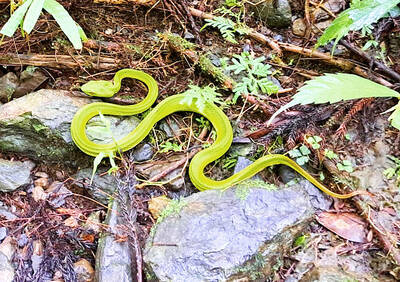
More than half of the bamboo vipers captured in Tainan in the past few years were found in the city’s Sinhua District (新化), while other districts had smaller catches or none at all. Every year, Tainan captures about 6,000 snakes which have made their way into people’s homes. Of the six major venomous snakes in Taiwan, the cobra, the many-banded krait, the brown-spotted pit viper and the bamboo viper are the most frequently captured. The high concentration of bamboo vipers captured in Sinhua District is puzzling. Tainan Agriculture Bureau Forestry and Nature Conservation Division head Chu Chien-ming (朱健明) earlier this week said that the

The Chinese Nationalist Party (KMT) caucus yesterday said it opposes the introduction of migrant workers from India until a mechanism is in place to prevent workers from absconding. Minister of Labor Hung Sun-han (洪申翰) on Thursday told the Legislative Yuan that the first group of migrant workers from India could be introduced as early as this year, as part of a government program. The caucus’ opposition to the policy is based on the assessment that “the risk is too high,” KMT caucus secretary-general Lin Pei-hsiang (林沛祥) said. Taiwan has a serious and long-standing problem of migrant workers absconding from their contracts, indicating that

TRADE-OFF: Beijing seeks to trade a bowl of tempura for a Chinese delicacy, an official said, while another said its promises were attempts to interfere in the polls The government must carefully consider the national security implications of building a bridge connecting Kinmen County and Xiamen, China, the Public Construction Commission (PCC) said yesterday. PCC Commissioner Derek Chen (陳金德), who is also a minister without portfolio, made the remarks in a meeting of the legislature’s Transportation Committee, after Democratic Progressive Party Legislator Hsu Fu-kuei (徐富癸) asked about China’s proposal of new infrastructure projects to further connect Kinmen and Lienchiang (Matsu) counties with Xiamen. China unveiled the bridge plan, along with nine other policies for Taiwan, on Sunday, the last day of Chinese Nationalist Party (KMT) Chairwoman Cheng Li-wun’s (鄭麗文) visit


 RSS
RSS