


Seeing concerts and chasing celebrities can be an effective way for elderly people to stay young and healthy, as it gives them new motivation to learn, go out, and interact with others, arts advocates and mental health experts said.
Wu Tzu-yi (吳滋懿), an art critic and the founder of Jil Wu Artiste, advocates for arts-based wellness and making art accessible.
She said she knows a group of retirees who seem to have frozen their age around 45 by immersing themselves in art and following South Korean celebrities.

Photo courtesy of Grandma Xiami via CNA
“Standing in front of the original artwork is very important,” Wu said, adding that entering an art museum to see original works stimulates the senses, recharges the brain and brings vitality.
Attending a concert and seeing celebrities in person produces a similar effect, she said.
Arts-based wellness differs from art therapy, a clinical practice that requires a physician, as it is suitable for anyone who wants to protect their mental health, Wu added.
It can be a life-support system for anyone, especially those 65 and older who are feeling unsettled after retirement and could be valuable for Taiwan’s super-aging society, she said.
To get closer to their favorite art and artists, older fans put themselves in new environments, learn new languages and cultures, make new friends, or join fan communities, she said, adding that music, dance and film connect them across cultural, language and generational divides
“Understanding each other across generations is the most healing thing in the world,” Wu said.
One’s well-being and mental health affect physical health, helping to delay functional decline, she added.
By instilling the concept of cultural access in people from a young age, there would be more possibilities for elderly people to lead healthy lives in the future, she said.
One elderly woman immersing themselves in art is the 80-year-old YouTuber Grandma Xiami (蝦米娘娘), who proves that there is no age limit to chasing celebrities.
Xiami in January attended a live concert for the first time, fulfilling her dream by seeing the K-pop girl group Twice’s world tour in Vancouver.
She said she initially wanted to better understand the idol culture of the younger generation, and now has personally experienced that music, dance and fashion have no age limit.
Another example is Veronica, now almost 65, who has watched dramas and K-pop idol groups to better understand her children’s world.
She said she loves the K-pop girl group Blackpink and is the biggest fan of its member Jennie, who inspires her to work out, eat healthy and live an exciting life.
Meanwhile, 84-year-old Chen is a huge fan of the K-pop boy group Super Junior.
She said that when her partner died a few years ago, her children started getting her to watch variety shows to help her mood, and she ended up falling in love with Super Junior when they appeared on a show.
Chen regularly goes to the hospital for dementia assessments, and she said the doctor always praises her condition.
One of her biggest motivations for staying healthy is to be able to keep watching Super Junior’s concerts, she said.
She recalled she was nervous when she first went to their concert, but young people warmly greeted her when queuing to enter the venue and even said they could accompany her at the concert.
Chen said she focuses on her health, so she can meet her idols, playing Super Junior’s music when she exercises every morning and when she is at home.
The biggest threat to most elderly people is not physical decline, but thinking that they have no purpose anymore, formal social worker Wu Su-fen (吳素芬) said, adding that when elderly people have a clear goal, their entire disposition is different.
Some seniors go to concerts with their grandchildren, while chasing celebrities gives others a new goal and reason to leave the house, psychologist Huang Hsun-yuan (黃薰緣) said.
Learning a new language, figuring out how to get concert tickets, and remembering audience choreography gives elderly people a sense of accomplishment and confidence that no medication can, Huang said.
For those just starting out or families who have doubts, it can help to acknowledge the courage it takes elderly people to try something new, she said.
“For many people, this is not just entertainment; it’s a way to prove that they can still learn and interact with others,” Huang said.
While fandom can give older adults new goals, it is important to watch for imbalance, she said.
Families can look out for disruptions from daily routines such as lost sleep from following idol news and excessive spending on merchandise, she added.
It could also be problematic if the elderly person’s social circle shrinks to only fellow fans, and they spend less time with family and friends, Huang said.
Family members can offer companionship and understanding, so elderly people know they are not alone, she said.
Once they feel supported and emotionally stable, it becomes easier to discuss lifestyle adjustments or future plans, she added.


UPGRADE: The Kang Ding-class frigate is replacing its Chaparall missiles with Tien Chien II and Hua Yang VLS, which would provide it with long-range, 360° air defense Taiwan plans to produce 1,200 to 1,376 Hai Chien II missiles (海劍二, Sea Sword II) — also known as TC-2N — to serve as the standard air defense system of the navy’s surface combatant fleet, a source said yesterday. Last week, the Hai Chien II, the naval version of the Tien Kung II missile (天劍二, Sky Sword II), completed a live-fire test in waters off the National Chungshan Institute of Science and Technology’s Jiupeng facility (九鵬) in Pingtung County’s Manjhou Township (滿州). The MIM72 Chaparral and other dated air defense missiles that currently arm Taiwanese ships have inadequate range to combat Chinese

REASONS FOR TRAVEL: An assistant professor said that proposed amendments to penalize drivers if they used drugs overseas would not deter people from traveling People who operate a motor vehicle under the influence of marijuana would have their driver’s license revoked, even if they used the substance while overseas, the Ministry of Transportation and Communications said yesterday, citing proposed amendments to the Road Traffic Management and Penalty Act (道路交通管理處罰條例). The amendments would also authorize the government to revoke the licenses of people determined to have used Category 1 or Category 2 narcotics, even if they were not operating a vehicle while under the influence of drugs, as well as ban them from taking the license test for three years, the ministry said. People aged 18 or
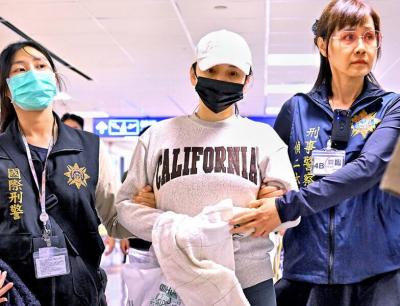
Johanne Liou (劉喬安), a Taiwanese woman who shot to unwanted fame during the Sunflower movement protests in 2014, returned to Taiwan last night after being deported from the US. She is to stand trial in Taiwan for charges involving embezzlement, fraud and drug crimes. The Criminal Investigation Bureau (CIB) said it took her into custody at Taiwan Taoyuan International Airport and would first question her before transferring her to the New Taipei District Prosecutors’ Office. She was arrested upon disembarking a flight from San Francisco that landed shortly before 7pm. Liou absconded to the US in 2019 after jumping bail

Shih Hsin University President Chen Ching-he (陳清河) yesterday issued a public apology for comments made in his commencement speech last week, stating that he has asked the school to suspend his duties and halt his wages for two months as a show of contrition. At the commencement ceremony on May 30, Chen said, “If you don’t manage your time well, or your own emotions, or your health, then I am telling every one of you — put a quick end to ‘you,’ because the world has no need for ‘you.’” The comments have sparked significant controversy online, and Chen through an open


 RSS
RSS