


Taiwan’s population of endangered Formosan black bears has been initially estimated at about 1,200, but the figure could still be revised, the Forestry and Nature Conservation Agency said yesterday.
The estimate was based on recent nationwide monitoring data, with duplicate infrared camera records removed, but remains preliminary pending more comprehensive local population density data, the agency said.
A more precise number is expected by the end of this year, it added.
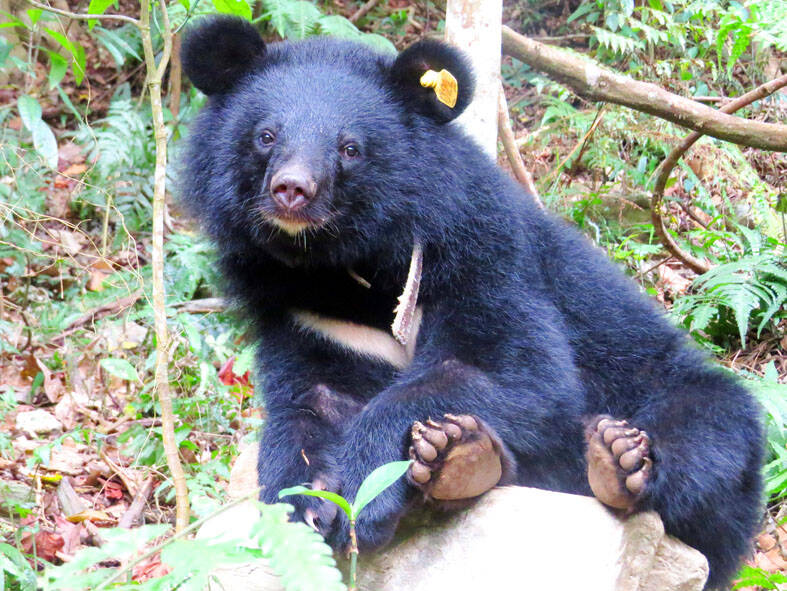
Photo courtesy of the Forestry and Nature Conservation Agency
The Formosan black bear, endemic to Taiwan, is listed as an endangered species under the Wildlife Conservation Act (野生動物保育法).
The new estimate follows the agency’s report last year showing increased bear activity, with monitoring data since 2011 indicating the population is expanding from mountain areas into foothills and plains near human settlements.
Human-bear encounters have also increased in the past few years. Authorities recorded 15 reported cases last year and four so far this year, some involving bears raiding poultry farms. Most sightings have occurred in Hualien and Taitung counties, as well as in Taichung, Kaohsiung, Miaoli, Chiayi, and within Yushan and Shei-Pa national parks.
Rescued or captured bears are typically placed in short-term care for treatment and rehabilitation before release, although some are deemed unsuitable for release due to repeated conflicts with humans, the agency said.
In a recent case in Hualien, a bear that returned twice to raid chicken coops was permanently rehomed at Taipei Zoo, it said.
A long-term shelter center would be built in Taitung to address such cases, with completion targeted for 2028, agency Director-General Lin Hwa-ching (林華慶) said.
Bears involved in repeated conflicts would generally be given two chances for release before being placed in long-term care, the agency said.
Until the facility is completed, such bears would continue to be housed by partner institutions such as the Taipei Zoo, it said.

NATIONAL SECURITY: Authorities are working to confirm the identities of the military personnel involved and investigating possible illegal conduct and regulatory violations Authorities are probing possible national security implications after Kinmen police and immigration officers on Sunday found a Chinese woman allegedly posing as a tourist while engaging in prostitution involving more than 10 military personnel. The woman, surnamed Chen (陳), has since been deported, authorities said, adding that investigators are still working to confirm the identities of those implicated, as the records only listed code names and aliases. The case stemmed from a report received by the Kinmen District Prosecutors’ Office on Friday last week from the Jinhu Precinct of the Kinmen County Police Bureau. On Sunday, police, along with the National Immigration

GLOBALGIVING: ‘ Caving to external pressure is not acceptable for an organization that has cultivated justice reform and human rights for 30 years,’ one NGO said A slew of non-government organizations (NGOs) have withdrawn from the GlobalGiving fundraising platform after it announced it would use “Chinese Taipei” instead of “Taiwan” from next month. The Taiwan Good Rice Association wrote on Facebook on Friday that it was informed on April 28 via a teleconference call of the change, which was made because the platform wanted to operate in China. Taiwan Good Rice is to terminate all cooperative relationships with GlobalGiving in response to the platform’s “unilateral and non-negotiable” decision to remove references to Taiwan, the NGO said. “Taiwan is in the official name of Taiwan Good Rice Association and the

HEAVY WEATHER: Typhoon Jangmi is due to crash straight into the Ryukyus as airlines look to shift flights to larger aircraft or cancel flights to Okinawa entirely Taiwan’s international air carriers announced flight adjustments over the weekend as Typhoon Jangmi is forecast to hit the Ryukyu Islands today and tomorrow. The Central Weather Administration (CWA) upgraded Jangmi from a tropical storm to a typhoon at 8am yesterday, with the eye located 580km south of Naha city. It was moving north at 19kph. Today, China Airlines’ CI-120, CI-121, CI-122 and CI-123 flights between Taoyuan and Naha, Okinawa, have been canceled as well as CI-132 and CI-133 between Kaohsiung and Naha. EVA Air’s BR-112, BR-113, BR-186 and BR-185 flights between Taoyuan and Naha are also canceled. Low-cost carrier Tigerair Taiwan canceled IT-230,

Chinese Nationalist Party (KMT) Chairwoman Cheng Li-wun (鄭麗文) yesterday briefed her party’s Central Standing Committee regarding her scheduled visit to the US between Monday next week and June 16, saying that her purpose would be to persuade the US that the Republic of China (ROC) Constitution was a “one China” constitution that would foster stable and peaceful cross-strait relations. The ROC Constitution is the most important defense for all Taiwanese citizens, as it upholds our democracy and has contributed to our robust economy, which aligns with international and US interests, she said. “We would not be troublemakers and drag the US under,”


 RSS
RSS