


Reviewing a possible restart of nuclear power plants is compatible with Taiwan’s continued push for renewable energy, President William Lai (賴清德) said yesterday in defending his administration’s reversal on nuclear power use.
Lai said the government would continue developing green energy — including wind, solar, small hydropower and hydrogen — alongside any assessment of nuclear restarts.
“The two approaches can move forward together without any contradiction or conflict,” he said.
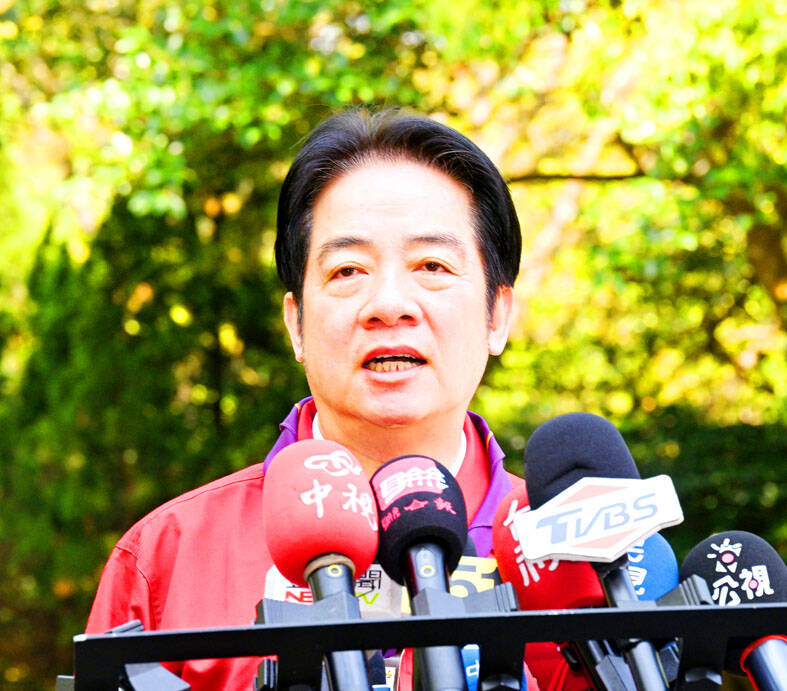
Photo: Fang Pin-chao, Taipei Times
Opposing nuclear power has long been a central tenet of Lai’s Democratic Progressive Party (DPP).
Former president Chen Shui-bian (陳水扁) of the DPP tried to stop the construction of the Fourth Nuclear Power Plant soon after he took power in 2000 and then pushed an amendment to the Basic Environment Act (環境基本法) in 2002 that called for devising plans to “progressively achieve the goal of a nuclear-free homeland.”
Former president Tsai Ing-wen (蔡英文) then fully embraced the goal of having a “nuclear-free homeland” by 2025 during her unsuccessful 2012 presidential campaign and enshrined it into law after winning the presidency in 2016.
Responding to questions on whether the move contradicted the longstanding “non-nuclear homeland” policy, Lai said the goal had already been achieved after the second reactor at the Ma-anshan Nuclear Power Plant in Pingtung County’s Hengchun Township (恆春) was shut down last year.
Lai said that renewable energy had compensated for the loss of nuclear power generation under Tsai’s green-energy initiative, helping maintain a stable power supply, but that Taiwan’s energy strategy needed to be reassessed.
Several factors, such as an expected rise in electricity demand driven by economic growth and artificial intelligence (AI) development as well as low-carbon standards and geopolitical shifts, had to be accounted for to ensure an adequate, resilient and low-carbon supply of electricity, Lai said.
Some DPP members said the move was triggered by the opposition-controlled Legislature’s passage of amendments to the Nuclear Reactor Facilities Regulation Act (核子反應器設施管制法) allowing nuclear power plant operators to apply for a 20-year license to extend the life of their facilities.
Lai said that based on those amendments, state-run Taiwan Power Co was preparing to submit restart plans for the Guosheng and Ma-anshan nuclear power plants to the Nuclear Safety Commission by the end of the month.
Any restart would be contingent on nuclear safety, waste management solutions and public consensus, he said.

NATIONAL SECURITY: Authorities are working to confirm the identities of the military personnel involved and investigating possible illegal conduct and regulatory violations Authorities are probing possible national security implications after Kinmen police and immigration officers on Sunday found a Chinese woman allegedly posing as a tourist while engaging in prostitution involving more than 10 military personnel. The woman, surnamed Chen (陳), has since been deported, authorities said, adding that investigators are still working to confirm the identities of those implicated, as the records only listed code names and aliases. The case stemmed from a report received by the Kinmen District Prosecutors’ Office on Friday last week from the Jinhu Precinct of the Kinmen County Police Bureau. On Sunday, police, along with the National Immigration

GLOBALGIVING: ‘ Caving to external pressure is not acceptable for an organization that has cultivated justice reform and human rights for 30 years,’ one NGO said A slew of non-government organizations (NGOs) have withdrawn from the GlobalGiving fundraising platform after it announced it would use “Chinese Taipei” instead of “Taiwan” from next month. The Taiwan Good Rice Association wrote on Facebook on Friday that it was informed on April 28 via a teleconference call of the change, which was made because the platform wanted to operate in China. Taiwan Good Rice is to terminate all cooperative relationships with GlobalGiving in response to the platform’s “unilateral and non-negotiable” decision to remove references to Taiwan, the NGO said. “Taiwan is in the official name of Taiwan Good Rice Association and the

HEAVY WEATHER: Typhoon Jangmi is due to crash straight into the Ryukyus as airlines look to shift flights to larger aircraft or cancel flights to Okinawa entirely Taiwan’s international air carriers announced flight adjustments over the weekend as Typhoon Jangmi is forecast to hit the Ryukyu Islands today and tomorrow. The Central Weather Administration (CWA) upgraded Jangmi from a tropical storm to a typhoon at 8am yesterday, with the eye located 580km south of Naha city. It was moving north at 19kph. Today, China Airlines’ CI-120, CI-121, CI-122 and CI-123 flights between Taoyuan and Naha, Okinawa, have been canceled as well as CI-132 and CI-133 between Kaohsiung and Naha. EVA Air’s BR-112, BR-113, BR-186 and BR-185 flights between Taoyuan and Naha are also canceled. Low-cost carrier Tigerair Taiwan canceled IT-230,

Chinese Nationalist Party (KMT) Chairwoman Cheng Li-wun (鄭麗文) yesterday briefed her party’s Central Standing Committee regarding her scheduled visit to the US between Monday next week and June 16, saying that her purpose would be to persuade the US that the Republic of China (ROC) Constitution was a “one China” constitution that would foster stable and peaceful cross-strait relations. The ROC Constitution is the most important defense for all Taiwanese citizens, as it upholds our democracy and has contributed to our robust economy, which aligns with international and US interests, she said. “We would not be troublemakers and drag the US under,”


 RSS
RSS