


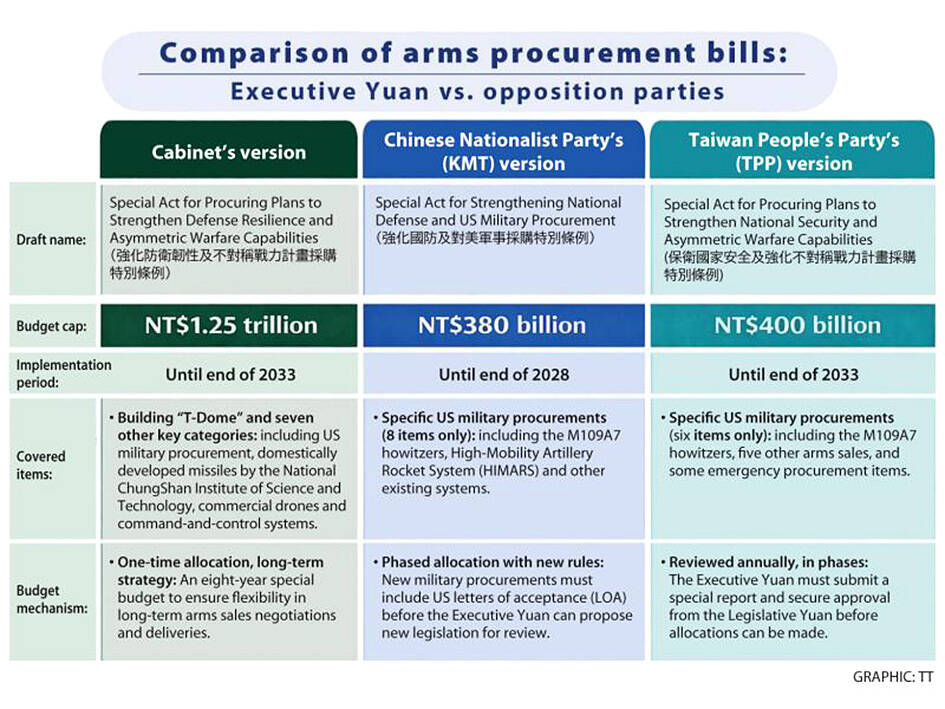
The Legislative Yuan is expected to host tense debates when it begins reviewing three competing special budget bills on arms procurement today, including a Cabinet proposal totaling NT$1.25 trillion (US$39.1 billion).
The Foreign Affairs and National Defense Committee and Finance Committee are holding joint sessions today, Wednesday and Thursday to review the bills proposed by the Cabinet, the Chinese Nationalist Party (KMT) and the Taiwan People’s Party (TPP).
Today’s session should focus on questioning defense officials on the various measures proposed, while line-by-line reviews of the bills would take place on Wednesday and Thursday, according to the Legislature’s agenda.
The ruling and opposition legislative caucuses were expected to make sure all of their members on the Foreign Affairs and National Defense Committee would attend.
The committee consists of seven KMT lawmakers, including Legislative Speaker Han Kuo-yu (韓國瑜), seven lawmakers from the ruling Democratic Progressive Party (DPP) and one TPP legislator.
In addition, the members of the Finance Committee — seven from the KMT, six from the DPP and one from the TPP — are expected to take part in reviewing the special budget bills.
At present, the KMT and TPP together hold a majority of 60 out of 113 seats in the Legislative Yuan, while the DPP holds 51 seats. The remaining two seats are held by KMT-leaning independent lawmakers.
The review process is expected to spark debate and draw considerable attention given the difference in funding proposed in the three bills and the support the US has given to the passage of the Cabinet’s proposal.
The Cabinet’s version of the national defense special act spans eight years and a budget of NT$1.25 trillion.
Since being sent to the legislature for review on Nov. 27, 2025, the Cabinet bill has been repeatedly blocked by the KMT and TPP due to what they said was its lack of transparency, preventing it from being referred to committee before the end of the previous legislative session on Jan. 31.
The TPP’s version was introduced on Jan. 26.
It includes five procurement items, including M109A7 self-propelled howitzers, HIMARS multiple launch rocket systems and anti-armor drone missile systems, capping arms spending at NT$400 billion through 2033 and requiring funding to be allocated on an annual basis.
The KMT’s version was introduced on March 5.
It caps the budget at NT$380 billion and authorizes the Ministry of National Defense (MND) to propose a “second-phase special act” if additional US arms purchases are needed in the future.
The KMT bill stipulates that all procurement projects must be completed by 2028.
Minister of National Defense Wellington Koo (顧立雄) has said that such a timetable was not realistic and would effectively block major procurement programs, including the HIMARS launchers.
The funding provided for in the TPP and KMT bills is enough to cover the US$11.1 billion in arms packages approved for sale to Taiwan by the US in December 2025.
The MND has said that military investment planning follows a program-based budgeting system and that any version of the special budget act must comply with this system to be implemented.
It said the issue is not merely about project items and funding levels. “If one looks only at the funding and ignores the requirements, the entire plan will inevitably be disrupted,” the ministry said.

FUKUOKA SITUATION: Japanese media reported that the pathogen is expected to be identified by the summer, while the CDC downplayed the idea that it was hMPV A “mysterious cold-like illness” reported in Japan’s Fukuoka Prefecture does not seem to be a new disease, but Japanese authorities have been asked about the situation, the Centers for Disease Control (CDC) said yesterday. The Fukuoka Prefectural Medical Association on Wednesday told a news conference that a “mystery cold” that has become a hot topic on social media is “highly likely to be caused by some kind of viral infection,” Japan’s KBC News reported. “Many people are experiencing symptoms starting with a sore throat, followed by a runny nose, phlegm and a severe cough,” KBC News reported, citing association officials. Health authorities are

Nvidia Corp CEO Jensen Huang (黃仁勳) arrived in Taiwan yesterday ahead of upcoming AI and technology events, saying he plans to meet with clients and Taiwan Semiconductor Manufacturing Co Chairman C.C. Wei (魏哲家) during his visit. After landing at Taipei Songshan Airport, Huang posed for photos with fans and handed out Yakult drinks to reporters and supporters waiting at the scene, saying he has “a lot to do” during the trip. Asked about reports that Nvidia’s planned headquarters site in Taipei’s Beitou Shilin Technology Park could break ground on May 27, Huang said that if the company holds an event, he would

The Ministry of Finance this afternoon announced the winning numbers for the March-April uniform invoice lottery. The winning number for the NT$10 million (US$318,060) special prize is 19531471, and the winning number for the NT$2 million grand prize is 85941329. Three numbers were drawn for the NT$200,000 first prize: 07225810, 20231230 and 83518781. Those with receipts matching the last seven digits of any of the first-prize numbers will win the NT$40,000 second prize, while those matching the last six digits will win the NT$10,000 third prize. Those whose receipts match the last five digits of the first-prize numbers can claim the NT$4,000 fourth prize,
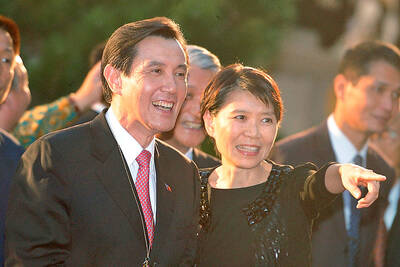
Former president Ma Ying-jeou (馬英九) yesterday expressed “shock and regret” over a statement issued by his wife without his consent, and rejected her assertion that his eldest sister, Ma Yi-nan (馬以南), would manage his medical care or act as his spokesperson amid an ongoing embezzlement probe into his foundation. Ma Ying-jeou in a statement said he was shocked by a statement by his wife, Chou Mei-ching (周美青), regarding his affairs. Ma Yi-nan “must not” be in charge of his healthcare and other personal affairs, nor can she be allowed to represent the Ma family, the former president said. He said he was also


 RSS
RSS