


Minister of National Defense Wellington Koo (顧立雄) said yesterday that Taiwan’s military has not considered sending troops to assist in the defense of the Strait of Hormuz, currently blocked by Iranian forces, amid calls for Taiwan to do so.
Since the US and Israel attacked Iran on Feb. 28, Iranian forces have taken military action against fuel tankers passing through the strait, through which around one-fifth of the world’s oil and liquefied natural gas (LNG) transits, sending global oil and LNG prices soaring.
In response, US President Donald Trump has asked the US’ allies to send ships to help secure the strait. In a joint statement issued on Thursday, Canada, the United Kingdom, France, Germany, Italy, the Netherlands and Japan expressed their readiness to “contribute to appropriate efforts” to ensure safe passage through the strait.

Photo: Chen Yi-kuan, Taipei Times
At a legislative session yesterday, Chinese Nationalist Party (KMT) Legislator Hsu Chiao-hsin (徐巧芯) asked Koo how Taiwan would respond if Trump asked it to help defend the strait.
Hsu cited Indo-Pacific Strategy Thinktank CEO Yaita Akio and former Pentagon official Tony Hu (胡振東), who have recommended that the Taiwanese government proactively signal to Trump its willingness to send troops to the strait to help secure it, thereby furthering bilateral ties.
Koo replied that the ministry “has not considered such an operation.”
“The mission of the armed forces is to defend Taiwan, Penghu, Kinmen and Matsu. Our entire focus is on the escalating gray zone harassment and potential military threats,” he said.
Koo noted that China has been prosecuting “high- intensity gray zone harassment” -- coercive actions short of an all-out war -- against Taiwan, by sending at least five ships to its vicinity daily.
The military will prioritize the Taiwan Strait and the Indo-Pacific region and continue gathering intelligence on enemy movements, he said.
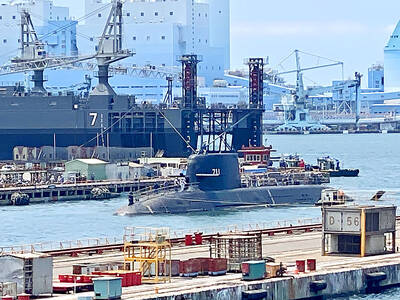
AGING: While Japan has 22 submarines, Taiwan only operates four, two of which were commissioned by the US in 1945 and 1946, and transferred to Taiwan in 1973 Taiwan would need at least 12 submarines to reach modern fleet capabilities, CSBC Corp, Taiwan chairman Chen Cheng-hung (陳政宏) said in an interview broadcast on Friday, citing a US assessment. CSBC is testing the nation’s first indigenous defense submarine, the Hai Kun (海鯤, Narwhal), which is scheduled to be delivered to the navy next month or in July. The Hai Kun has completed torpedo-firing tests and is scheduled to undergo overnight sea trials, Chen said on an SET TV military affairs program. Taiwan would require at least 12 submarines to establish a modern submarine force after assessing the nation’s operational environment and defense
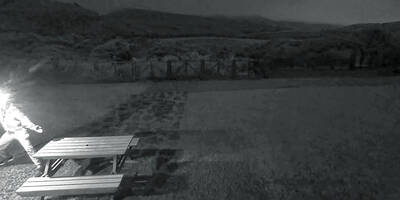
Yangmingshan National Park authorities yesterday urged visitors to respect public spaces and obey the law after a couple was caught on a camera livestream having sex at the park’s Qingtiangang (擎天崗) earlier in the day. The Shilin Police Precinct in Taipei said it has identified a suspect and his vehicle registration number, and would summon him for questioning. The case would be handled in accordance with public indecency charges, it added. The couple entered the park at about 11pm on Thursday and began fooling around by 1am yesterday, the police said, adding that the two were unaware of the park’s all-day live
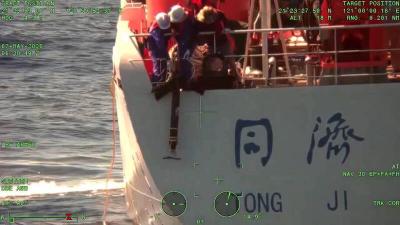
The coast guard today said that it had disrupted "illegal" operations by a Chinese research ship in waters close to the nation and driven it away, part of what Taipei sees a provocative pattern of China's stepped up maritime activities. The coast guard said that it on Thursday last week detected the Chinese ship Tongji (同濟號), which was commissioned only last year, 29 nautical miles (54km) southeast of the southern tip of Taiwan, although just outside restricted waters. The ship was observed lowering ropes into the water, suspected to be the deployment of scientific instruments for "illegal" survey operations, and the coast

A former soldier and an active-duty army officer were yesterday indicted for allegedly selling classified military training materials to a Chinese intelligence operative for a total of NT$79,440. The Taipei District Prosecutors’ Office indicted Chen Tai-yin (陳泰尹) and Lee Chun-ta (李俊達) for contravening the National Security Act (國家安全法) and the Anti-Corruption Act (貪污治罪條例). Chen left the military in September 2013 after serving alongside then-staff sergeant Lee, now an army lieutenant, at the 21st Artillery Command of the army’s Sixth Corps from 2011 to 2013, according to the indictment. Chen met a Chinese intelligence operative identified as “Wang” (王) through a friend in November


 RSS
RSS