


Beijing’s latest “ethnic unity” law could put Taiwanese visiting China in legal jeopardy, as room for maintaining the “status quo” risks being erased and anyone who does not voice support for unification could face fabricated charges at any moment, the Mainland Affairs Council (MAC) warned yesterday.
The council made the comments in a statement summarizing the findings of academics who convened for a seminar on China’s Law on Promoting Ethnic Unity and Progress, which Chinese President Xi Jinping (習近平) signed on Thursday last week and is to come into effect in July.
China’s ethnic unity law is broadly construed and blurs the legal red line on what constitutes as being a “supporter of Taiwanese independence,” it cited the academics as saying.
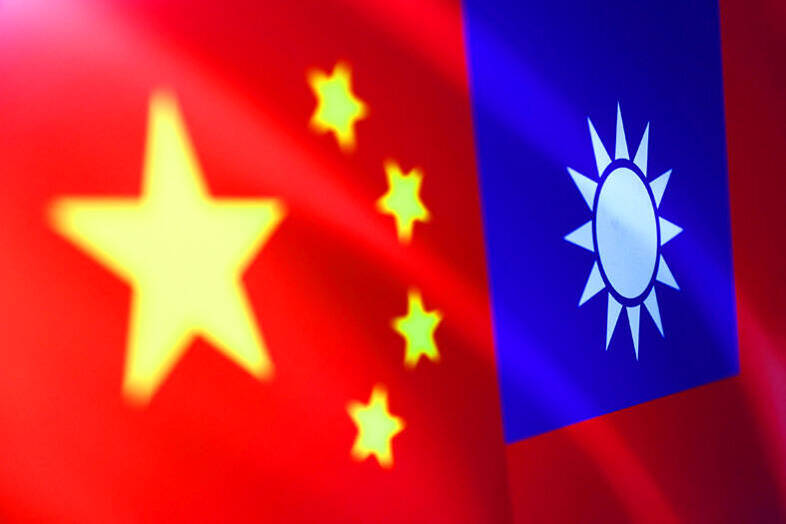
Photo: Reuters
The new legislation states that any political opinion or activity that does not support “unification” with China or identify with the Chinese ethnicity is considered separatism, they said.
This means Taiwanese who support the government’s policy of maintaining the cross-strait “status quo” can no longer expect safety on Chinese soil, the academics said.
The law aimed to transform the constitutional framework of China, not just modify Beijing’s stance on Taiwan, they said.
The law appears to be a part of Xi’s bid to bolster the Chinese Communist Party’s legitimacy amid economic and political turmoil by inventing a new ideology centered on Chinese ethnic identity, homogeneity and economic development, they said.
The legislation enshrines China’s nationalist mythology into law to construct a version of Chinese identity that suppresses the previously recognized rights of ethnic minorities to self-governance, the academics said.
This means the Chinese state now deems its perspective on history, culture, politics and society as the only one legally allowed to exist, they added.
The word “shall” appeared 53 times in the law, which was composed of 65 articles, they said.
The entities legally required to enforce “Chinese identity” include all levels of the government, educational institutions, religious organizations, enterprises and even parents, they said.
This suggests that Beijing designed the law to deal with disobedient citizens by using a wide range of punitive measures ranging from administrative to criminal penalties, they said.
The mandate for constructing “interbedded communities” in ethnic minority regions is a euphemism for power projection, as forcing non-Han groups to assimilate serves to facilitate China’s efforts to extract natural resources from its periphery, the academics said.
The assimilation of a subjugated population and the absorption of their resources is a formula for total control that should alarm Taiwanese, they said.
Requiring local governments and educational institutions to promote assimilation suggests that cultural and educational exchanges with China would be more politicized than ever, they added.
China’s use of “united front” tactics in unofficial interactions would likely intensify in the wake of the ethnic unity law, the academics said.

The military has spotted two Chinese warships operating in waters near Penghu County in the Taiwan Strait and sent its own naval and air forces to monitor the vessels, the Ministry of National Defense (MND) said. Beijing sends warships and warplanes into the waters and skies around Taiwan on an almost daily basis, drawing condemnation from Taipei. While the ministry offers daily updates on the locations of Chinese military aircraft, it only rarely gives details of where Chinese warships are operating, generally only when it detects aircraft carriers, as happened last week. A Chinese destroyer and a frigate entered waters to the southwest
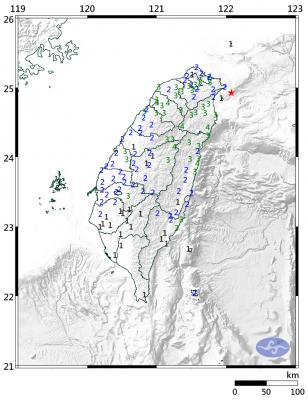
A magnitude 6.1 earthquake struck off the coast of Yilan County at 8:39pm tonight, the Central Weather Administration (CWA) said, with no immediate reports of damage or injuries. The epicenter was 38.7km east-northeast of Yilan County Hall at a focal depth of 98.3km, the CWA’s Seismological Center said. The quake’s maximum intensity, which gauges the actual physical effect of a seismic event, was a level 4 on Taiwan’s 7-tier intensity scale, the center said. That intensity level was recorded in Yilan County’s Nanao Township (南澳), Hsinchu County’s Guansi Township (關西), Nantou County’s Hehuanshan (合歡山) and Hualien County’s Yanliao (鹽寮). An intensity of 3 was
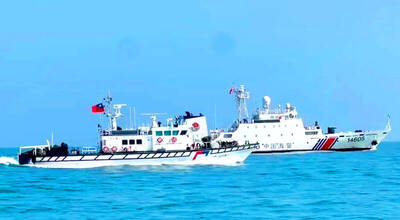
Instead of focusing solely on the threat of a full-scale military invasion, the US and its allies must prepare for a potential Chinese “quarantine” of Taiwan enforced through customs inspections, Stanford University Hoover fellow Eyck Freymann said in a Foreign Affairs article published on Wednesday. China could use various “gray zone” tactics in “reconfiguring the regional and ultimately the global economic order without a war,” said Freymann, who is also a nonresident research fellow at the US Naval War College. China might seize control of Taiwan’s links to the outside world by requiring all flights and ships entering or leaving Taiwan
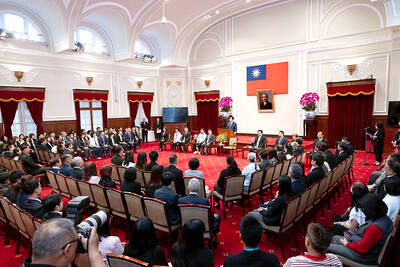
The next minimum wage hike is expected to exceed NT$30,000, President William Lai (賴清德) said yesterday during an award ceremony honoring “model workers,” including migrant workers, at the Presidential Office ahead of Workers’ Day today. Lai said he wished to thank the awardees on behalf of the nation and extend his most sincere respect for their hard work, on which Taiwan’s prosperity has been built. Lai specifically thanked 10 migrant workers selected for the award, saying that although they left their home countries to further their own goals, their efforts have benefited Taiwan as well. The nation’s industrial sector and small businesses lay


 RSS
RSS