


The Ministry of Digital Affairs (MODA) yesterday said that it would closely monitor the evolution of agentic artificial intelligence (AI) before making any decisions about its integration into government systems.
Minister of Digital Affairs Lin Yi-jing (林宜敬) made the remarks at a meeting of the legislature’s Transportation Committee, when he was asked about security issues related to OpenClaw and other agentic AI applications.
The use of the open-source AI agent has been scrutinized after it was found to be vulnerable to cybersecurity attacks, allowing malicious actors to hack machines, steal credentials and access sensitive data.

Photo: Tu Chien-jung, Taipei Times
China has restricted the use of OpenClaw by government agencies and corporations, and cautioned against it in a cybersecurity manual.
Nvidia CEO Jensen Huang (黃仁勳) on Monday announced at a tech conference in San Jose, California, that the company would launch “NemoClaw” to add privacy and security control to AI agents, making them more “trustworthy, scalable and accessible” to users worldwide.
Taiwan People’s Party Legislator Jacky Chen (陳清龍) and Chinese Nationalist Party (KMT) Legislator Huang Chien-hao (黃建豪) asked Lin how the government plans to regulate the use of AI agents and whether there is any plan to integrate them into the operation of government systems.
Unlike ChatGPT developed by OpenAI, agentic AI applications such as OpenClaw would automatically help users upload videos to YouTube and book flight tickets, Lin said.
“People can converse with ChatGPT just like they do in the real world. However, the use of OpenClaw would generate cybersecurity concerns, as some users reported that the AI agent automatically made purchases,” Lin said.
The US, China and the EU hold different views about AI development, he said.
The EU is wary of the technology and released a list of banned applications in its AI Act, while Washington has been reluctant in imposing restrictions on AI, as it considers regulations hinder innovation, Lin said.
In China, whatever Beijing says about AI goes, he said.
Singapore, Taiwan, Japan and South Korea are under great diplomatic pressure to choose between EU and US regulatory frameworks, Lin said.
“We hope to find a balance between these two models,” Lin added. “Personally, I think, in the long run, agentic AI would be integrated into the operation of the government systems to enhance their efficiency. However, the technology is so new that there might be cybersecurity risks that have not been identified yet.”
The government should propose regulatory guidelines for AI agents after monitoring their continual evolution, he said, adding that they might not be necessarily the same as the ones proposed by leading technology firms.
The nation’s AI governance framework was initiated with the AI Basic Act (人工智慧基本法), followed by an AI risk classification framework, and using the framework, government agencies handle health, finance and traffic data, Lin said.
Huang Chien-hao asked whether the government’s plan to spend NT$10 billion (US$314.1 million) over 10 years to develop AI is adequate considering that some other countries have budgeted much more for AI-related programs.
Lin said that it is crucial that Taiwan increases its computing power for AI.
Projects to build AI computing power centers in other countries are mostly initiated and funded by private investors, he said.
In Taiwan, the AI computing centers are categorized as important basic infrastructure and would be built using government and private funds, Lin said.
“We would be discussing with the Financial Supervisory Commission [FSC] allowing investments from private insurance firms,” Lin said. “So far, Hon Hai Precision Co has applied to invest in AI computing centers.”
Separately, lawmakers on the legislature’s Finance Committee voiced concerns over the risks of using OpenClaw in stock trading, citing the possibility of errors in share quantities.
FSC Chairman Peng Jin-lung (彭金隆) said that the commission has issued the Guidelines for Artificial Intelligence Applications in the Financial Industry, but further studies are needed on the issue.
He did not say when such AI agent guidelines might be published.

The Ministry of Finance this afternoon announced the winning numbers for the March-April uniform invoice lottery. The winning number for the NT$10 million (US$318,060) special prize is 19531471, and the winning number for the NT$2 million grand prize is 85941329. Three numbers were drawn for the NT$200,000 first prize: 07225810, 20231230 and 83518781. Those with receipts matching the last seven digits of any of the first-prize numbers will win the NT$40,000 second prize, while those matching the last six digits will win the NT$10,000 third prize. Those whose receipts match the last five digits of the first-prize numbers can claim the NT$4,000 fourth prize,

SIX SUBSIDIES: The monthly allowance for older farmers is to increase to NT$10,000, and NT$5,000 is to be given to homemakers under the national pension system, Lai said The government is to implement major welfare policies for disadvantaged groups, including raising the monthly allowance for older farmers to NT$10,000 and providing homemakers with NT$5,000 per month, President William Lai (賴清德) said yesterday. Lai made the remarks during a visit to Wangling Temple in Chiayi County, saying that the planned increases were being introduced amid economic growth and an increase in tax revenue. Touting a policy, in which the government plans to provide a monthly allowance of NT$5,000 for every child under the age of 18 in a bid to address Taiwan’s low birthrate, Lai said that if received for the
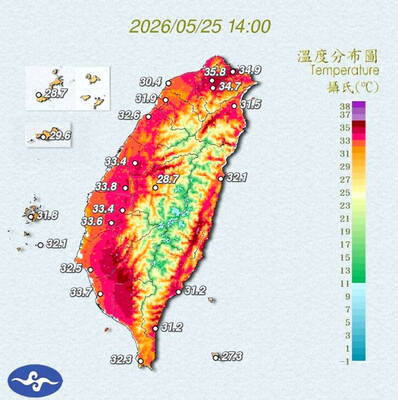
STAY COOL: The HPA recommended that people stay hydrated, use air-conditioning or fans while indoors, wear loose-fitting clothes and walk in the shade while outdoors Employers must implement measures such as installing cooling equipment, and providing drinking water and rest breaks for outdoor workers starting from Monday next week, the Taipei Department of Labor said on Sunday. Employers who fail to comply could face fines of NT$30,000 to NT$300,000 under the Occupational Safety and Health Act (職業安全衛生法), the department said. Businesses in Taipei employing fewer than 100 workers, as well as registered self-employed workers with labor insurance coverage, could receive on-site assessments and guidance from occupational safety consultants to help them apply for central government subsidies to implement or improve heat-protection measures, it said. Under the Ministry of
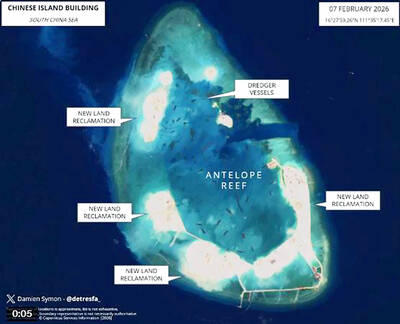
ISOLATION: The outposts would serve as support and backup bases, forcing US forces to either face China head-on or reroute, increasing travel time and operational costs China’s outposts in the South China Sea could be used to delay and constrain foreign forces during a conflict in the Taiwan Strait, giving Beijing a critical window to carry out amphibious landing and blockade operations, a report said. The Chinese Communist Party’s (CCP) forward operating bases on islands and reclaimed features in the South China Sea could delay foreign forces long enough for the Chinese People’s Liberation Army (PLA) to secure a key 48-to-72-hour window in the Taiwan Strait, a report commissioned by the Mainland Affairs Council found. The report, conducted by the Institute for National Defense and Security Research, examined


 RSS
RSS