


With tens of thousands of people seeking treatment for breast cancer each year, the government has allocated about NT$40 million (US$1.25 million) to improve treatment quality, Minister of Health and Welfare Shih Chung-liang (石崇良) told a news conference yesterday.
Citing National Health Insurance (NHI) data, Shih said that about 180,000 people seek treatment each year, which add up to about 21.228 billion NHI points (one point usually equals NT$0.9 to NT$1) of medical expense and 9.88 billion NHI points of drug expense per year.
To improve healthcare quality and reduce the mortality rate of breast cancer, the ministry last year announced that a “pay for performance” (P4P) strategy — a model rewarding healthcare providers with financial incentives for meeting specific quality, efficiency and health outcome metrics — would be implemented this year.

Photo: Hou Chia-yu, Taipei Times
Shih, along with NHI Administration Director-General Chen Lian-yu (陳亮妤) and representatives from the Taiwan Breast Cancer Society, yesterday announced the official launch of the P4P Breast Cancer Care Quality Improvement Program.
“Breast cancer care is a national challenge that cannot be overlooked, as breast cancer is the most common cancer and the second-leading cause of cancer deaths among women,” Shih said.
Early diagnosis is a key factor to reducing the mortality rate, he added.
The overall five-year survival rate for breast cancer is relatively high compared with many other types of cancers, he said.
If discovered at stages 1 and 2, the survival rate is more than 90 percent, but this drops significantly when the disease reaches stages 3 and 4, with only about 40 percent for the latter, he said.
The WHO’s Global Breast Cancer Initiative has set a goal to improve early detection and diagnosis of breast cancer, with the key performance indicator being at least 60 percent of invasive breast cancers being diagnosed and treated at stage 1 or 2, he said, adding that Taiwan’s is more than 70 percent.
However, screening is not enough to reduce the mortality rate, so improved quality of care is needed at the same time, he said.
The P4P program aims to gradually transform the medical payment from a “fee-for-service” model to a “value-based” model, he said.
In line with the WHO’s initiative, the program also aims to have more than 60 percent of breast cancer patients diagnosed and treated at stage 1 or 2, limit the time between the first diagnosis to treatment within 60 days, and provide comprehensive and integrated care, he said.
Chen said the P4P program is expected to bring about substantial benefits in three aspects: quality assurance, value-based rewards and NHI sustainabililty.
People are used to seeking famous doctors at large hospitals because of concern over treatment quality, but the P4P program is to assure them that if they seek treatment at hospitals that are members of the program, they will received standardized quality care, she said.
The program’s value-based rewards for hospitals and healthcare providers allow doctors to focus on pursuing excellence in treatment, rather than on number of patient visits, she said.
Additionally, the program focuses on early diagnosis, precision medicine and effective management, ensuring that NHI resources create maximum value, she said.
The P4P program’s target clients include newly diagnosed or first-recurrence breast cancer patients at any stage, and the NHIA has allocated about NT$40 million to encourage healthcare facilities to join the program and provide continuous quality care following the latest treatment guidelines, Chen said.
Additional reporting by CNA

UPGRADE: The Kang Ding-class frigate is replacing its Chaparall missiles with Tien Chien II and Hua Yang VLS, which would provide it with long-range, 360° air defense Taiwan plans to produce 1,200 to 1,376 Hai Chien II missiles (海劍二, Sea Sword II) — also known as TC-2N — to serve as the standard air defense system of the navy’s surface combatant fleet, a source said yesterday. Last week, the Hai Chien II, the naval version of the Tien Kung II missile (天劍二, Sky Sword II), completed a live-fire test in waters off the National Chungshan Institute of Science and Technology’s Jiupeng facility (九鵬) in Pingtung County’s Manjhou Township (滿州). The MIM72 Chaparral and other dated air defense missiles that currently arm Taiwanese ships have inadequate range to combat Chinese

REASONS FOR TRAVEL: An assistant professor said that proposed amendments to penalize drivers if they used drugs overseas would not deter people from traveling People who operate a motor vehicle under the influence of marijuana would have their driver’s license revoked, even if they used the substance while overseas, the Ministry of Transportation and Communications said yesterday, citing proposed amendments to the Road Traffic Management and Penalty Act (道路交通管理處罰條例). The amendments would also authorize the government to revoke the licenses of people determined to have used Category 1 or Category 2 narcotics, even if they were not operating a vehicle while under the influence of drugs, as well as ban them from taking the license test for three years, the ministry said. People aged 18 or

HEAVY WEATHER: Typhoon Jangmi is due to crash straight into the Ryukyus as airlines look to shift flights to larger aircraft or cancel flights to Okinawa entirely Taiwan’s international air carriers announced flight adjustments over the weekend as Typhoon Jangmi is forecast to hit the Ryukyu Islands today and tomorrow. The Central Weather Administration (CWA) upgraded Jangmi from a tropical storm to a typhoon at 8am yesterday, with the eye located 580km south of Naha city. It was moving north at 19kph. Today, China Airlines’ CI-120, CI-121, CI-122 and CI-123 flights between Taoyuan and Naha, Okinawa, have been canceled as well as CI-132 and CI-133 between Kaohsiung and Naha. EVA Air’s BR-112, BR-113, BR-186 and BR-185 flights between Taoyuan and Naha are also canceled. Low-cost carrier Tigerair Taiwan canceled IT-230,
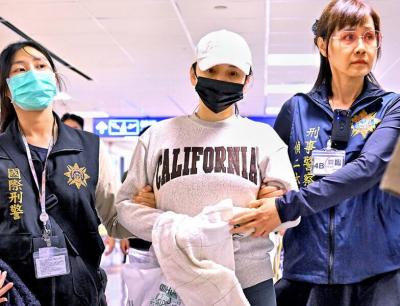
Johanne Liou (劉喬安), a Taiwanese woman who shot to unwanted fame during the Sunflower movement protests in 2014, returned to Taiwan last night after being deported from the US. She is to stand trial in Taiwan for charges involving embezzlement, fraud and drug crimes. The Criminal Investigation Bureau (CIB) said it took her into custody at Taiwan Taoyuan International Airport and would first question her before transferring her to the New Taipei District Prosecutors’ Office. She was arrested upon disembarking a flight from San Francisco that landed shortly before 7pm. Liou absconded to the US in 2019 after jumping bail


 RSS
RSS