


Leaders of the Chinese Nationalist Party (KMT) and the Taiwan People’s Party (TPP) yesterday pledged to work together to promote a shared vision they said would benefit the public ahead of, and beyond, the 2028 presidential election.
Speaking at a news conference in New Taipei City, KMT Chairwoman Cheng Li-wun (鄭麗文) said her party and the TPP outlined issues that the two parties would tackle together, including high housing prices, low wages and the low birthrate.
They would also discuss responses to the rapid development of artificial intelligence and climate change, she said.
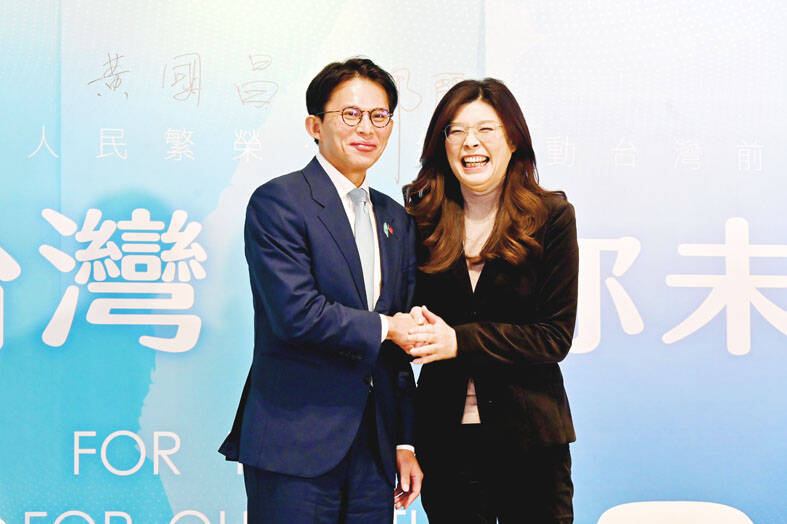
Photo: George Tsorng, Taipei Times
The parties would soon begin discussions on how to coordinate for the local elections scheduled for Nov. 28.
Cheng criticized the ruling Democratic Progressive Party’s (DPP) “ideological governance,” which she said has intensified partisan politics.
The KMT-TPP partnership would adhere to democratic principles and remain accountable to voters and supporters, she said.
TPP Chairman Huang Kuo-chang (黃國昌) said 10 years ago, then-president Tsai Ing-wen (蔡英文) had promised to build a better future for young people, but a decade later, under President William Lai’s (賴清德) leadership, Taiwan has the world’s lowest birthrate and fastest-aging population.
Stagnant wages and skyrocketing housing prices have made young people hesitant to start families, he said, adding that the government has taken the lead at exacerbating political divisions among the public.
When then-TPP chairman Ko Wen-je (柯文哲) on May 20, 2023, announced his presidential candidacy, he announced his hopes to create a harmonious society through a coalition-style government to foster an inclusive and united Taiwan, Huang said.
The TPP has never forgotten Ko’s words and would continue to advance that principle, Huang added.
“Over the years, the two parties have demonstrated that, despite their distinct identities and positions, they can work together for Taiwan and find common ground,” he said. “From legislation to local joint governance, this cooperation goes beyond election alliances and does not involve exchanging positions of power.”
The TPP and the KMT would soon draft a cooperation agreement detailing the rules on the nomination process for the Nov. 28 local elections, Huang said.
The two parties have agreed to assign three representatives each to determine the specifics of the agreement, Huang said, adding that the nominations would likely be based on opinion polls.
“The paramount objective of the agreement is to identify the strongest candidates using the best method, and so far, the best method seems to be opinion polls,” he said.

FUKUOKA SITUATION: Japanese media reported that the pathogen is expected to be identified by the summer, while the CDC downplayed the idea that it was hMPV A “mysterious cold-like illness” reported in Japan’s Fukuoka Prefecture does not seem to be a new disease, but Japanese authorities have been asked about the situation, the Centers for Disease Control (CDC) said yesterday. The Fukuoka Prefectural Medical Association on Wednesday told a news conference that a “mystery cold” that has become a hot topic on social media is “highly likely to be caused by some kind of viral infection,” Japan’s KBC News reported. “Many people are experiencing symptoms starting with a sore throat, followed by a runny nose, phlegm and a severe cough,” KBC News reported, citing association officials. Health authorities are

Nvidia Corp CEO Jensen Huang (黃仁勳) arrived in Taiwan yesterday ahead of upcoming AI and technology events, saying he plans to meet with clients and Taiwan Semiconductor Manufacturing Co Chairman C.C. Wei (魏哲家) during his visit. After landing at Taipei Songshan Airport, Huang posed for photos with fans and handed out Yakult drinks to reporters and supporters waiting at the scene, saying he has “a lot to do” during the trip. Asked about reports that Nvidia’s planned headquarters site in Taipei’s Beitou Shilin Technology Park could break ground on May 27, Huang said that if the company holds an event, he would

The Ministry of Finance this afternoon announced the winning numbers for the March-April uniform invoice lottery. The winning number for the NT$10 million (US$318,060) special prize is 19531471, and the winning number for the NT$2 million grand prize is 85941329. Three numbers were drawn for the NT$200,000 first prize: 07225810, 20231230 and 83518781. Those with receipts matching the last seven digits of any of the first-prize numbers will win the NT$40,000 second prize, while those matching the last six digits will win the NT$10,000 third prize. Those whose receipts match the last five digits of the first-prize numbers can claim the NT$4,000 fourth prize,
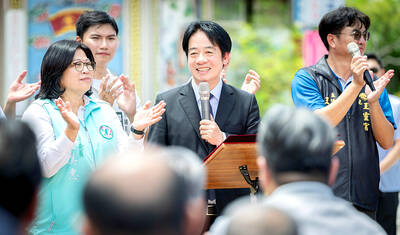
SIX SUBSIDIES: The monthly allowance for older farmers is to increase to NT$10,000, and NT$5,000 is to be given to homemakers under the national pension system, Lai said The government is to implement major welfare policies for disadvantaged groups, including raising the monthly allowance for older farmers to NT$10,000 and providing homemakers with NT$5,000 per month, President William Lai (賴清德) said yesterday. Lai made the remarks during a visit to Wangling Temple in Chiayi County, saying that the planned increases were being introduced amid economic growth and an increase in tax revenue. Touting a policy, in which the government plans to provide a monthly allowance of NT$5,000 for every child under the age of 18 in a bid to address Taiwan’s low birthrate, Lai said that if received for the


 RSS
RSS