


China’s “hidden” military spending is a grave threat to Taiwan’s national security that could trigger an arms race in the Indo-Pacific region, Taiwanese researchers said on Thursday.
They made the remarks during a symposium hosted by Secure Taiwan Associate Corp on the annual budget of the Chinese People’s Liberation Army.
The 7 percent growth in military spending announced by Beijing last week is deceptively low, the researchers said.
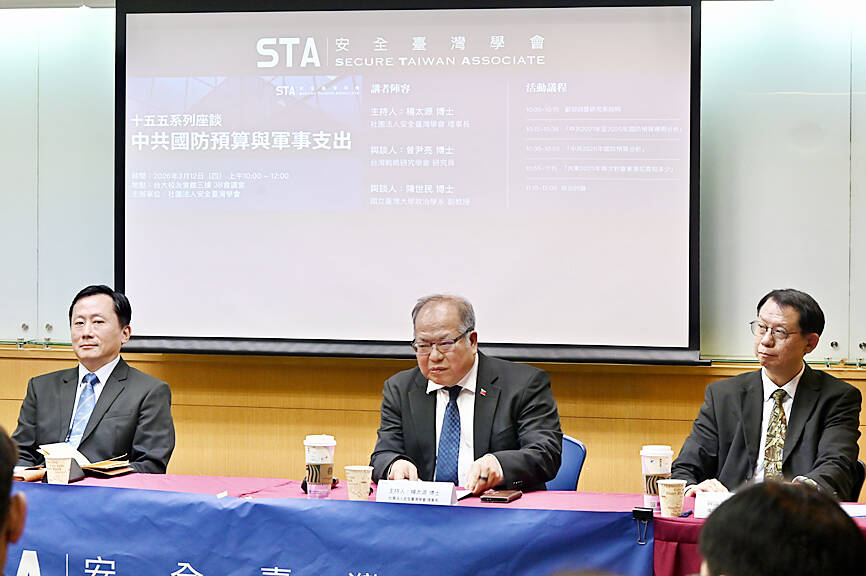
Photo: George Tsorng, Taipei Times
Beijing’s 14th five-year economic plan prioritized spending on the military’s rocket forces and strategic strike systems, a departure from previous plans that spread resources evenly across the armed forces, researcher Tzeng In-liang (曾尹亮) said.
China is acting under greater government spending constraints than before, and its defense budget reflected a focus on improving or replacing the PLA’s most important platforms and systems, he said.
Building a military that features the “three integrations” — mechanization, informational warfare and smart technology — is the top priority of the Chinese armed forces, Tzeng said.
The Chinese government publicly acknowledged an NT$8.8 trillion (US$275.71 billion) military budget this year, National Taiwan University political science associate professor Chen Shih-min (陳世民) said.
The amount of annual growth in China’s military allocations is projected to be 11 times bigger than the year-to-year increase President William Lai’s (賴清德) special defense budget projects to bring over eight years, he said.
However, the figure likely grossly understates China’s actual defense allocations, as the Stockholm International Peace Research Institute estimates its real spending to be 30 to 40 percent higher that number, Chen said.
This is because large swathes of China’s military budget are hidden in allocations for technological research and development, and paramilitary organizations, including the Chinese maritime militia and armed police, he said.
Local government subsidies for retired service members and arms imports also serve to underestimate real military expenditures, Chen said.
Beijing has the largest defense budget and spends as much on its military than the next three greatest Asian military powers combined: Japan, South Korea and India, he said.
China’s surging military spending and the fact that Beijing cannot be appeased by concessions has driven Japan, South Korea, the Philippines and other Asian countries into forming defensive alliances, Chen said.
However, China’s military expenditure is not enough for a Taiwan invasion and defeating intervening US forces, Chen added.
This means Beijing is highly unlikely to attack Taiwan next year unless it is confident that the US would not intervene, he said.
The budget shortfall would almost certainly be exacerbated by an increased need to harden Beijing against decapitation strikes following the display of US precision strike capabilities in Iran, he said.
In-house projections suggest that China’s back-to-back military exercises came at a high fiscal cost, group chairman Yang Tai-yuan (楊太源) said.
China’s allocated budget for military exercises is capped at about 27 percent of the total defense budget, meaning that irregular special drills such as last year’s Strait Thunder 2025A and Justice Mission 2025 could be held three times a year at most, he said.

The military has spotted two Chinese warships operating in waters near Penghu County in the Taiwan Strait and sent its own naval and air forces to monitor the vessels, the Ministry of National Defense (MND) said. Beijing sends warships and warplanes into the waters and skies around Taiwan on an almost daily basis, drawing condemnation from Taipei. While the ministry offers daily updates on the locations of Chinese military aircraft, it only rarely gives details of where Chinese warships are operating, generally only when it detects aircraft carriers, as happened last week. A Chinese destroyer and a frigate entered waters to the southwest
The eastern extension of the Taipei MRT Red Line could begin operations as early as late June, the Taipei Department of Rapid Transit Systems said yesterday. Taipei Rapid Transit Corp said it is considering offering one month of free rides on the new section to mark its opening. Construction progress on the 1.4km extension, which is to run from the current terminal Xiangshan Station to a new eastern terminal, Guangci/Fengtian Temple Station, was 90.6 percent complete by the end of last month, the department said in a report to the Taipei City Council's Transportation Committee. While construction began in October 2016 with an
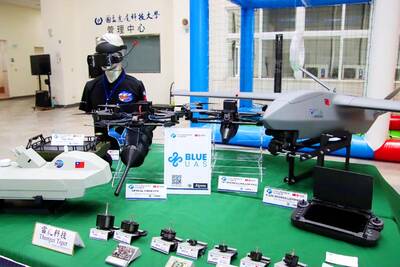
NON-RED SUPPLY: Boosting the nation’s drone industry is becoming increasingly urgent as China’s UAV dominance could become an issue in a crisis, an analyst said Taiwan’s drone exports to Europe grew 41.7-fold from 2024 to last year, with demand from Ukraine’s fight against Russian aggression the most likely driver of growth, a study showed. The Institute for Democracy, Society and Emerging Technology (DSET) in a statement on Wednesday said it found that many of Taiwan’s uncrewed aerial vehicle (UAV) sales were from Poland and the Czech Republic. These countries likely transferred the drones to Ukraine to aid it in its fight against the Russian invasion that started in 2022, it said. Despite the gains, Taiwan is not the dominant drone exporter to these markets, ranking second and fourth

Japanese Prime Minister Sanae Takaichi’s comment last year on Tokyo’s potential reaction to a Taiwan-China conflict has forced Beijing to rewrite its invasion plans, a retired Japanese general said. Takaichi told the Diet on Nov. 7 last year that a Chinese naval blockade or military attack on Taiwan could constitute a “survival-threatening situation” for Japan, potentially allowing Tokyo to exercise its right to collective self-defense. Former Japan Ground Self-Defense Force general Kiyofumi Ogawa said in a recent speech that the remark has been interpreted as meaning Japan could intervene in the early stages of a Taiwan Strait conflict, undermining China’s previous assumptions


 RSS
RSS