


The Chinese People’s Liberation Army (PLA) could have held off flying military aircraft close to Taiwan over the past two weeks over fear of defections by pilots, Taiwanese researchers said yesterday.
The decline in sorties could be due to factors other than US President Donald Trump’s planned state visit to meet with Chinese President Xi Jinping (習近平) from March 31 to April 2, the experts said at a symposium held by Secure Taiwan Associate Corp.
The event was hosted by Secure Taiwan Associate Corp Research Project on China’s Defense Affairs deputy director Yang Tai-yuan (楊太源), and included National Taiwan University political science professor Chen Shih-min (陳世民) and Taiwan Strategic Research Association researcher Tzeng In-liang (曾尹亮) as guest speakers.
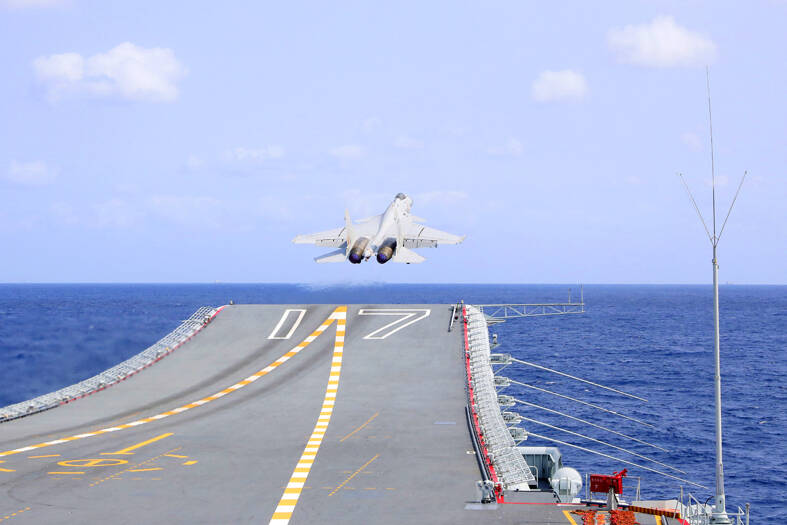
Photo: Xinhua via AP
Despite a near total absence of Chinese military aircraft in the areas surrounding Taiwan proper, the PLA deployed at least six ships every day, the experts said.
The discrepancy is striking, as the PLA usually reduces the number of ships deployed near Taiwan to two or three ahead of diplomatic events, they said, adding that this suggested that showing goodwill is not an explanation.
The CIA on Feb. 12 made the unusual step of openly calling for PLA military officers to give information to the US, which might have stoked fears in Beijing over pilots defecting with their planes, the researchers said.
The PLA stopped sending aircraft to the vicinity of Taiwan proper on Feb. 28, which continued for more than 10 consecutive days, they said.
Restricting air sorties would be consistent with an attempt by the Chinese Discipline Inspection Commission of the Central Military Commission (CMCCDI) to strengthen surveillance and control in the military, they said.
Notably, the CIA’s messaging came amid the latest drive by Xi in October last year to consolidate his authority over the Chinese armed forces by appointing CMCCDI head Zhang Shengmin (張升民) as deputy chairman of the Central Military Commission.
Xi in January removed top general Zhang Youxia (張又俠) from office and had him arrested, leaving himself and Zhang Shengmin the sole leaders in charge at the Central Military Commission.
The moves are sure to negatively impact the PLA’s morale, potentially increasing the risks of defections and officers being turned by foreign intelligence services, the researchers said.
The PLA deploying ships instead of aircraft has the advantage of mitigating such risks, as larger surface combatants have a crew numbering in the hundreds and political commissars to keep ship captains in check, they said.
Compared with a ship’s commanding officers and sailors, fighter jet pilots could unilaterally decide to go rogue, they said.
The safest way for the PLA to weather the annual plenary sessions without incident is to halt all activities that might allow defections to occur, they added.
Ships patrolling the waters around Taiwan could have been deployed as a barrier to cut off the escape of potentially mutinous pilots, the analysts said.
Taiwan’s national security and intelligence community is urged to investigate whether Chinese aviation forces are calling off routinely scheduled training exercises and increasing political education to determine the motive behind the pause in PLA sorties, they said.

LOUD AND PROUD Taiwan might have taken a drubbing against Australia and Japan, but you might not know it from the enthusiasm and numbers of the fans Taiwan might not be expected to win the World Baseball Classic (WBC) but their fans are making their presence felt in Tokyo, with tens of thousands decked out in the team’s blue, blowing horns and singing songs. Taiwanese fans have packed out the Tokyo Dome for all three of their games so far and even threatened to drown out home team supporters when their team played Japan on Friday. They blew trumpets, chanted for their favorite players and had their own cheerleading squad who dance on a stage during the game. The team struggled to match that exuberance on the field, with
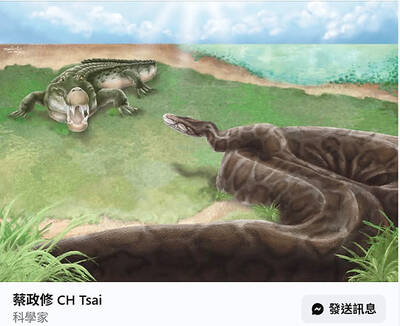
Taiwanese paleontologists have discovered fossil evidence that pythons up to 4m long inhabited Taiwan during the Pleistocene epoch, reporting their findings in the international scientific journal Historical Biology. National Taiwan University (NTU) Institute of Ecology and Evolutionary Biology associate professor Tsai Cheng-hsiu (蔡政修) led the team that discovered the largest snake fossil ever found in Taiwan. The single trunk vertebra was discovered in Tainan at the Chiting Formation, dated to between 400,000 and 800,000 years ago in the Middle Pleistocene, the paper said. The area also produced Taiwan’s first avian fossil, as well as crocodile, mammoth, saber-toothed cat and rhinoceros fossils, it said. Discoveries

Taiwanese paleontologists have discovered fossil evidence that pythons up to 4m long inhabited Taiwan during the Pleistocene epoch, reporting their findings in the international scientific journal Historical Biology. National Taiwan University (NTU) Institute of Ecology and Evolutionary Biology associate professor Tsai Cheng-hsiu (蔡政修) led the team that discovered the largest snake fossil ever found in Taiwan. A single trunk vertebra was discovered in Tainan at the Chiting Formation, dated to between 800,000 to 400,000 years ago in the Middle Pleistocene, the paper said. The area also produced Taiwan’s first avian fossil, as well as crocodile, mammoth, sabre-toothed cat and rhinoceros fossils, it said. Discoveries

Whether Japan would help defend Taiwan in case of a cross-strait conflict would depend on the US and the extent to which Japan would be allowed to act under the US-Japan Security Treaty, former Japanese minister of defense Satoshi Morimoto said. As China has not given up on the idea of invading Taiwan by force, to what extent Japan could support US military action would hinge on Washington’s intention and its negotiation with Tokyo, Morimoto said in an interview with the Liberty Times (sister paper of the Taipei Times) yesterday. There has to be sufficient mutual recognition of how Japan could provide


 RSS
RSS