


The General Association of Chinese Culture (GACC) is to convene a meeting on Tuesday next week to discuss altering the association’s English name to include “Taiwan,” association secretary-general Lee Hou-ching (李厚慶) said yesterday.
Association members and officials have repeatedly called for the organization’s name to be changed, most recently following the resignation of United Microelectronics Corp founder Robert Tsao (曹興誠) from the association on Tuesday.
Tsao left the group saying that he was perplexed as to why the association, which is tasked with promoting Taiwanese culture, still carried the word Zhonghua (中華) in its official name.
Photo: screen grab from the association’s Web site
Lee yesterday said members made a similar proposal during a general meeting in February last year.
The association in December last year decided to change its official English-language name to include the word “Taiwan,” Lee said, adding that the decision would be discussed at a full convention of association members on Tuesday next week to ensure the change follows proper procedure.
The association said that changing its Chinese name would require a complicated process and that it is not currently considering such a move.
Separately, the Formosan Association for Public Affairs (FAPA), a Washington-based nonprofit organization, on Wednesday called on supporters in the US to contact their state and local representatives to urge US Secretary of State Marco Rubio to follow through on a campaign promise to change the name of Taiwan’s office in the US.
Rubio, then a senator, last year sponsored a bill to rename the Taipei Economic and Cultural Representative Office (TECRO) as the Taiwan Representative Office.
FAPA said it hopes bipartisan support would help pass the bill and allow it to reach the desk of US President Donald Trump by the end of the year.
The name TECRO is misleading, as it suggests the office represents only Taipei, rather than Taiwan and its people as a whole, FAPA said.
US-Taiwan relations are not limited to economic and cultural exchanges, but they also include cooperation in security, technology and public health, it said.
The name TECRO also runs counter to official US policy, it said, citing the Taiwan Relations Act, the Taiwan Travel Act and the American Institute in Taiwan as examples of US legislation and institutions that refer to Taiwan by name.
FAPA president Kao Su-mei (林素梅) said that renaming TECRO would better reflect the reality of US-Taiwan relations and send a clear signal to the international community of the US’ support for its democratic allies.
Support in the US Congress for such a move has grown over the past two decades, Kao said, urging supporters across the US to call on their representatives to advance the legislation.

LOUD AND PROUD Taiwan might have taken a drubbing against Australia and Japan, but you might not know it from the enthusiasm and numbers of the fans Taiwan might not be expected to win the World Baseball Classic (WBC) but their fans are making their presence felt in Tokyo, with tens of thousands decked out in the team’s blue, blowing horns and singing songs. Taiwanese fans have packed out the Tokyo Dome for all three of their games so far and even threatened to drown out home team supporters when their team played Japan on Friday. They blew trumpets, chanted for their favorite players and had their own cheerleading squad who dance on a stage during the game. The team struggled to match that exuberance on the field, with
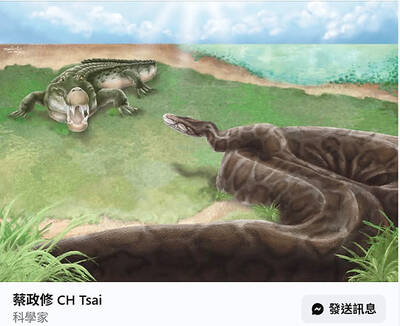
Taiwanese paleontologists have discovered fossil evidence that pythons up to 4m long inhabited Taiwan during the Pleistocene epoch, reporting their findings in the international scientific journal Historical Biology. National Taiwan University (NTU) Institute of Ecology and Evolutionary Biology associate professor Tsai Cheng-hsiu (蔡政修) led the team that discovered the largest snake fossil ever found in Taiwan. The single trunk vertebra was discovered in Tainan at the Chiting Formation, dated to between 400,000 and 800,000 years ago in the Middle Pleistocene, the paper said. The area also produced Taiwan’s first avian fossil, as well as crocodile, mammoth, saber-toothed cat and rhinoceros fossils, it said. Discoveries

Taiwanese paleontologists have discovered fossil evidence that pythons up to 4m long inhabited Taiwan during the Pleistocene epoch, reporting their findings in the international scientific journal Historical Biology. National Taiwan University (NTU) Institute of Ecology and Evolutionary Biology associate professor Tsai Cheng-hsiu (蔡政修) led the team that discovered the largest snake fossil ever found in Taiwan. A single trunk vertebra was discovered in Tainan at the Chiting Formation, dated to between 800,000 to 400,000 years ago in the Middle Pleistocene, the paper said. The area also produced Taiwan’s first avian fossil, as well as crocodile, mammoth, sabre-toothed cat and rhinoceros fossils, it said. Discoveries
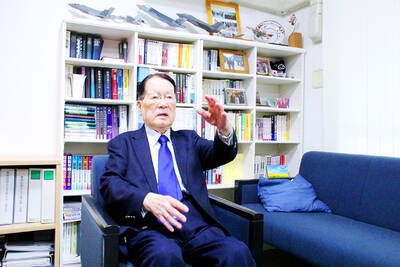
Whether Japan would help defend Taiwan in case of a cross-strait conflict would depend on the US and the extent to which Japan would be allowed to act under the US-Japan Security Treaty, former Japanese minister of defense Satoshi Morimoto said. As China has not given up on the idea of invading Taiwan by force, to what extent Japan could support US military action would hinge on Washington’s intention and its negotiation with Tokyo, Morimoto said in an interview with the Liberty Times (sister paper of the Taipei Times) yesterday. There has to be sufficient mutual recognition of how Japan could provide


 RSS
RSS