


Beijing is expected to intensify long-arm jurisdiction and transnational persecution against dissidents in China and abroad after the passage of the Act on the Promotion of Ethnic Unity and Progress at the Chinese National People’s Congress, the Mainland Affairs Council (MAC) said yesterday.
The act is essentially a law representing Chinese President Xi Jinping’s (習近平) vision about governing different ethnic groups in China, MAC Deputy Minister Liang Wen-chieh (梁文傑) told a news conference.
“The purpose of the act is to establish what the Chinese Communist Party [CCP] perceives as ‘correct’ views on the nation, history, ethnicity, culture, education and religion,” Liang said. “All ethnic groups in China must have the same views on the nation and Chinese history, meaning that there is only one interpretation of Chinese culture and history.”
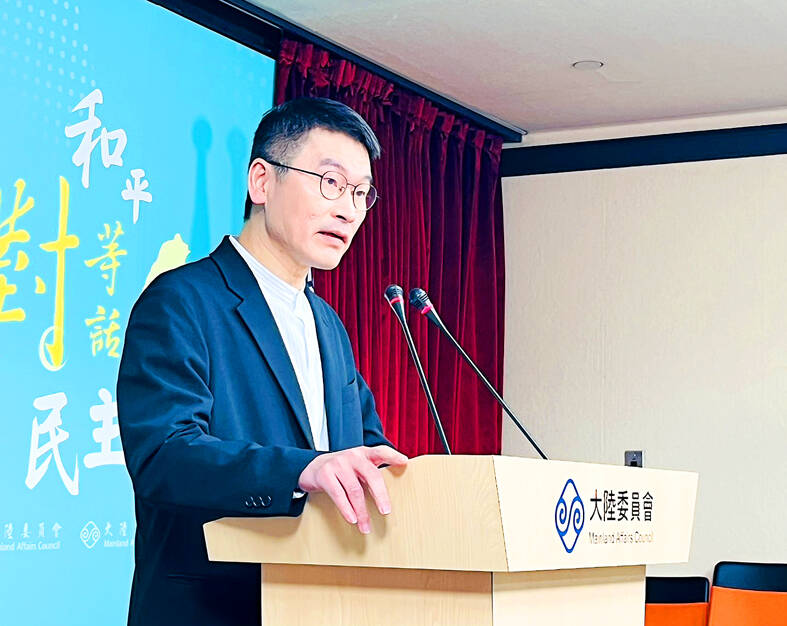
Photo: Chen Yu-fu, Taipei Times
Anyone interpreting Chinese history differently or in ways disapproved of by the CCP face legal consequences, as it could be considered as undermining national unity and deliberately inciting separatism, he said.
Gusa Press (八旗文化) editor-in-chief Li Yanhe (李延賀), commonly known by his pen name Fucha (富察), was arrested and detained by Chinese national security authorities when he was visiting relatives in China in March 2023.
The National People’s Congress on Wednesday last week delivered a report by the Chinese Supreme People’s Court and the Chinese Supreme People’s Procuratorate, saying that Li was convicted of inciting secession and undermining national unity, as required by law.
Liang said that the report also listed a series of books he wrote by which he was convicted.
One of them, titled Grassland Without Tombstones (沒有墓碑的草原), was about the massacre of Mongols during the Chinese Cultural Revolution.
Li verified the details of history and reflected on the significance of the incident, “which is unacceptable to the CCP,” Liang said, adding that simply publishing these books can be considered contravening the law.
“Our concern is that the terms in the law are vaguely defined and could implicate an extensive range of situations. The CCP decides how the law should be interpreted and whether one contravenes the law, which applies not only to Chinese nationals, but also to historians, writers and religious leaders in other countries,” Liang said.
MAC Deputy Minister Shen Yu-chung (沈有忠) told a forum in Taipei that, on the surface, the law was created to maintain internal stability in China.
However, it was actually passed as a legal base to attack and punish supporters of independence in Taiwan, he said.
“China considers Taiwan to be under its jurisdiction and Taiwanese who do not facilitate national unity or unification are punishable by the act,” Lee said.
“In that case, cracking down on separatists and facilitating cross-strait unification are not separate matters,” he said.
During discussion of the act, the Chinese People’s Political Consultative Conference also passed a resolution on the “Sinicization of religion,” which is listed in the same chapter on pushing for cross-strait reunification and “one country, two systems,” Lee said.
Many consider that the resolution was introduced to enhance China’s “united front” work and enable it to exercise long-arm jurisdiction in Taiwan, Lee added.
Zhao Leji (趙樂際), chairman of the National People’s Congress of China, said that it aims to reinforce shared memories of history between Chinese and Taiwanese this year by celebrating the retrocession of Taiwan to China and that 160th anniversary of the birth of Sun Yat-sen (孫中山), Lee said, adding that these are measures to facilitate “memory integration.”
The CCP also identified Pingtan in Fujian Province and Kunshan in Jiangsu Province to be part of the memory integration initiative, Lee said.
Additional reporting by Chen Yu-fu

NATIONAL SECURITY: Authorities are working to confirm the identities of the military personnel involved and investigating possible illegal conduct and regulatory violations Authorities are probing possible national security implications after Kinmen police and immigration officers on Sunday found a Chinese woman allegedly posing as a tourist while engaging in prostitution involving more than 10 military personnel. The woman, surnamed Chen (陳), has since been deported, authorities said, adding that investigators are still working to confirm the identities of those implicated, as the records only listed code names and aliases. The case stemmed from a report received by the Kinmen District Prosecutors’ Office on Friday last week from the Jinhu Precinct of the Kinmen County Police Bureau. On Sunday, police, along with the National Immigration

GLOBALGIVING: ‘ Caving to external pressure is not acceptable for an organization that has cultivated justice reform and human rights for 30 years,’ one NGO said A slew of non-government organizations (NGOs) have withdrawn from the GlobalGiving fundraising platform after it announced it would use “Chinese Taipei” instead of “Taiwan” from next month. The Taiwan Good Rice Association wrote on Facebook on Friday that it was informed on April 28 via a teleconference call of the change, which was made because the platform wanted to operate in China. Taiwan Good Rice is to terminate all cooperative relationships with GlobalGiving in response to the platform’s “unilateral and non-negotiable” decision to remove references to Taiwan, the NGO said. “Taiwan is in the official name of Taiwan Good Rice Association and the

HEAVY WEATHER: Typhoon Jangmi is due to crash straight into the Ryukyus as airlines look to shift flights to larger aircraft or cancel flights to Okinawa entirely Taiwan’s international air carriers announced flight adjustments over the weekend as Typhoon Jangmi is forecast to hit the Ryukyu Islands today and tomorrow. The Central Weather Administration (CWA) upgraded Jangmi from a tropical storm to a typhoon at 8am yesterday, with the eye located 580km south of Naha city. It was moving north at 19kph. Today, China Airlines’ CI-120, CI-121, CI-122 and CI-123 flights between Taoyuan and Naha, Okinawa, have been canceled as well as CI-132 and CI-133 between Kaohsiung and Naha. EVA Air’s BR-112, BR-113, BR-186 and BR-185 flights between Taoyuan and Naha are also canceled. Low-cost carrier Tigerair Taiwan canceled IT-230,

Chinese Nationalist Party (KMT) Chairwoman Cheng Li-wun (鄭麗文) yesterday briefed her party’s Central Standing Committee regarding her scheduled visit to the US between Monday next week and June 16, saying that her purpose would be to persuade the US that the Republic of China (ROC) Constitution was a “one China” constitution that would foster stable and peaceful cross-strait relations. The ROC Constitution is the most important defense for all Taiwanese citizens, as it upholds our democracy and has contributed to our robust economy, which aligns with international and US interests, she said. “We would not be troublemakers and drag the US under,”


 RSS
RSS