


Taiwan’s air force is expected to conduct a series of exercises this week as part of its joint combat tactics specialty course, implementing a combat-like simulated environment, airdefensenews.com wrote on Facebook on Sunday, with Ministry of National Defense sources yesterday appearing to confirm the report.
The exercises would include several types of aircraft and include the use of Tien Kung (Sky Bow, 天弓) surface-to-air missiles, as well as naval forces providing air defense and maritime protection, airdefensenews wrote.
Unlike the air force’s Tien Lung exercises, this week’s joint combat tactics specialty training would not have a scoring system and is intended to allow participants to gain joint combat experience through trial and error, it wrote.
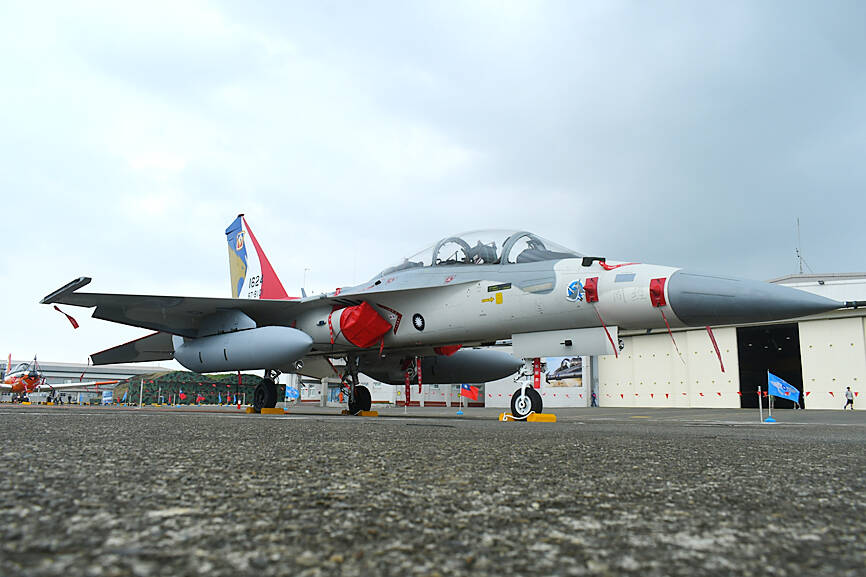
Photo: Liu Yu-chieh, Taipei Times
The exercises are expected to last three weeks, it added.
The ministry sources said on condition of anonymity that a combat-like exercise without prescripted scenarios would help improve the air force’s operational effectiveness and joint combat capabilities.
The training would emphasize small-group sessions and encourage participants to develop innovative, asymmetrical tactics, the sources said, adding that improved tactical execution and combat efficiency would enhance overall defensive resilience.
Separately, the ministry said that military units have deployed High Mobility Artillery Rocket Systems (HIMARS) delivered from the US and it has received a letter of acceptance to purchase 82 additional HIMARS, which must be signed by March 26.
The US announced the sale of 82 HIMARS to Taiwan on Dec. 17 last year at an estimated cost of US$4.05 billion as part of a US$11.1 billion arms package.
The ministry also said it is considering the purchase of Precision Strike Missiles, a series of Lockheed Martin-developed ballistic missiles intended to replace the MGM-140 Army Tactical Missile Systems and has reserved funds for their potential acquisition.
However, Taiwan would likely have to wait six to 10 years for delivery, as Australia, the UK, Japan and Norway, among others, have already expressed interest in purchasing the missiles, the ministry said.
The missile has only recently entered mass production and, according to US policy, initial production would first have to pass US military requirements, the ministry said, adding that Australia is second in line as a development partner in the program.
Meanwhile, the Hai Kun (Narwhal), Taiwan’s first domestically built submarine, conducted its fifth round of dive testing after departing from the Port of Kaohsiung at about 8am on Tuesday, the Military News Agency reported.
Shipbuilder CSBC Corp, Taiwan has been accumulating fines since missing a deadline in November last year due to “testing delays,” but last month said that it hopes to deliver the submarine to the navy in June.
Videos of the previous four shallow-water dive trials from Jan. 29 to Feb. 6 released by CSBC showed the submarine performing functions such as steering and control, opening vent valves, diving, raising its periscope and antenna mast, changing depths, launching decoys and surfacing.
Testing of ship maneuverability, reconnaissance equipment, emergency functions and combat management systems has also been carried out, the Military News Agency reported.
Those and other tests comprehensively verified the Hai Kun’s performance, and ensure it meets the navy’s operational requirements and standards, it said.
Additional reporting by CNA

LOUD AND PROUD Taiwan might have taken a drubbing against Australia and Japan, but you might not know it from the enthusiasm and numbers of the fans Taiwan might not be expected to win the World Baseball Classic (WBC) but their fans are making their presence felt in Tokyo, with tens of thousands decked out in the team’s blue, blowing horns and singing songs. Taiwanese fans have packed out the Tokyo Dome for all three of their games so far and even threatened to drown out home team supporters when their team played Japan on Friday. They blew trumpets, chanted for their favorite players and had their own cheerleading squad who dance on a stage during the game. The team struggled to match that exuberance on the field, with
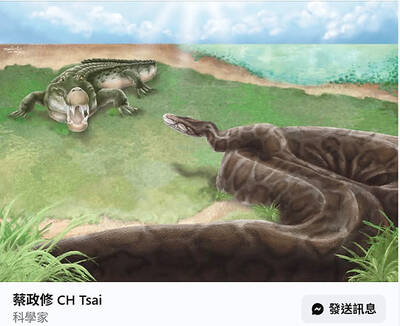
Taiwanese paleontologists have discovered fossil evidence that pythons up to 4m long inhabited Taiwan during the Pleistocene epoch, reporting their findings in the international scientific journal Historical Biology. National Taiwan University (NTU) Institute of Ecology and Evolutionary Biology associate professor Tsai Cheng-hsiu (蔡政修) led the team that discovered the largest snake fossil ever found in Taiwan. The single trunk vertebra was discovered in Tainan at the Chiting Formation, dated to between 400,000 and 800,000 years ago in the Middle Pleistocene, the paper said. The area also produced Taiwan’s first avian fossil, as well as crocodile, mammoth, saber-toothed cat and rhinoceros fossils, it said. Discoveries

Taiwanese paleontologists have discovered fossil evidence that pythons up to 4m long inhabited Taiwan during the Pleistocene epoch, reporting their findings in the international scientific journal Historical Biology. National Taiwan University (NTU) Institute of Ecology and Evolutionary Biology associate professor Tsai Cheng-hsiu (蔡政修) led the team that discovered the largest snake fossil ever found in Taiwan. A single trunk vertebra was discovered in Tainan at the Chiting Formation, dated to between 800,000 to 400,000 years ago in the Middle Pleistocene, the paper said. The area also produced Taiwan’s first avian fossil, as well as crocodile, mammoth, sabre-toothed cat and rhinoceros fossils, it said. Discoveries

Whether Japan would help defend Taiwan in case of a cross-strait conflict would depend on the US and the extent to which Japan would be allowed to act under the US-Japan Security Treaty, former Japanese minister of defense Satoshi Morimoto said. As China has not given up on the idea of invading Taiwan by force, to what extent Japan could support US military action would hinge on Washington’s intention and its negotiation with Tokyo, Morimoto said in an interview with the Liberty Times (sister paper of the Taipei Times) yesterday. There has to be sufficient mutual recognition of how Japan could provide


 RSS
RSS