


Former Taiwan soccer coach Chen Kuei-jen (陳貴人) was reportedly removed from an Asian Football Confederation (AFC) game involving Taiwan’s women’s national team in Sydney on Tuesday for shouting “go Taiwan” after organizers told fans to use “Chinese Taipei” to refer to the team.
Taiwan defeated India 3-1 in the match, sending them into the quarter-finals of the Women’s Asian Cup.
Fans said that they were asked to sit down by staff, as “standing to cheer” was not allowed.
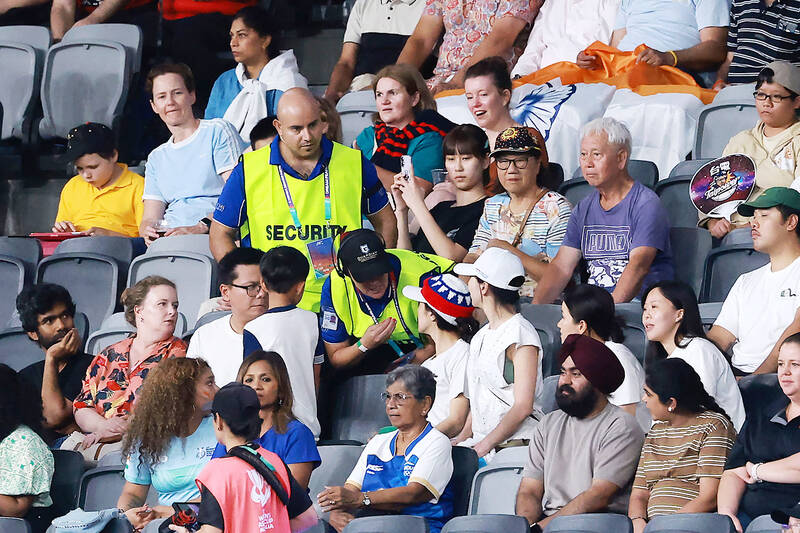
Photo: AFP
However, fans of India’s team who were standing, cheering and banging drums were not restricted in the same manner, they said.
During halftime, Chen — who represented Taiwan 11 times as a player in the 1990s and was head coach of the men’s national team from 2012 to 2016 — was reportedly removed from the stadium by security personnel after shouting “Taiwan.”
Tiffany Chen, a Taiwanese fan in the stands, said that Chen Kuei-jen encouraged fans to create a lively atmosphere in the mostly empty stadium, the Guardian reported.
“He was standing away from the aisle, having the time of his life,” Tiffany Chen said. “Social media people from the tournament were taking videos of him and saying: ‘This is such a great vibe.’”
The national soccer association later said that the AFC told Taiwanese fans to refer to their team as “Chinese Taipei.”
Restricting the way fans cheer and forbidding them from saying “Taiwan” goes beyond crowd management — it suppresses the basic rights and identity of Taiwanese fans, Democratic Progressive Party Legislator Lee Po-yi (李柏毅) said.
Cheering for the national team and shouting the country’s name is a fundamental right, Lee said.
Taiwan has long faced political pressure from China in the international arena, with its name, flag and other symbols frequently restricted or excluded, he said.
For Taiwan there has never been room to separate politics from sports, as China has long sought to suppress and diminish its national status on the global stage, he added.
Lee said he would ask the Ministry of Sports and the Australian Office Taipei to express their concern over the incident, and ask Football Australia to explain the incident and prevent a similar situation from arising again.
The Ministry of Foreign Affairs later yesterday said that its representative office in Sydney had “immediately lodged a strong protest on the spot” on Tuesday, which prevented staff at the match from further “mistreating” Taiwanese spectators.
The office sent a letter to AFC general secretary Windsor John to protest “unequal treatment” and urge “organizers to uphold human rights and the principles of fairness in the competition,” the foreign ministry said.
The office also conveyed its “dissatisfaction and concern” to local police, it added.
People should pay attention to how this case develops and unite in support of Taiwan, he added.
No matter how challenging the international environment, the voices of Taiwanese cheering for their national team should not be silenced, Lee said.
Prior to their win over India, Taiwan lost to Japan 2-0 and beat Vietnam 1-0 to finish second in Group C with a 2-1 record and advance to the quarter-finals.
They face China in Perth on Saturday for a spot in the semi-finals.
Additional reporting by CNA and AFP

UPGRADE: The Kang Ding-class frigate is replacing its Chaparall missiles with Tien Chien II and Hua Yang VLS, which would provide it with long-range, 360° air defense Taiwan plans to produce 1,200 to 1,376 Hai Chien II missiles (海劍二, Sea Sword II) — also known as TC-2N — to serve as the standard air defense system of the navy’s surface combatant fleet, a source said yesterday. Last week, the Hai Chien II, the naval version of the Tien Kung II missile (天劍二, Sky Sword II), completed a live-fire test in waters off the National Chungshan Institute of Science and Technology’s Jiupeng facility (九鵬) in Pingtung County’s Manjhou Township (滿州). The MIM72 Chaparral and other dated air defense missiles that currently arm Taiwanese ships have inadequate range to combat Chinese

REASONS FOR TRAVEL: An assistant professor said that proposed amendments to penalize drivers if they used drugs overseas would not deter people from traveling People who operate a motor vehicle under the influence of marijuana would have their driver’s license revoked, even if they used the substance while overseas, the Ministry of Transportation and Communications said yesterday, citing proposed amendments to the Road Traffic Management and Penalty Act (道路交通管理處罰條例). The amendments would also authorize the government to revoke the licenses of people determined to have used Category 1 or Category 2 narcotics, even if they were not operating a vehicle while under the influence of drugs, as well as ban them from taking the license test for three years, the ministry said. People aged 18 or

HEAVY WEATHER: Typhoon Jangmi is due to crash straight into the Ryukyus as airlines look to shift flights to larger aircraft or cancel flights to Okinawa entirely Taiwan’s international air carriers announced flight adjustments over the weekend as Typhoon Jangmi is forecast to hit the Ryukyu Islands today and tomorrow. The Central Weather Administration (CWA) upgraded Jangmi from a tropical storm to a typhoon at 8am yesterday, with the eye located 580km south of Naha city. It was moving north at 19kph. Today, China Airlines’ CI-120, CI-121, CI-122 and CI-123 flights between Taoyuan and Naha, Okinawa, have been canceled as well as CI-132 and CI-133 between Kaohsiung and Naha. EVA Air’s BR-112, BR-113, BR-186 and BR-185 flights between Taoyuan and Naha are also canceled. Low-cost carrier Tigerair Taiwan canceled IT-230,

Johanne Liou (劉喬安), a Taiwanese woman who shot to unwanted fame during the Sunflower movement protests in 2014, returned to Taiwan last night after being deported from the US. She is to stand trial in Taiwan for charges involving embezzlement, fraud and drug crimes. The Criminal Investigation Bureau (CIB) said it took her into custody at Taiwan Taoyuan International Airport and would first question her before transferring her to the New Taipei District Prosecutors’ Office. She was arrested upon disembarking a flight from San Francisco that landed shortly before 7pm. Liou absconded to the US in 2019 after jumping bail


 RSS
RSS