


Taiwan Power Co (Taipower) this month would submit a plan to restart the decommissioned Ma-anshan Nuclear Power Plant in Pingtung County’s Hengchun Township (恆春), setting the stage for it to begin generating electricity as early as 2028, Minister of Economic Affairs Kung Ming-hsin (龔明鑫) told a hearing at the legislature in Taipei yesterday.
Taiwan People’s Party Legislator Liu Shu-pin (劉書彬) asked Kung whether the government is considering using nuclear energy as a stable energy source in the event of a wartime blockade.
If China blockaded the Taiwan Strait, Taiwan would exhaust its natural gas reserves in 10 days, its coal reserves in seven weeks and its oil reserves in 20 weeks, leaving only 20 percent of its power generation capacity, Liu said, citing the results of a war game by a US-based think tank.
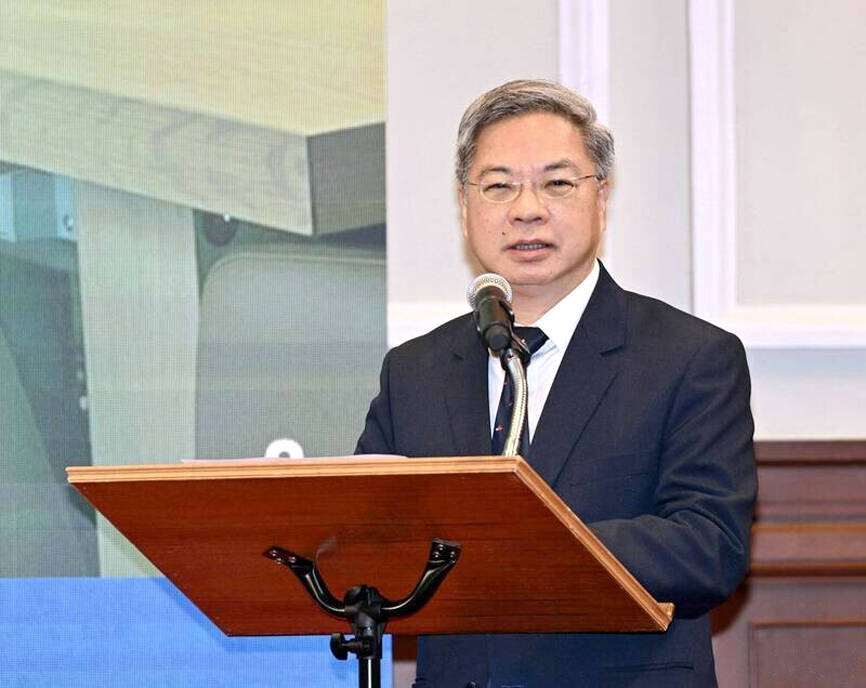
Photo: Liao Chia-ning, Taipei Times
Kung said that a safety inspection of the Ma-anshan plant is under way and that state-run Taipower is expected to submit a plan later this month to restart it.
Asked if that could happen by 2028, Kung said the government has signed a contract with Westinghouse to check the state of the plant’s generators.
If the equipment is in good condition and not too much needs to be replaced, the timeline could be shorter, he said.
Kung’s response tracked with comments he made late last year, when he estimated that safety inspections would take one-and-a-half to two years, with a report submitted to the Nuclear Safety Commission in the middle of next year and reopening in 2028 at the earliest.
Following the Tohuku earthquake, tsunami and Fukushima Dai-ichi nuclear meltdown in Japan on March 11, 2011, opposition to nuclear power in Taiwan grew.
Supported by the Democratic Progressive Party (DPP), the anti-nuclear movement pressured the then-Chinese Nationalist Party (KMT) government to halt and seal the still-under-construction Fourth Nuclear Power Plant in New Taipei City’s Gongliao District (貢寮) in 2014.
After taking office in 2016, the DPP made plans for a “nuclear-free homeland” by last year.
It phased out electricity generation at the Jinshan Nuclear Power Plant in New Taipei City’s Shihmen District (石門) in 2019, at the Guosheng Nuclear Power Plant in New Taipei City’s Wanli District (萬里) in 2023 and at Ma-anshan on May 17 last year.
Under the policy, nuclear power as a share of Taiwan’s energy mix dropped from 19 percent in 2011 to nothing, with much of the gap filled by fossil fuel sources.
According to Energy Administration data, 47.8 percent of Taiwan’s energy generation last year was from natural gas, while coal accounted for 35.4 percent and renewables made up 13.1 percent.
Fuel oil, pumped hydro and the final few months of nuclear power from Ma-anshan accounted for the rest, the data showed.
Since Taipower closed the plant in Pingtung, fears of China blocking energy imports from reaching Taiwan in the event of a war, as well as issues such as air pollution and increased power demand, have prompted the government to abruptly reverse its position.
In November last year, the government said that Taipower was expected to submit plans to reopen the Guosheng and Maanshan plants.

FUKUOKA SITUATION: Japanese media reported that the pathogen is expected to be identified by the summer, while the CDC downplayed the idea that it was hMPV A “mysterious cold-like illness” reported in Japan’s Fukuoka Prefecture does not seem to be a new disease, but Japanese authorities have been asked about the situation, the Centers for Disease Control (CDC) said yesterday. The Fukuoka Prefectural Medical Association on Wednesday told a news conference that a “mystery cold” that has become a hot topic on social media is “highly likely to be caused by some kind of viral infection,” Japan’s KBC News reported. “Many people are experiencing symptoms starting with a sore throat, followed by a runny nose, phlegm and a severe cough,” KBC News reported, citing association officials. Health authorities are

Nvidia Corp CEO Jensen Huang (黃仁勳) arrived in Taiwan yesterday ahead of upcoming AI and technology events, saying he plans to meet with clients and Taiwan Semiconductor Manufacturing Co Chairman C.C. Wei (魏哲家) during his visit. After landing at Taipei Songshan Airport, Huang posed for photos with fans and handed out Yakult drinks to reporters and supporters waiting at the scene, saying he has “a lot to do” during the trip. Asked about reports that Nvidia’s planned headquarters site in Taipei’s Beitou Shilin Technology Park could break ground on May 27, Huang said that if the company holds an event, he would

Carrefour Taiwan is to begin using a new name from the start of July, but it cannot divulge the name until then, the chairman of the supermarket chain's parent company said today. President Chain Store Co chairman Lo Chih-hsien (羅智先) was asked by reporters after a shareholders' meeting to confirm whether the company has settled on a new name for the supermarket brand. In March, the government-registered name of two Carrefour Taiwan branches was quietly changed to "Le Chia Kang" (樂家康) in Chinese, raising speculation that has been selected as the name. Lo said that because of local regulations and contractual obligations, the
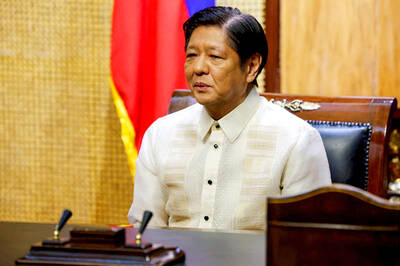
The Philippines would likely be involved in any conflict over Taiwan due to its proximity to the democracy claimed by China, President Ferdinand Marcos Jr said, reiterating a stance that risks angering Beijing. “In the Philippines, we do not have a choice because Taiwan is so close to the Philippines and we have almost 200,000 Filipino nationals living and working in Taiwan,” Marcos said in an interview with Japanese media in Manila on Monday. The Philippine leader’s comments come ahead of a state visit to Japan next week, where he is to meet with Japanese Prime Minister Sanae Takaichi to discuss security


 RSS
RSS