


Taiwan has not detected any Chinese military aircraft in its vicinity for nine of the past 10 days, a decline that some commentators have found unusual, while others cautioned against alarm.
Beijing has continuously increased military pressure against Taiwan in recent years, dispatching military aircraft and vessels close to Taiwan almost daily.
However, no more than two Chinese military aircraft have been detected around Taiwan within a 24-hour period since Feb. 28, while there were 86 incursions over the same period last year, according to Agence France-Presse (AFP) statistics compiled from Ministry of National Defense data.
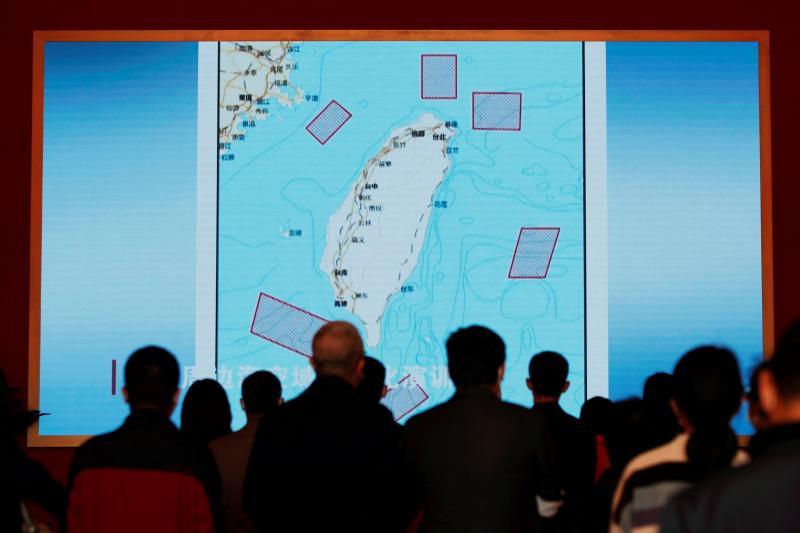
Photo: Reuters
This is the longest period that Chinese aircraft have not been detected in the area since AFP began compiling the data in 2024.
Over the past 10 days, Taiwan detected an average of six Chinese military vessels per day in its surrounding waters, the same as during this period last year, data showed.
Chinese aircraft incursions went down 42 percent in January and last month compared with the period last year, while vessel incursions went down by about 4.5 percent, AFP said.
The drop in incursions could be tied to China’s annual “two sessions” meetings or recent personnel reorganization within the Chinese People’s Liberation Army (PLA), experts said.
Other reasons could include US President Donald Trump’s upcoming meeting with Chinese President Xi Jinping (習近平) later his month, or the conflict in the Middle East.
“I didn't expect to be worried about the cessation of PLA operations around Taiwan, but the lack of a rational explanation is disconcerting,” Drew Thompson, a senior research fellow at Nanyang Technological University, wrote on Substack on Friday last week.
“The longer the activity gap persists, the more concerned I will be about broader implications, but I have not seen any indications that the PRC [People’s Republic of China] is preparing for any major kinetic action,” said Ben Lewis, founder of the open-source data platform PLATracker.
Beijing might be trying to “weaken Taiwanese support for increasing national defense spending,” Institute for National Defense and Security Research research fellow Su Tzu-yun (蘇紫雲) said.
However, another expert thought this is not unusual.
“This isn’t mysterious. PLA air incursions into Taiwan’s ADIZ [air defense identification zone] drop to/near zero around the time of the annual ‘two sessions’ every year,” Brian Hart, deputy director and fellow of the China Power Project at the Center for Strategic and International Studies, wrote on X on Saturday.
“If this pattern persists well beyond the two sessions then it would be unusual. But I don’t think there’s evidence of anything unusual yet,” Hart said.
Beijing may be trying to create a false impression that China is easing threats against Taiwan to deceive the US into reducing support for Taiwan, a Taiwanese security official said.
“We must not let our guard down,” the official said.
Additional reporting by AFP

FUKUOKA SITUATION: Japanese media reported that the pathogen is expected to be identified by the summer, while the CDC downplayed the idea that it was hMPV A “mysterious cold-like illness” reported in Japan’s Fukuoka Prefecture does not seem to be a new disease, but Japanese authorities have been asked about the situation, the Centers for Disease Control (CDC) said yesterday. The Fukuoka Prefectural Medical Association on Wednesday told a news conference that a “mystery cold” that has become a hot topic on social media is “highly likely to be caused by some kind of viral infection,” Japan’s KBC News reported. “Many people are experiencing symptoms starting with a sore throat, followed by a runny nose, phlegm and a severe cough,” KBC News reported, citing association officials. Health authorities are

Nvidia Corp CEO Jensen Huang (黃仁勳) arrived in Taiwan yesterday ahead of upcoming AI and technology events, saying he plans to meet with clients and Taiwan Semiconductor Manufacturing Co Chairman C.C. Wei (魏哲家) during his visit. After landing at Taipei Songshan Airport, Huang posed for photos with fans and handed out Yakult drinks to reporters and supporters waiting at the scene, saying he has “a lot to do” during the trip. Asked about reports that Nvidia’s planned headquarters site in Taipei’s Beitou Shilin Technology Park could break ground on May 27, Huang said that if the company holds an event, he would

The Ministry of Finance this afternoon announced the winning numbers for the March-April uniform invoice lottery. The winning number for the NT$10 million (US$318,060) special prize is 19531471, and the winning number for the NT$2 million grand prize is 85941329. Three numbers were drawn for the NT$200,000 first prize: 07225810, 20231230 and 83518781. Those with receipts matching the last seven digits of any of the first-prize numbers will win the NT$40,000 second prize, while those matching the last six digits will win the NT$10,000 third prize. Those whose receipts match the last five digits of the first-prize numbers can claim the NT$4,000 fourth prize,
Former president Ma Ying-jeou (馬英九) yesterday expressed “shock and regret” over a statement issued by his wife without his consent, and rejected her assertion that his eldest sister, Ma Yi-nan (馬以南), would manage his medical care or act as his spokesperson amid an ongoing embezzlement probe into his foundation. Ma Ying-jeou in a statement said he was shocked by a statement by his wife, Chou Mei-ching (周美青), regarding his affairs. Ma Yi-nan “must not” be in charge of his healthcare and other personal affairs, nor can she be allowed to represent the Ma family, the former president said. He said he was also


 RSS
RSS