


Taiwan’s first indigenous coffee exchange platform has been set up in Yilan County to promote distinctively flavored indigenous coffee, with the goal of making indigenous coffee beans a premium on the global market.
About 150 coffee trees were planted in Taiwan during the Japanese colonial period.
Cultivated in the unique environment of Taiwan over the past century, the most widely planted arabica coffee trees have already produced variant varieties, such as typica.
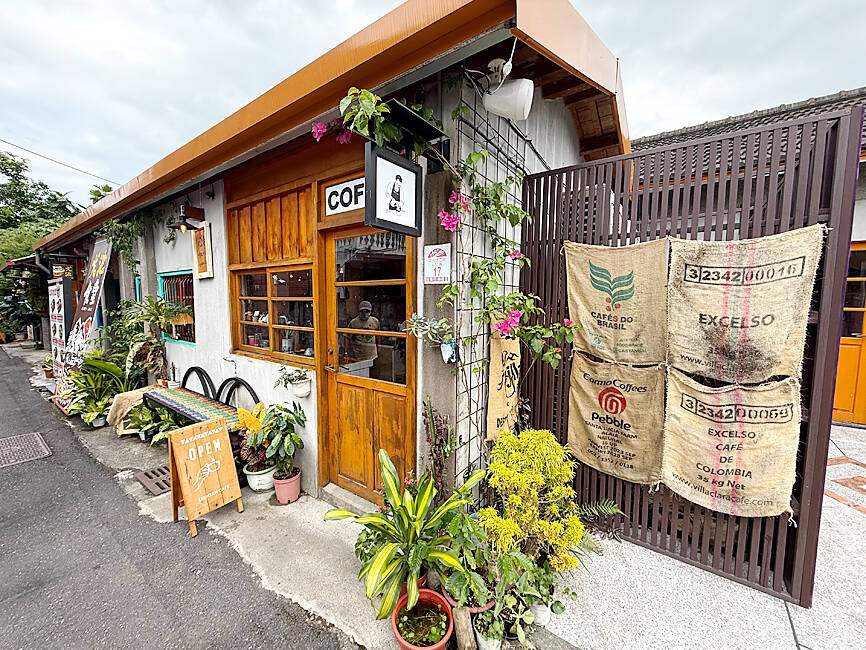
Photo: Wang Chun-chi, Taipei Times
Although the planting areas of coffee beans in the county only totaled about 10 hectares, locally grown green coffee beans won accolades at an evaluation held by the platform last year.
The platform was set up last year by the Yilan Style (蘭陽原創館) in collaboration with Lighten Cafe (光覺咖啡), with a coffee bean evaluation held in May last year. Nine indigenous coffee brands from across Taiwan were invited to compete in the event.
The Yilan-based Cloud Red Soil Coffee Estate (雲端紅土咖啡莊園) and Myasa Coffee Estate (迷雅薩咖啡莊園) earned a total of three awards, making Yilan the area with most awards, while the top awards went to Pingtung County’s Taiwu Coffee Production Cooperative (泰武咖啡生產合作社) and Chiayi County’s Gu Bua Kak Estate (牛磨角庄園).
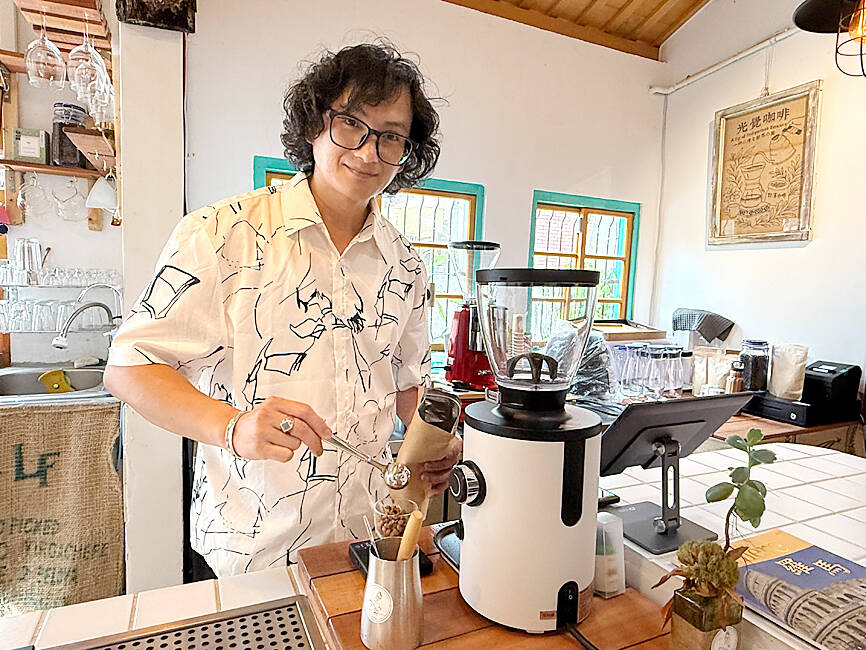
Photo: Wang Chun-chi, Taipei Times
The planting areas of coffee beans amount to more than 1,000 hectares nationwide, with Pingtung, Chiayi and Nantou counties being the main production areas, yielding an annual output value of about NT$1 billion (US$31.5 million) every year.
Coffee plantations in Yilan County are mainly located in Tatung (大同) and Nanao (南澳) areas, totaling about 10 hectares in the area and producing an annual coffee bean production of more than 5 tonnes.
Coffee grown in the region has a mild texture and a lingering aftertaste, as a grass-cover cultivation technique was adopted and the hillside environment has good drainage with significant daily temperature swings.
Cloud Red Soil Coffee Estate coffee farmer Hsu A-jung (許阿榮) grows a 1-hectare farm with about 600 Typica coffee trees in Tatung District’s Kalan Dalah indigenous village and has earned a reputation with 16 years of experience in grass-cover cultivation.
Local climates in Yilan gave slightly varying flavors to his coffee every year and could cause unstable production, Hsu said, adding that the production was good in 2024, but plunged last year.
The coffee trees cultivated by Hsu have big fruit with small coffee beans, with the beans possessing a unique flavor, he said.
The National Ilan University’s Indigenous Student Resource Center director Wang Chin-fa (王進發) said there are more than 10 indigenous coffee varieties in Taiwan since coffee was introduced under Japanese rule.
Although Yilan has relatively low altitudes, its humidity, temperature and drainage conditions are all ideal for coffee and could give locally grown coffee layered aftertastes, he said.
About 50 percent of coffee’s delicious taste is decided by cultivation techniques, 30 percent by roast level, and 20 percent by the brewing process, Wang said.
Yilan Style executive director Wang Chia-hsun (王嘉勳) said the platform was established to engage with more indigenous coffee farmers and to demonstrate various flavors of coffee grown in the hills and mountains of Taiwan.
That helps promote indigenous coffee to the public and bring it further into international markets, he said.
The university also launched training programs for coffee farmers in collaboration with the industry to help build an indigenous coffee industrial chain and continue to make indigenous coffee a premium product.
Lighten Cafe co-founder Hsia Lien-kuang (夏連光), a Truku born in Hualien who moved to Yilan with his wife seven years ago, is an enthusiast for pour-over coffee and devotes himself to promoting premium indigenous coffee.
He and his wife co-founded Lighten Cafe and visited many indigenous coffee farmers around Taiwan — including among the Paiwan, Bunun, Atayal and Amis people — to help promote and market their indigenous coffee, he said.
The visibility of indigenous coffee remains to be seen in the local market, which is dominated by imported coffee beans, Hsia said.
A hand-brewing exchange area has been set up at the Yilan Style where Hsia runs workshops on “Store Manager’s Day” that he said “allows visitors to experience the joy of hand brewing, while enjoying the sights and scents, as well as the happiness of being surrounded by the aroma of coffee.”

Taiwan has received more than US$70 million in royalties as of the end of last year from developing the F-16V jet as countries worldwide purchase or upgrade to this popular model, government and military officials said on Saturday. Taiwan funded the development of the F-16V jet and ended up the sole investor as other countries withdrew from the program. Now the F-16V is increasingly popular and countries must pay Taiwan a percentage in royalties when they purchase new F-16V aircraft or upgrade older F-16 models. The next five years are expected to be the peak for these royalties, with Taiwan potentially earning
STAY IN YOUR LANE: As the US and Israel attack Iran, the ministry has warned China not to overstep by including Taiwanese citizens in its evacuation orders The Ministry of Foreign Affairs (MOFA) yesterday rebuked a statement by China’s embassy in Israel that it would evacuate Taiwanese holders of Chinese travel documents from Israel amid the latter’s escalating conflict with Iran. Tensions have risen across the Middle East in the wake of US and Israeli airstrikes on Iran beginning Saturday. China subsequently issued an evacuation notice for its citizens. In a news release, the Chinese embassy in Israel said holders of “Taiwan compatriot permits (台胞證)” issued to Taiwanese nationals by Chinese authorities for travel to China — could register for evacuation to Egypt. In Taipei, the ministry yesterday said Taiwan
Taiwan is awaiting official notification from the US regarding the status of the Agreement on Reciprocal Trade (ART) after the US Supreme Court ruled US President Donald Trump's global tariffs unconstitutional. Speaking to reporters before a legislative hearing today, Premier Cho Jung-tai (卓榮泰) said that Taiwan's negotiation team remains focused on ensuring that the bilateral trade deal remains intact despite the legal challenge to Trump's tariff policy. "The US has pledged to notify its trade partners once the subsequent administrative and legal processes are finalized, and that certainly includes Taiwan," Cho said when asked about opposition parties’ doubts that the ART was
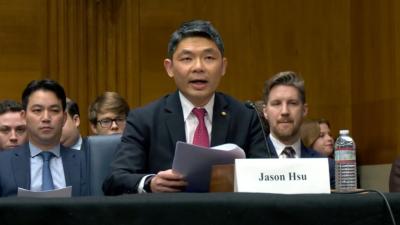
If China chose to invade Taiwan tomorrow, it would only have to sever three undersea fiber-optic cable clusters to cause a data blackout, Jason Hsu (許毓仁), a senior fellow at the Hudson Institute and former Chinese Nationalist Party (KMT) legislator, told a US security panel yesterday. In a Taiwan contingency, cable disruption would be one of the earliest preinvasion actions and the signal that escalation had begun, he said, adding that Taiwan’s current cable repair capabilities are insufficient. The US-China Economic and Security Review Commission (USCC) yesterday held a hearing on US-China Competition Under the Sea, with Hsu speaking on


 RSS
RSS