


Tibetans yesterday marched in Taipei alongside human rights advocates to protest China’s transnational repression and its crack down on the spirituality of Tibetans.
The march marked the 67th anniversary of Tibetan Uprising Day on March 10, 1959.
The Swiss government in February last year published a report saying that exiled Tibetans and Uighurs are facing transnational repression from China.
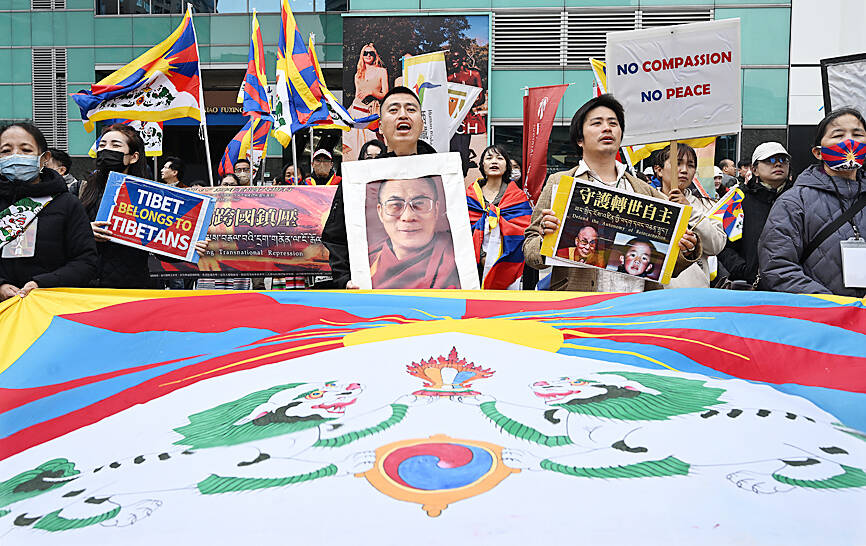
Photo: Liao Chen-huei, Taipei Times
Kelsang Gyaltsen Bawa, chairman of the Tibet Religious Foundation of His Holiness the Dalai Lama, said at the march that China is seeking to rewrite the history of Tibet through linguistic and cultural means.
He cited as an example China’s requirement of the international community to replace the term “Tibet” with “Xizang (西藏)” — the Hanyu pinyin romanization of Tibet in Mandarin.
The Central Tibetan Administration is promoting the use of the Chinese characters “圖伯特” (Tibet) over “西藏” to refer to Tibet in Mandarin, Bawa said.
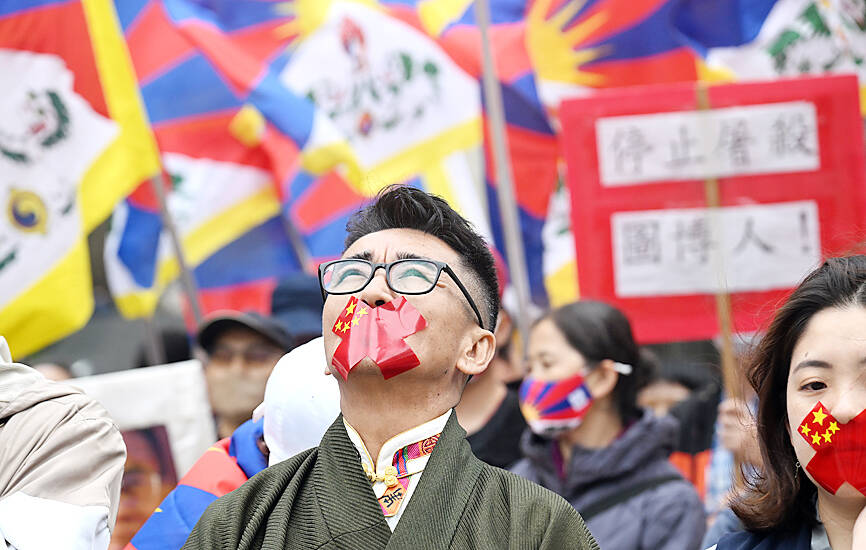
Photo: Liao Chen-huei, Taipei Times
Millions of Tibetan children are ordered to attend boarding schools, and separated from their families, their mother tongue and the Tibetan culture, he said.
Religious freedom is facing unprecedented suppression as China attempts to manipulate recognition of the Dalai Lama’s reincarnation, Bawa said.
The Chinese policies have a clear goal — to wipe out cultural and spiritual heritage, he said.
“Democracy did not come easy and freedom might not last forever,” Bawa said, adding that supporting Tibet is defending the values of freedom for Taiwan and the rest of the world.
Tashi Tsering said he is a second-generation Tibetan in the independence movement and has not been able to contact his family in Tibet since he was 18 years old due to his political stance.
The families of many young Tibetans promoting independence are terrorized by the Chinese Communist Party, he said.
National Human Rights Commission member Yeh Ta-hua (葉大華) said that China’s surveillance and oppression of Tibetans have not ceased since it broke the Seventeen Point Agreement more than 67 years ago.
The agreement, signed in 1951 between China and Tibetan representatives, affirmed Chinese sovereignty over Tibet while promising autonomy, religious freedom and preservation of local systems.
The oppression has escalated into transnational repression, which targets not only Tibetans and Uighurs, but also Hong Kongers and Taiwanese, Yeh said.
“Supporting Tibetans upholds Taiwan’s own democracy and freedom,” she said.
Hong Kong Outlanders member Sky Fung (馮詔天) said that Tibetans and Hong Kongers with connections to Taiwan are at risk of being charged of “collusion with external forces” by Beijing.
However, Tibetans and Hong Kongers continue their independence movements in Taiwan because they cannot voice dissent in their homeland, Fung said.
China attempted to interfere in the Dalai Lama’s reincarnation in Tibet, and also destroyed the rule of law and freedom in Hong Kong, he said.
“It actions push Tibetans and Hong Kongers to the limit,” he said, calling on people in Taiwan to take action to resist Chinese oppression.
About 300 people participated in the march, organizers said.
Additional reporting by CNA

FUKUOKA SITUATION: Japanese media reported that the pathogen is expected to be identified by the summer, while the CDC downplayed the idea that it was hMPV A “mysterious cold-like illness” reported in Japan’s Fukuoka Prefecture does not seem to be a new disease, but Japanese authorities have been asked about the situation, the Centers for Disease Control (CDC) said yesterday. The Fukuoka Prefectural Medical Association on Wednesday told a news conference that a “mystery cold” that has become a hot topic on social media is “highly likely to be caused by some kind of viral infection,” Japan’s KBC News reported. “Many people are experiencing symptoms starting with a sore throat, followed by a runny nose, phlegm and a severe cough,” KBC News reported, citing association officials. Health authorities are

Nvidia Corp CEO Jensen Huang (黃仁勳) arrived in Taiwan yesterday ahead of upcoming AI and technology events, saying he plans to meet with clients and Taiwan Semiconductor Manufacturing Co Chairman C.C. Wei (魏哲家) during his visit. After landing at Taipei Songshan Airport, Huang posed for photos with fans and handed out Yakult drinks to reporters and supporters waiting at the scene, saying he has “a lot to do” during the trip. Asked about reports that Nvidia’s planned headquarters site in Taipei’s Beitou Shilin Technology Park could break ground on May 27, Huang said that if the company holds an event, he would

The Ministry of Finance this afternoon announced the winning numbers for the March-April uniform invoice lottery. The winning number for the NT$10 million (US$318,060) special prize is 19531471, and the winning number for the NT$2 million grand prize is 85941329. Three numbers were drawn for the NT$200,000 first prize: 07225810, 20231230 and 83518781. Those with receipts matching the last seven digits of any of the first-prize numbers will win the NT$40,000 second prize, while those matching the last six digits will win the NT$10,000 third prize. Those whose receipts match the last five digits of the first-prize numbers can claim the NT$4,000 fourth prize,
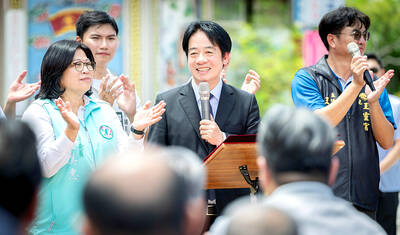
SIX SUBSIDIES: The monthly allowance for older farmers is to increase to NT$10,000, and NT$5,000 is to be given to homemakers under the national pension system, Lai said The government is to implement major welfare policies for disadvantaged groups, including raising the monthly allowance for older farmers to NT$10,000 and providing homemakers with NT$5,000 per month, President William Lai (賴清德) said yesterday. Lai made the remarks during a visit to Wangling Temple in Chiayi County, saying that the planned increases were being introduced amid economic growth and an increase in tax revenue. Touting a policy, in which the government plans to provide a monthly allowance of NT$5,000 for every child under the age of 18 in a bid to address Taiwan’s low birthrate, Lai said that if received for the


 RSS
RSS