


A juvenile eastern grass owl was spotted around Pingtung County’s Linbian River (林邊溪) last month, which was the southernmost sighting of the critically endangered species nesting in Taiwan, according to the Forestry and Nature Conservation Agency’s Pingtung branch.
The branch sent a team led by Hong Shiao-yu (洪孝宇), assistant professor of the Graduated Institute of Wildlife Conservation at National Pingtung University of Science and Technology, to conduct eastern grass owl conservation projects in Kaohsiung and Pingtung County.
The team observed an atypical reproduction case where a juvenile female eastern grass owl with tawny feathers nested at an overgrown area near the river and successfully reared two fledglings, the branch said.
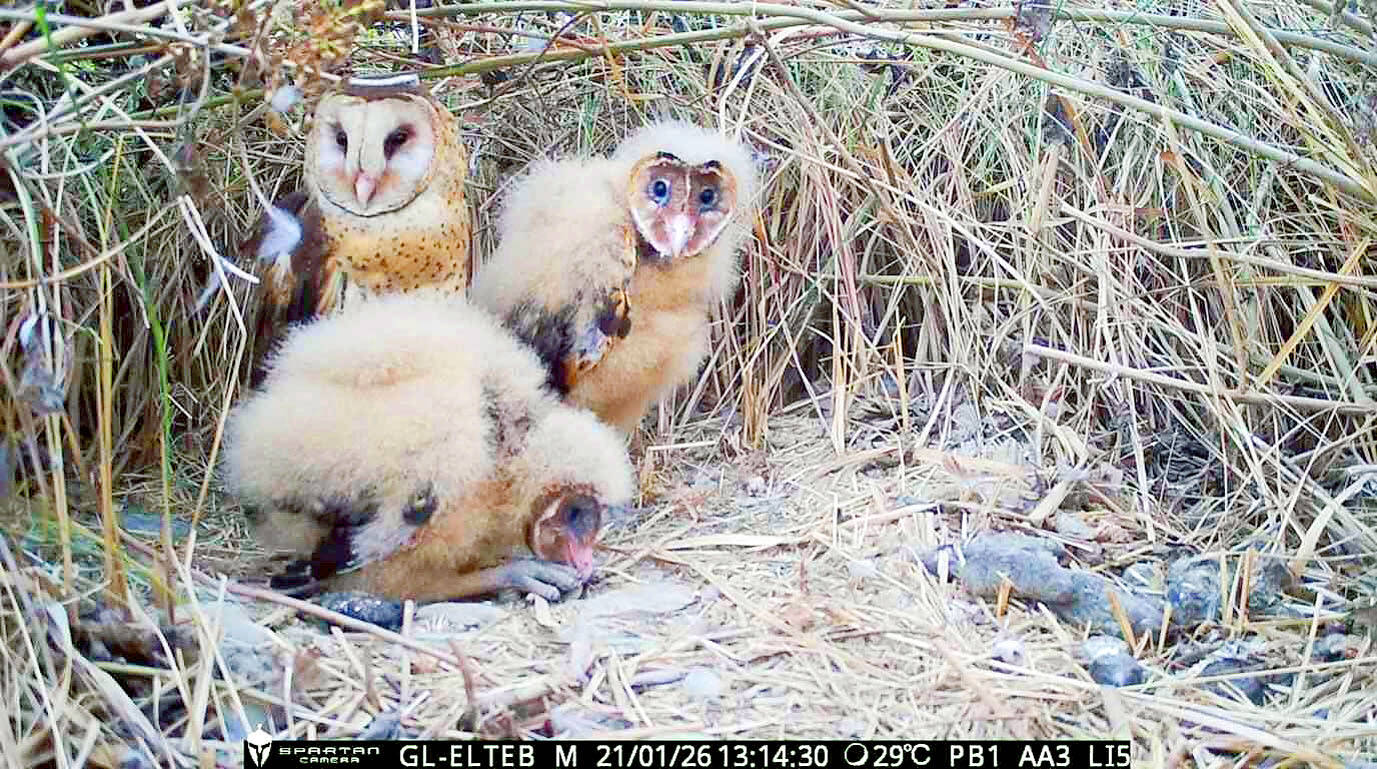
Photo courtesy of the Forestry and Nature Conservation Agency’s Pingtung branch
The finding marked the southernmost sighting of eastern grass owls nesting in Taiwan and demonstrated the species’ adaptability for habitat choice and life cycle, it said.
The eastern grass owl, known as the “monkey-faced owl,” is the only owl species that nests in grassland in Taiwan, the branch said.
While eastern grass owl nests typically concentrate near the
Gaoping River (高屏溪) basin, the nest spotted around the Linbian River was an unusual habitat choice, as the area was dominated by Siam weed — an alien plant species — instead of the often-preferred white cogon grass, it said.
The juvenile owl built a nest within one of the cogon grass bushes among the Siam weed-
dominated area, the branch said, adding that it reflected an expansion in the distribution of eastern grass owls in Taiwan.
It might have chosen that location because typical habitats around the Gaoping River are limited, it said, citing data showing that most cogon grass-dominated areas around the river were already occupied by adult owls.
Young owls who have fledged would be banished out of their parent owls’ territory, but they are forced to stay in environments with less-preferable conditions due to habitat saturation, possibly leading to a decrease in fledgling survival rates, the branch said.
There were only two fledglings living in the atypical nest spotted around the Linbian River, although typical eastern grass owl nests generally have three to five fledglings, indicating that it was not an ideal habitat, it added.
The research team has set up 4G auto-tracking cameras around the nest to remotely monitor and video the fledglings’ growing process, the branch said.
The fledglings underwent health check-ups and tagging when they reached a month old, it said.
Tagging the fledglings with a leg ring is like an “identification card” so the team can track their survival status after they leave the nest and identify new eastern grass owl populations, the branch said.
The branch has been creating cogon grass habitats for eastern grass owls to nest since 2022 and would extend the effort to more areas aside from the county’s northern region, it said.
The finding shows the significance of the National Ecological Network, as plain overgrown areas proved to be critical habitats for endangered wildlife as well, the branch said.
The branch is including Sinpi (新埤) and Fangliao (枋寮) townships as regions qualified for ecosystem service payments for endangered species, it said, reflecting the owls’ preference for suburban hills and farmland for survival.
Agricultural workers who refrain from using vermicides and herbicides and feed free-roaming animals can earn up to NT$20,000 for every hectare of their fields every year for their help with eastern grass owl conservation, the branch said.
Those who collaborate with the branch on installing raptor perches around their fields can earn extra bonuses, it said, adding eastern grass owls could “volunteer to stand guard” at such perches, protecting crops by catching rats in the fields.

FUKUOKA SITUATION: Japanese media reported that the pathogen is expected to be identified by the summer, while the CDC downplayed the idea that it was hMPV A “mysterious cold-like illness” reported in Japan’s Fukuoka Prefecture does not seem to be a new disease, but Japanese authorities have been asked about the situation, the Centers for Disease Control (CDC) said yesterday. The Fukuoka Prefectural Medical Association on Wednesday told a news conference that a “mystery cold” that has become a hot topic on social media is “highly likely to be caused by some kind of viral infection,” Japan’s KBC News reported. “Many people are experiencing symptoms starting with a sore throat, followed by a runny nose, phlegm and a severe cough,” KBC News reported, citing association officials. Health authorities are

Nvidia Corp CEO Jensen Huang (黃仁勳) arrived in Taiwan yesterday ahead of upcoming AI and technology events, saying he plans to meet with clients and Taiwan Semiconductor Manufacturing Co Chairman C.C. Wei (魏哲家) during his visit. After landing at Taipei Songshan Airport, Huang posed for photos with fans and handed out Yakult drinks to reporters and supporters waiting at the scene, saying he has “a lot to do” during the trip. Asked about reports that Nvidia’s planned headquarters site in Taipei’s Beitou Shilin Technology Park could break ground on May 27, Huang said that if the company holds an event, he would

The Ministry of Finance this afternoon announced the winning numbers for the March-April uniform invoice lottery. The winning number for the NT$10 million (US$318,060) special prize is 19531471, and the winning number for the NT$2 million grand prize is 85941329. Three numbers were drawn for the NT$200,000 first prize: 07225810, 20231230 and 83518781. Those with receipts matching the last seven digits of any of the first-prize numbers will win the NT$40,000 second prize, while those matching the last six digits will win the NT$10,000 third prize. Those whose receipts match the last five digits of the first-prize numbers can claim the NT$4,000 fourth prize,

SIX SUBSIDIES: The monthly allowance for older farmers is to increase to NT$10,000, and NT$5,000 is to be given to homemakers under the national pension system, Lai said The government is to implement major welfare policies for disadvantaged groups, including raising the monthly allowance for older farmers to NT$10,000 and providing homemakers with NT$5,000 per month, President William Lai (賴清德) said yesterday. Lai made the remarks during a visit to Wangling Temple in Chiayi County, saying that the planned increases were being introduced amid economic growth and an increase in tax revenue. Touting a policy, in which the government plans to provide a monthly allowance of NT$5,000 for every child under the age of 18 in a bid to address Taiwan’s low birthrate, Lai said that if received for the


 RSS
RSS