


Taiwan last year reported 3,656 sexual harassment complaints, up 45 percent from 2023, the Ministry of Health and Welfare said yesterday as officials recommendations to protect women in public spaces.
Ministry officials said that 92 percent of alleged victims were women and 60 percent were 30 years of age or younger, with 57 percent of reported incidents taking place in public.
Deputy Minister of Health and Welfare Lu Chien-te (呂建德) said that 2,396 of the reports resulted in a formal investigation and that the most prominent type of harassment was groping, at 37 percent.
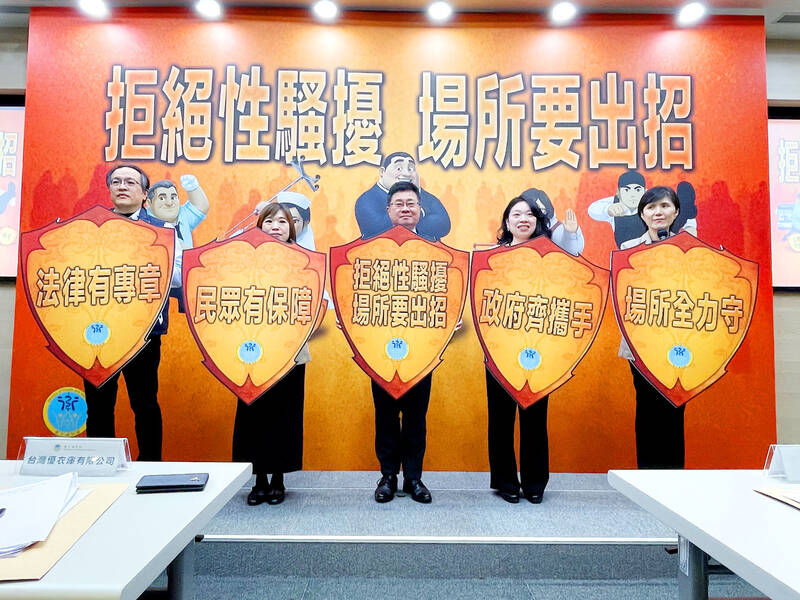
Photo: Lo Pi, Taipei Times
The latter figure represented a drop from 44 percent for that type of harassment reported in the 2023 study, while verbal harassment went up to 22 percent from the previous 14 percent, he said.
The changes in the data suggest that Taiwanese are becoming aware of what constitutes disrespectful sexual language as a form of harassment and are willing to report such incidents to the authorities, Lu said.
The 2023 amendments to the Sexual Harassment Prevention Act (性騷擾防治法) simplified the process for filing a complaint and made managers of public venues responsible for implementing measures to prevent the offense, he said.
Department of Protective Services Director Kuo Tsai-jung (郭彩榕) said the prevalence of reported sexual harassment in public spaces showed that people in charge of these spaces need to do better.
The ministry has published various guidelines to provide guidance to metro transit service providers and private companies to enact prevention strategies, respond to sexual harassment complaints, and cooperate with law enforcement, officials said.
In 2024, the ministry subsidized local governments to employ 65 sexual harassment prevention specialists, who raised the incident clearance rate to 96.26 percent within four months of the original complaint’s filing across the nation, they said.
Taiwanese judicial authorities imposed penalties in 1,527 sexual harassment cases, doubling the conviction rate when compared with 2023, officials said.
Wang Li-qian (王儷倩), senior manager at the legal department of Uniqlo Taiwan, who was invited to speak at the event, said her company’s anti-harassment policies revolve around prevention and post-incident operating procedures.
Corporate policy should include mandatory sexual harassment prevention training and regular tests, as well as specialized training for managers and investigators, she said.
Employees should be taught the C.A.R.E. model, which stands for confronting the situation, alerting others, redirecting attention, and engaging the authorities afterward, Wang said.
In addition, clerks and managers must know when to call police and the importance of preserving evidence should the authorities later decide to launch an investigation, she said.
Patrolling the premises of a large venue at regular and randomized intervals and ensuring all spaces are well-lit and have good camera courage are important to safety, said Tsao Chun-wen (曹俊文), deputy head of station operations at Taipei Rapid Transit Corp.
High-resolution surveillance cameras, intercoms, emergency buttons in restrooms, and artificial intelligence customer service agents capable of responding to anonymous texts and alerting human supervisors are useful technological safety devices, he said.
Elsewhere, the Taoyuan Flight Attendants Union yesterday called on the government to protect flight attendants from sexual harassment in Taiwan-owned aircraft flying in foreign countries.
In 2022, a Dutch pilot harassed a Taiwanese flight attendant, but local courts declined to impose penalties, stating that it had no jurisdiction over acts happening on a Taiwanese aircraft, the union said.
When asked about it, Kuo acknowledged that transnational incidents could complicate law enforcement efforts, as the Administrative Penalty Act (行政罰法) seemingly limits its applicability to Taiwanese soil.
However, this interpretation of the law is likely incorrect, as airplanes and ships operated by Taiwanese entities are part of the nation’s sovereign territory and therefore subject to its laws, she said.
The Ministry of Health and Welfare has initiated discussions with the Ministry of Labor to consolidate a common understanding of the law to protect the rights of airline employees, she said.

FUKUOKA SITUATION: Japanese media reported that the pathogen is expected to be identified by the summer, while the CDC downplayed the idea that it was hMPV A “mysterious cold-like illness” reported in Japan’s Fukuoka Prefecture does not seem to be a new disease, but Japanese authorities have been asked about the situation, the Centers for Disease Control (CDC) said yesterday. The Fukuoka Prefectural Medical Association on Wednesday told a news conference that a “mystery cold” that has become a hot topic on social media is “highly likely to be caused by some kind of viral infection,” Japan’s KBC News reported. “Many people are experiencing symptoms starting with a sore throat, followed by a runny nose, phlegm and a severe cough,” KBC News reported, citing association officials. Health authorities are

Nvidia Corp CEO Jensen Huang (黃仁勳) arrived in Taiwan yesterday ahead of upcoming AI and technology events, saying he plans to meet with clients and Taiwan Semiconductor Manufacturing Co Chairman C.C. Wei (魏哲家) during his visit. After landing at Taipei Songshan Airport, Huang posed for photos with fans and handed out Yakult drinks to reporters and supporters waiting at the scene, saying he has “a lot to do” during the trip. Asked about reports that Nvidia’s planned headquarters site in Taipei’s Beitou Shilin Technology Park could break ground on May 27, Huang said that if the company holds an event, he would

The Ministry of Finance this afternoon announced the winning numbers for the March-April uniform invoice lottery. The winning number for the NT$10 million (US$318,060) special prize is 19531471, and the winning number for the NT$2 million grand prize is 85941329. Three numbers were drawn for the NT$200,000 first prize: 07225810, 20231230 and 83518781. Those with receipts matching the last seven digits of any of the first-prize numbers will win the NT$40,000 second prize, while those matching the last six digits will win the NT$10,000 third prize. Those whose receipts match the last five digits of the first-prize numbers can claim the NT$4,000 fourth prize,

SIX SUBSIDIES: The monthly allowance for older farmers is to increase to NT$10,000, and NT$5,000 is to be given to homemakers under the national pension system, Lai said The government is to implement major welfare policies for disadvantaged groups, including raising the monthly allowance for older farmers to NT$10,000 and providing homemakers with NT$5,000 per month, President William Lai (賴清德) said yesterday. Lai made the remarks during a visit to Wangling Temple in Chiayi County, saying that the planned increases were being introduced amid economic growth and an increase in tax revenue. Touting a policy, in which the government plans to provide a monthly allowance of NT$5,000 for every child under the age of 18 in a bid to address Taiwan’s low birthrate, Lai said that if received for the


 RSS
RSS