


The Cabinet yesterday said that Premier Cho Jung-tai (卓榮泰) would not countersign three legal amendments passed this year by the opposition-controlled legislature, citing what he claimed were flaws in their constitutionality.
The amendments, passed with the support of the Chinese Nationalist Party (KMT) and the Taiwan People's Party (TPP), were made in January to the Act Governing the Settlement of Ill-gotten Properties by Political Parties and Their Affiliate Organizations (政黨及其附隨組織不當取得財產處理條例), the Satellite Broadcasting Act (衛星廣播電視法) and the Organic Law of the Legislative Yuan (立法院組織法).
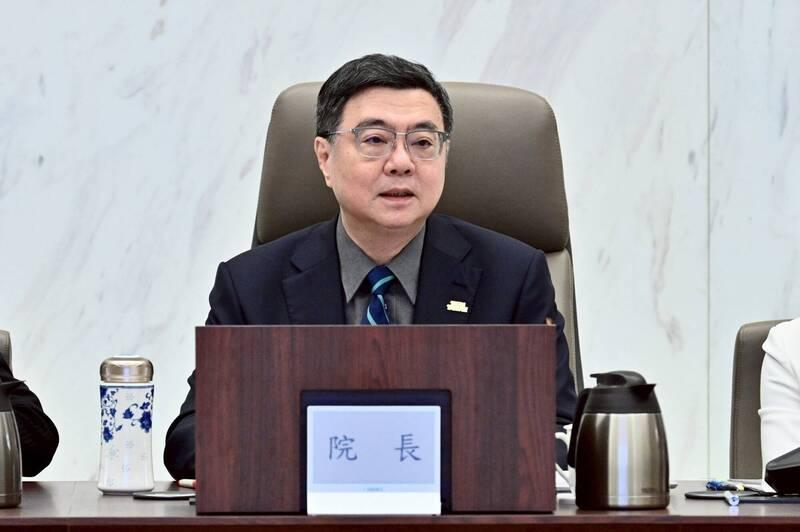
Photo courtesy of the Executive Yuan
Based on the Cabinet's interpretation, Cho's refusal to countersign the laws effectively means the revisions would not be enacted.
The revision to the ill-gotten properties act seeks to reverse a 2022 designation of the China Youth Corps as a KMT affiliate during Taiwan's authoritarian era, contravening a 2023 constitutional interpretation, Cabinet spokesperson Michelle Lee (李慧芝) said in a statement on Wednesday.
The amendment to the Satellite Broadcasting Act allows channels to continue broadcasting in their original slots during administrative lawsuits and requires authorities to provide remedies if a channel has been reassigned.
The amendment is "case specific" and therefore represents an "unreasonable differential treatment" that is "unfair" for other TV news channels, Lee said.
The changes have been dubbed the "CTi TV clause" by critics who say they could pave the way for CTi News to regain its license after it was taken off the air in December 2020, when its license was not renewed by the National Communications Commission (NCC).
The broadcasting regulator rejected CTi News' license renewal application, citing "repeated rule violations" and "a failure of its internal discipline and control mechanisms."
CTi TV, a company under the Want Want Group, later entered into an administrative lawsuit with the NCC.
The proceedings are still ongoing.
The amendment to the Organic Law of the Legislative Yuan, reclassified public funds previously earmarked as salary payments to lawmakers' aides as "subsidies" to lawmakers, and set the amount at five times a lawmaker's annual remuneration.
The amendment would create a loophole that could encourage lawmakers to pocket their aides' salaries, Lee said.
It would also increase the financial burden on the central government without identifying funding to offset the expected rise in expenditure, Lee said, claiming this was unconstitutional.
Cho's decision drew strong criticism from the KMT, which in a statement accused the premier of trampling on the separation of powers and usurping the power of the courts to determine whether a law is constitutional.
In its statement, the TPP caucus targeted President William Lai (賴清德), who it said bears the ultimate responsibility for his administration's "contempt for the law."
This is not the first time Cho has declined to countersign a bill passed by the legislature over what he claims to be constitutional concerns.
In December, Cho declined to sign a legal amendment pushed through by the opposition parties that would increase the share of tax revenues allocated for local governments.
That was the first time a premier had ever refused to countersign a law passed by the legislature in the history of the Republic of China.
Last month, he also declined to countersign an opposition-backed amendment that directed the relocation of 50 households in a veteran village in Taipei to a Ministry of National Defense housing project.
There is also an instance in which — although Cho and Lai signed bills into law — the government still refused to implement them.
The Cabinet has also failed to earmark funds for pension increases for police officers and firefighters, as well as salary raises for active-duty military personnel, as required by legislation passed by the legislature in the central government's general budget proposal for this year, even though the legislation had been promulgated.

FUKUOKA SITUATION: Japanese media reported that the pathogen is expected to be identified by the summer, while the CDC downplayed the idea that it was hMPV A “mysterious cold-like illness” reported in Japan’s Fukuoka Prefecture does not seem to be a new disease, but Japanese authorities have been asked about the situation, the Centers for Disease Control (CDC) said yesterday. The Fukuoka Prefectural Medical Association on Wednesday told a news conference that a “mystery cold” that has become a hot topic on social media is “highly likely to be caused by some kind of viral infection,” Japan’s KBC News reported. “Many people are experiencing symptoms starting with a sore throat, followed by a runny nose, phlegm and a severe cough,” KBC News reported, citing association officials. Health authorities are

Nvidia Corp CEO Jensen Huang (黃仁勳) arrived in Taiwan yesterday ahead of upcoming AI and technology events, saying he plans to meet with clients and Taiwan Semiconductor Manufacturing Co Chairman C.C. Wei (魏哲家) during his visit. After landing at Taipei Songshan Airport, Huang posed for photos with fans and handed out Yakult drinks to reporters and supporters waiting at the scene, saying he has “a lot to do” during the trip. Asked about reports that Nvidia’s planned headquarters site in Taipei’s Beitou Shilin Technology Park could break ground on May 27, Huang said that if the company holds an event, he would

The Ministry of Finance this afternoon announced the winning numbers for the March-April uniform invoice lottery. The winning number for the NT$10 million (US$318,060) special prize is 19531471, and the winning number for the NT$2 million grand prize is 85941329. Three numbers were drawn for the NT$200,000 first prize: 07225810, 20231230 and 83518781. Those with receipts matching the last seven digits of any of the first-prize numbers will win the NT$40,000 second prize, while those matching the last six digits will win the NT$10,000 third prize. Those whose receipts match the last five digits of the first-prize numbers can claim the NT$4,000 fourth prize,
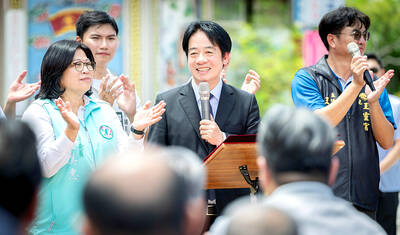
SIX SUBSIDIES: The monthly allowance for older farmers is to increase to NT$10,000, and NT$5,000 is to be given to homemakers under the national pension system, Lai said The government is to implement major welfare policies for disadvantaged groups, including raising the monthly allowance for older farmers to NT$10,000 and providing homemakers with NT$5,000 per month, President William Lai (賴清德) said yesterday. Lai made the remarks during a visit to Wangling Temple in Chiayi County, saying that the planned increases were being introduced amid economic growth and an increase in tax revenue. Touting a policy, in which the government plans to provide a monthly allowance of NT$5,000 for every child under the age of 18 in a bid to address Taiwan’s low birthrate, Lai said that if received for the


 RSS
RSS