


Health officials yesterday announced new dietary guidelines that puts emphasis on eating more fruits and vegetables, as well as a plan to introduce a color code on food packaging to show its sugar and salt content.
The new Daily Dietary Guidelines, which would be implemented next month at the earliest, focuses on the consumption of whole foods, recommending that people increase their daily vegetable consumption from the previous three to five servings, to three to eight servings, the Health Promotion Administration (HPA) said on Tuesday.
One serving is equivalent to about half a rice bowl or covering about 15cm of a plate.
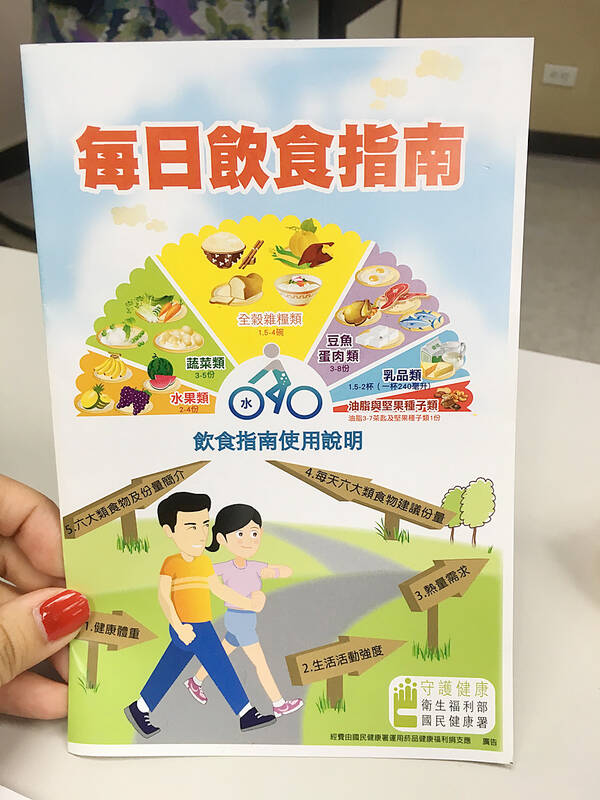
Photo: Lin Yen-tung, Taipei Times
It also recommend eating more fruits, raising daily consumption from two to four servings, to two to six servings.
The guidelines formally included a “water section” for the first time, the HPA said, adding that water is indispensable in maintaining health, body functions and regular metabolism.
The daily intake of milk and dairy products was adjusted from two servings per day to one serving, HPA Director-General Shen Ching-fen (沈靜芬) said.
The new guidelines also advise choosing more high-calcium food, Shen added.
The aim is to encourage people to eat a balanced diet with sufficient daily calcium intake through diverse food sources — such as tofu, black sesame, dried small fish and deep green vegetables — and enough vitamin D to enable higher absorption, she said.
The new version is expected to take effect next month, Shen said, adding that the HPA would ask for the public’s and other sectors’ input and suggestions, and nutrition experts would convene meetings to evaluate the guidelines.
It would also include updated “dietary reference intakes,” increasing the recommendation from 2,700kcal per day to 3,500kcal, after taking into account the dietary patterns of Taiwanese and the varying energy needs of different groups.
The revision is in line with latest international data and national nutrition health survey results, and establishes recommended energy needs and water intake levels for all age groups, Shen said.
The guidelines recommend a daily water intake of 2,400ml for men aged 19 and older, and 2,000ml for women, to maintain good health.
HPA officials said the actual daily liquid requirements should be adjusted based on the person’s body type, activity level, daily weather conditions and health status.
The adjustment on milk and dairy products consumption does not aim to encourage the public to reduce consuming such items, HPA officials said.
As Taiwanese typically consume about 0.5 cups of dairy product daily, and taking into consideration the fact that greenhouse gases produced by dairy production are higher than those from plant-based foods, the new version modified consumption to one serving per day, they added.
The recommended servings for legumes, beans, fish, eggs and meat have also been increased from three to eight servings, to three to 13 servings, the HPA said, adding that those for nuts and seeds were also increased from one serving, to one to two servings.
These changes are based on the energy requirements of different age groups, officials said, adding that they were flexible and do not intend to encourage excessive intake.
The HPA said they would continue to use visual guides and educational tools to help the public make correct choices and choose combinations based on their personal needs.
The new guidelines reference international dietary recommendations, but are still primarily based on Taiwan’s National Nutrition and Health Survey data, as well as local study results, it said.
A mechanism for regular review and revision every five years has been established since 2021, the HPA added.
The HPA said it also plans to introduce a “color code” — green, yellow and red — for food packages, to indicate items’ sugar and salt content.
It aims to help consumers make healthy choices, it said, adding that the initiative has received endorsement at meetings of nutrition and health experts.
As some people find it difficult to check salt and sugar content, color codes would be placed on the front of food packaging, in which items with high sugar and salt would be marked red, and low sugar and salt foods would have the color green, the HPA said.
As experts have reached a preliminary consensus on this plan, the Food and Drug Administration would follow up on communication and feedback with food companies, it added.

FUKUOKA SITUATION: Japanese media reported that the pathogen is expected to be identified by the summer, while the CDC downplayed the idea that it was hMPV A “mysterious cold-like illness” reported in Japan’s Fukuoka Prefecture does not seem to be a new disease, but Japanese authorities have been asked about the situation, the Centers for Disease Control (CDC) said yesterday. The Fukuoka Prefectural Medical Association on Wednesday told a news conference that a “mystery cold” that has become a hot topic on social media is “highly likely to be caused by some kind of viral infection,” Japan’s KBC News reported. “Many people are experiencing symptoms starting with a sore throat, followed by a runny nose, phlegm and a severe cough,” KBC News reported, citing association officials. Health authorities are

Nvidia Corp CEO Jensen Huang (黃仁勳) arrived in Taiwan yesterday ahead of upcoming AI and technology events, saying he plans to meet with clients and Taiwan Semiconductor Manufacturing Co Chairman C.C. Wei (魏哲家) during his visit. After landing at Taipei Songshan Airport, Huang posed for photos with fans and handed out Yakult drinks to reporters and supporters waiting at the scene, saying he has “a lot to do” during the trip. Asked about reports that Nvidia’s planned headquarters site in Taipei’s Beitou Shilin Technology Park could break ground on May 27, Huang said that if the company holds an event, he would

The Ministry of Finance this afternoon announced the winning numbers for the March-April uniform invoice lottery. The winning number for the NT$10 million (US$318,060) special prize is 19531471, and the winning number for the NT$2 million grand prize is 85941329. Three numbers were drawn for the NT$200,000 first prize: 07225810, 20231230 and 83518781. Those with receipts matching the last seven digits of any of the first-prize numbers will win the NT$40,000 second prize, while those matching the last six digits will win the NT$10,000 third prize. Those whose receipts match the last five digits of the first-prize numbers can claim the NT$4,000 fourth prize,

SIX SUBSIDIES: The monthly allowance for older farmers is to increase to NT$10,000, and NT$5,000 is to be given to homemakers under the national pension system, Lai said The government is to implement major welfare policies for disadvantaged groups, including raising the monthly allowance for older farmers to NT$10,000 and providing homemakers with NT$5,000 per month, President William Lai (賴清德) said yesterday. Lai made the remarks during a visit to Wangling Temple in Chiayi County, saying that the planned increases were being introduced amid economic growth and an increase in tax revenue. Touting a policy, in which the government plans to provide a monthly allowance of NT$5,000 for every child under the age of 18 in a bid to address Taiwan’s low birthrate, Lai said that if received for the


 RSS
RSS