


The Mainland Affairs Council (MAC) said it would submit evidence to the Central Election Commission (CEC) proving that Taiwan People’s Party Legislator Li Zhenxiu (李貞秀) was not qualified to register as a candidate, which would then determine whether it should file a lawsuit to invalidate her qualification.
“We were surprised to hear that Li said she did not submit the certificate renouncing her Chinese household registration until March last year,” MAC Minister Chiu Chui-cheng (邱垂正) said in an interview with the Chinese-language Liberty Times (sister paper of the Taipei Times) that was published yesterday.
Article 21 of the Act Governing Relations Between the People of the Taiwan Area and the Mainland Area (臺灣地區與大陸地區人民關係條例) stipulates that Chinese nationals can run for or hold public offices in Taiwan after having a registered household in Taiwan for 10 years.
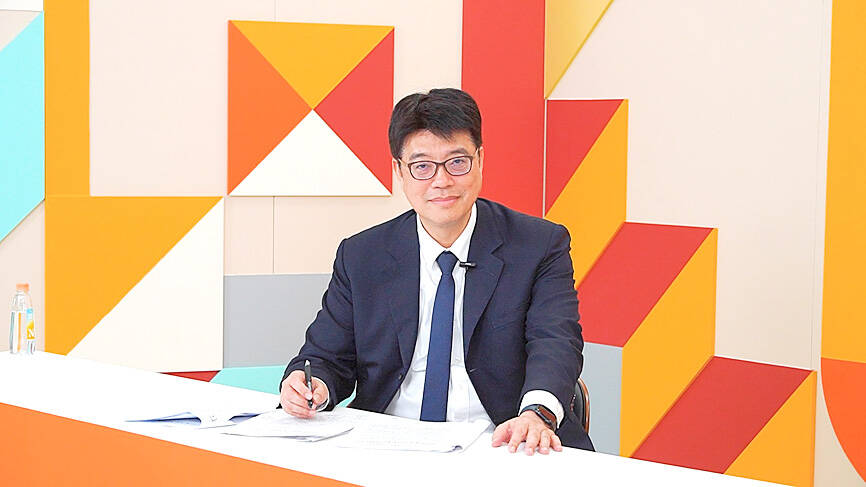
Photo: Chen Yu-jui, Taipei Times
An amendment to Article 9 of the act, which was passed in 2004, states that Taiwanese must not have a Chinese passport or household registration, or they would lose their Taiwanese citizenship.
Having only submitted proof of renouncing her Chinese household registration in March last year, Li has been a naturalized citizen for less than one year, Chiu said.
The National Immigration Agency does not have records of Li renouncing her Chinese household registration before March last year, he added.
“We do not think that she is qualified to register or run for elections based on the act. We will relay these facts to the CEC and hope that it would strictly enforce election laws,” Chiu said.
All Chinese spouses in Taiwan are required to renounce their Chinese household registration and submit proof within three months after obtaining a Taiwanese ID card, Chiu said, adding that the naturalization process would not be complete without these procedures.
Controversy surrounding Li’s qualifications have triggered doubts in other people about their own nationality status, the council said.
MAC Deputy Minister Liang Wen-chieh (梁文傑) said people in similar situations — as well as those who were born in China, who were born from marriages of Taiwanese and Chinese or who grew up in China before returning to Taiwan — are strongly advised to confirm with their parents or relatives whether they are registered Chinese citizens.
“We urge these people to ascertain their status with their parents, or issues may arise when they seek employment in the government,” Liang said.
Chiu said the council is monitoring the Chinese National People’s Congress and Chinese People’s Political Consultative Conference, which opened this week.
Aside from addresses given by Chinese President Xi Jinping (習近平) and Chinese People’s Political Consultative Conference Chairman Wang Huning (王滬寧), the council would also closely watch whether the Chinese Communist Party (CCP) presents new policies to facilitate cross-strait integration, Chiu said.
“The CCP is scheduled to review a draft act on the promotion of ethnic unity and progress during the two important political gatherings, which, if passed, would provide another legal basis for holding those whom they perceive as damaging ethnic unity and creating divisions, accountable. As this could affect Taiwanese, we will study the act and introduce countermeasures,” Chiu said.
Liang said that the council has conducted a preliminary review of the bill, which appears to be more of a declaration of moral values than an enforceable law.
“Overall, the act’s terms are vaguely defined, giving the Chinese government broad discretion to determine whether certain behaviors or statements are lawful,” Liang said.

FUKUOKA SITUATION: Japanese media reported that the pathogen is expected to be identified by the summer, while the CDC downplayed the idea that it was hMPV A “mysterious cold-like illness” reported in Japan’s Fukuoka Prefecture does not seem to be a new disease, but Japanese authorities have been asked about the situation, the Centers for Disease Control (CDC) said yesterday. The Fukuoka Prefectural Medical Association on Wednesday told a news conference that a “mystery cold” that has become a hot topic on social media is “highly likely to be caused by some kind of viral infection,” Japan’s KBC News reported. “Many people are experiencing symptoms starting with a sore throat, followed by a runny nose, phlegm and a severe cough,” KBC News reported, citing association officials. Health authorities are

Nvidia Corp CEO Jensen Huang (黃仁勳) arrived in Taiwan yesterday ahead of upcoming AI and technology events, saying he plans to meet with clients and Taiwan Semiconductor Manufacturing Co Chairman C.C. Wei (魏哲家) during his visit. After landing at Taipei Songshan Airport, Huang posed for photos with fans and handed out Yakult drinks to reporters and supporters waiting at the scene, saying he has “a lot to do” during the trip. Asked about reports that Nvidia’s planned headquarters site in Taipei’s Beitou Shilin Technology Park could break ground on May 27, Huang said that if the company holds an event, he would

The Ministry of Finance this afternoon announced the winning numbers for the March-April uniform invoice lottery. The winning number for the NT$10 million (US$318,060) special prize is 19531471, and the winning number for the NT$2 million grand prize is 85941329. Three numbers were drawn for the NT$200,000 first prize: 07225810, 20231230 and 83518781. Those with receipts matching the last seven digits of any of the first-prize numbers will win the NT$40,000 second prize, while those matching the last six digits will win the NT$10,000 third prize. Those whose receipts match the last five digits of the first-prize numbers can claim the NT$4,000 fourth prize,

SIX SUBSIDIES: The monthly allowance for older farmers is to increase to NT$10,000, and NT$5,000 is to be given to homemakers under the national pension system, Lai said The government is to implement major welfare policies for disadvantaged groups, including raising the monthly allowance for older farmers to NT$10,000 and providing homemakers with NT$5,000 per month, President William Lai (賴清德) said yesterday. Lai made the remarks during a visit to Wangling Temple in Chiayi County, saying that the planned increases were being introduced amid economic growth and an increase in tax revenue. Touting a policy, in which the government plans to provide a monthly allowance of NT$5,000 for every child under the age of 18 in a bid to address Taiwan’s low birthrate, Lai said that if received for the


 RSS
RSS