


The legislature should approve a defense funding bill, former Chinese Nationalist Party (KMT) legislator Jason Hsu (許毓仁) told a US Senate security panel hearing on undersea cable security in Washington on Monday.
The US-China Economic and Security Review Commission on Monday held a hearing on US-China Competition Under the Sea, with Hsu speaking on a panel about undersea infrastructure and strategic resources.
Speaking as a former lawmaker, the Hudson Institute senior fellow said that the Legislative Yuan must pass the defense budget.
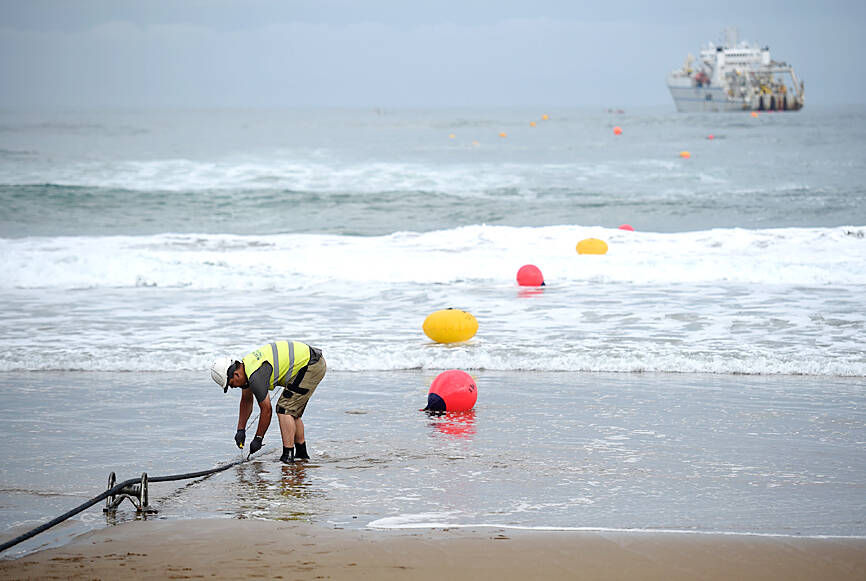
Photo: AFP
Taiwan’s national security “cannot be a partisan issue,” Hsu said.
President William Lai (賴清德) in November last year announced a NT$1.25 trillion (US$39.55 billion) special defense budget to be allocated over eight years, including arms purchases from the US.
After repeatedly blocking the bill, the opposition-controlled legislature on Friday last week agreed to allow the Executive Yuan’s proposal to proceed to committee review, alongside a NT$400 billion version drafted by the Taiwan People’s Party and a planned version from the KMT.
Taiwan’s political parties must stand in unity when facing national security threats, Hsu said.
“Only by strengthening our own resilience, demonstrating resolve and backing commitments with action can we ask the world to stand with us,” he said.
Hsu told the panel that if China invaded Taiwan tomorrow, it would only have to sever three undersea fiber-optic cable clusters to cause a data blackout.
In a Taiwan contingency, cable disruption would be one of the earliest preinvasion actions and the signal that escalation had begun, he said, adding that Taiwan’s cable repair capabilities are insufficient.
China has deliberately targeted Taiwan’s undersea cables as part of its expanding “gray zone” warfare toolkit, with a notable and alarming escalation since 2023, Hsu said.
It is one of the most urgent security challenges facing Taiwan and the broader Indo-Pacific region as a “gray zone” warfare tactic that is “calibrated, deniable and escalating,” he said.
Severing three cable clusters near the Bashi Channel could reduce Taiwan’s international bandwidth by up to 95 percent when combined with cyberoperations and satellite jamming, Hsu said.
Taiwan is connected to the global network through 24 undersea cables, 14 of which are international links to Japan, the Philippines, Singapore, South Korea and the US, he said.
Any disruption to undersea cables would cost Taiwan up to US$55 million per day, before considering the wider implications of interrupting semiconductor supply chains, he said.
It would “paralyze financial markets, disrupt semiconductor manufacturing, and sever critical military and government communications,” Hsu said.
In peacetime, average cable repair time exceeds 40 days, he said, adding that Taiwan has no indigenous cable repair ships.
In wartime, repairs would be “nearly impossible,” while satellite data links would be insufficient, he said.
Hsu recommended actions to the US Congress, including passing the Taiwan Undersea Cable Resilience Initiative Act, introduced in July last year, investing in cable repair capacity and increasing sanctions on vessels that cut cables.
Taiwan should also build domestic cable repair capacity, ideally with Japan, and the Coast Guard Administration should expand vessel watch lists and patrols near critical cable corridors, he said.
Established in 2000, the US-China Economic and Security Review Commission is a legislative branch commission of the US Congress assigned to monitor, investigate and report on the national security implications of the bilateral trade and economic relationship between the US and China.

FUKUOKA SITUATION: Japanese media reported that the pathogen is expected to be identified by the summer, while the CDC downplayed the idea that it was hMPV A “mysterious cold-like illness” reported in Japan’s Fukuoka Prefecture does not seem to be a new disease, but Japanese authorities have been asked about the situation, the Centers for Disease Control (CDC) said yesterday. The Fukuoka Prefectural Medical Association on Wednesday told a news conference that a “mystery cold” that has become a hot topic on social media is “highly likely to be caused by some kind of viral infection,” Japan’s KBC News reported. “Many people are experiencing symptoms starting with a sore throat, followed by a runny nose, phlegm and a severe cough,” KBC News reported, citing association officials. Health authorities are

Nvidia Corp CEO Jensen Huang (黃仁勳) arrived in Taiwan yesterday ahead of upcoming AI and technology events, saying he plans to meet with clients and Taiwan Semiconductor Manufacturing Co Chairman C.C. Wei (魏哲家) during his visit. After landing at Taipei Songshan Airport, Huang posed for photos with fans and handed out Yakult drinks to reporters and supporters waiting at the scene, saying he has “a lot to do” during the trip. Asked about reports that Nvidia’s planned headquarters site in Taipei’s Beitou Shilin Technology Park could break ground on May 27, Huang said that if the company holds an event, he would

The Ministry of Finance this afternoon announced the winning numbers for the March-April uniform invoice lottery. The winning number for the NT$10 million (US$318,060) special prize is 19531471, and the winning number for the NT$2 million grand prize is 85941329. Three numbers were drawn for the NT$200,000 first prize: 07225810, 20231230 and 83518781. Those with receipts matching the last seven digits of any of the first-prize numbers will win the NT$40,000 second prize, while those matching the last six digits will win the NT$10,000 third prize. Those whose receipts match the last five digits of the first-prize numbers can claim the NT$4,000 fourth prize,

SIX SUBSIDIES: The monthly allowance for older farmers is to increase to NT$10,000, and NT$5,000 is to be given to homemakers under the national pension system, Lai said The government is to implement major welfare policies for disadvantaged groups, including raising the monthly allowance for older farmers to NT$10,000 and providing homemakers with NT$5,000 per month, President William Lai (賴清德) said yesterday. Lai made the remarks during a visit to Wangling Temple in Chiayi County, saying that the planned increases were being introduced amid economic growth and an increase in tax revenue. Touting a policy, in which the government plans to provide a monthly allowance of NT$5,000 for every child under the age of 18 in a bid to address Taiwan’s low birthrate, Lai said that if received for the


 RSS
RSS