

A potential bill by the Chinese Nationalist Party (KMT) calling for the government to pay all children’s health insurance costs would harm policies to support disadvantaged families, medical experts said today, with the Ministry of Health and Welfare advising the party to reconsider.
The Chinese-language United Daily News reported that the KMT caucus plans to propose that the central government pay National Health Insurance (NHI) costs for all children aged up to six, meant to encourage people to have more children to boost the birthrate.
The NHI is a universal social insurance built on mutual support, the ministry said today.

Photo: Taipei Times
The government already subsidizes insurance premiums for low and middle-income households with children under 18, as well as people with disabilities and indigenous people who meet requirements, easing the financial burden of medical care for disadvantaged families, it said.
The government also subsidizes medical fees for children under three and disadvantaged children under 18, it added.
Children under three enrolled in NHI receive subsidies for inpatient and outpatient copayments, which totaled an average of NT$1.7 billion (US$52.9 million) annually from 2020 to 2024, benefiting an estimated 8.88 million patients annually, ministry data showed.
Subsidies for disadvantaged children under 18 cover hospitalization, nursing care fees, preventative evaluations and certain therapies, benefiting about 18,000 people, with subsidies totaling about NT$150 million annually, the ministry said.
The core of NHI is insurance and mutual-aid, with the wealthy helping the poor, Taiwan College of Healthcare Executives director Hung Tzu-jen (洪子仁) said.
According to regulations, children’s NHI costs vary according to their parents’ income, so families with more money would pay higher fees, Hung said.
If the government subsidizes NHI costs for all children up to age six, subsidies for wealthy families could end up being higher than those for other children, which goes against the NHI’s spirit of mutual support, he said.
In addition, subsidizing all children’s NHI costs could compromise the government’s ability to meet its mandated share of NHI funding, which would be “absolutely detrimental” to the program’s financial stability, Hung said.
There are many healthcare-related solutions to address the declining birthrate, including strengthening childbirth subsidies and creating more child-friendly environments, he added.
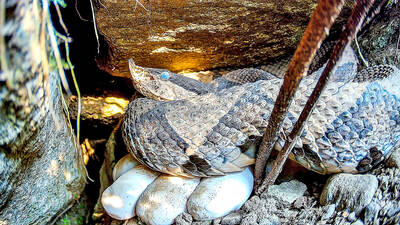
NATURE TAKES ITS COURSE: The agency’s head said he felt a sense of loss watching red-banded snakes eat the babies, as they had decided on non-intervention The Forestry and Nature Conservation Agency yesterday released a documentary on a hundred-pace viper that had incubated 16 eggs, all of which hatched, but only a baby viper escaped after they were attacked by red-banded snakes. The agency’s Taichung branch last year launched the viper reproduction monitoring project soon after forest rangers Lin Chun-yu (林俊佑) and Chou Chia-cheng (周家成) spotted a pregnant hundred-pace viper in a grass-covered burrow near a parking lot in Tbulan Village (松鶴部落). The Atayal village, in Taichung’s Heping District (和平), is headed by Ecyang Yapu, who was positive about the project and assisted in access control and power

The Coast Guard Administration (CGA) yesterday said that it had deployed vessels to “monitor” Chinese ships operating in waters off the east coast. The CGA said it dispatched vessels in response to a China Coast Guard announcement that it had carried out another “routine law-enforcement patrol” in waters off the east coast. “The CGA firmly rejects China’s cognitive warfare campaign of ‘law enforcement in name, jurisdictional expansion in practice,’” it said on X. As of 11am yesterday, two China Coast Guard ships were “loitering and drifting” about 105 nautical miles (195km) and 74 nautical miles east of Green Island (綠島) respectively, it said. It

A Straits Exchange Foundation official today warned that yielding to political pressure in exchange for access to China’s entertainment industry rarely ends well, amid rumors that China is seeking to lure Taiwanese K-pop star Chou Tzu-yu (周子瑜). Chou, more commonly known as Tzuyu, is the only Taiwanese member of the girl group Twice. Her contract with JYP Entertainment is set to expire at the end of this year, and there have been widespread reports that she would not renew it. She is reportedly planning to pursue solo activities under her parents’ agency, Yu Hai Entertainment (瑜海娛樂), although China has also reportedly offered
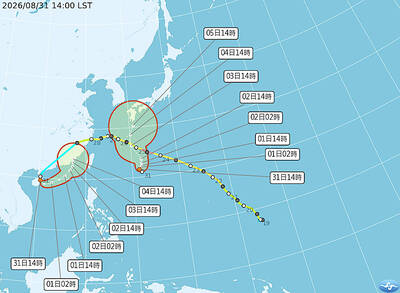
A tropical depression near Hainan that was once Typhoon Saudel may once again strengthen into a tropical storm, the Central Weather Administration (CWA) said yesterday, but a sea warning for waters around Taiwan is unlikely. CWA forecaster Huang En-hung (黃恩鴻) said that Saudel would return to being a weak tropical storm by late yesterday or early this morning. However, as the storm is to gradually weaken again and would head toward China’s Guangdong Province away from Taiwan, the chances that it would affect Taiwan enough for the CWA to issue a sea warning are relatively low,


 RSS
RSS