


The Ministry of Agriculture’s Tea and Beverage Research Station has developed an artificial intelligence (AI)-powered drip irrigation system that can save up to 24 percent of irrigation water and double the production of raw tea leaves during dry seasons.
Traditional irrigation techniques can no longer guarantee tea production quality amidst frequent floods and droughts caused by extreme weather, the station said.
While typhoons used to be the main natural disaster faced by tea plants from 1999 to 2019, droughts have become more common after 2011, it said.
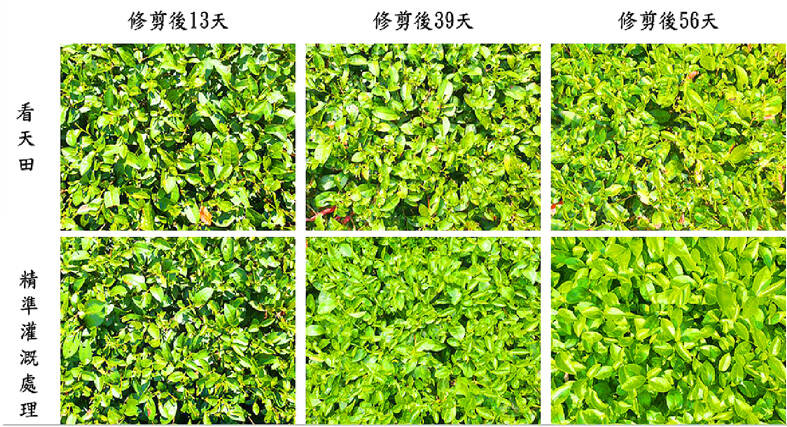
Photo courtesy of the Ministry of Agriculture’s Tea and Beverage Research Station
The drought from 2020 to 2021 was so severe that it led to reduced tea production nationwide and major agricultural financial losses, it added.
To address such issues, the station has been researching and developing precision irrigation methods to efficiently deploy limited water resources, and has introduced a smart decisionmaking system to maintain optimal water volume for tea plants, it said.
Station director Su Tsung-chen (蘇宗振) said tea plants are drought-tolerant, but would still wilt and die if not sufficiently irrigated or if daily rainfall is less than 20mm for 30 consecutive days.
The station has built 23 micro-weather stations nationwide to monitor tea plants’ growing environments, and sources weather data from the Central Weather Administration, he said.
It also used the concept of evapotranspiration to quantify and calculate the sum of water loss from soil evaporation and tea leaves’ transpiration, Su said.
Daily evapotranspiration values are like the “daily sweat amounts” of tea plants, which could be used by tea farmers as an indicator to precisely judge irrigation timing and water amounts, he said.
With this data, the station developed a smart drip irrigation system that incorporated Internet of Things sensors and AI, Su said.
The system provides a complete dynamic database of tea fields’ water content and is connected to a cloud platform that supports real-time decisionmaking, he said.
That means tea farmers can monitor soil moisture, tea plants’ water needs and weather forecasts through a mobile phone after they install the sensors and irrigation equipment in their fields, Su said.
The system can also generate customized irrigation advice based on tea plants’ varietal characteristics, terrain conditions, cultivation approaches and micro-weather data, he added.
Although rainfall is higher in during the summer, it tends to be concentrated in a few days, Su said, adding that such unstable rainfall might not be able to maintain the tea plants’ needed soil moisture.
The smart system helps farmers tell whether the rainfall would be enough to make up for the water loss from evapotranspiration and whether drip irrigation should be initiated, he said.
That is a technical breakthrough that allows tea farmers to shift from depending on the weather for their livelihoods to directly managing the plants’ water intake, Su said.
The station’s research showed that the system boosted the number of tea shoots by 1.6-fold and the production of raw tea leaves by 1.24-fold during summer last year, when rainfall was abundant.
Production further rose by 2.2-fold during the dry periods in autumn and winter, compared with tea fields without a smart irrigation system, it showed.
The system also saved about 13 percent and 24 percent of irrigation water in wet and dry seasons respectively last year, the research showed.
Although tea leaves grown with the system contained caffeine, total polyphenols and catechins slightly fell, and outperformed those grown with traditional irrigation techniques in terms of fragrance, flavor and sweet aftertaste, it showed.

FUKUOKA SITUATION: Japanese media reported that the pathogen is expected to be identified by the summer, while the CDC downplayed the idea that it was hMPV A “mysterious cold-like illness” reported in Japan’s Fukuoka Prefecture does not seem to be a new disease, but Japanese authorities have been asked about the situation, the Centers for Disease Control (CDC) said yesterday. The Fukuoka Prefectural Medical Association on Wednesday told a news conference that a “mystery cold” that has become a hot topic on social media is “highly likely to be caused by some kind of viral infection,” Japan’s KBC News reported. “Many people are experiencing symptoms starting with a sore throat, followed by a runny nose, phlegm and a severe cough,” KBC News reported, citing association officials. Health authorities are

Nvidia Corp CEO Jensen Huang (黃仁勳) arrived in Taiwan yesterday ahead of upcoming AI and technology events, saying he plans to meet with clients and Taiwan Semiconductor Manufacturing Co Chairman C.C. Wei (魏哲家) during his visit. After landing at Taipei Songshan Airport, Huang posed for photos with fans and handed out Yakult drinks to reporters and supporters waiting at the scene, saying he has “a lot to do” during the trip. Asked about reports that Nvidia’s planned headquarters site in Taipei’s Beitou Shilin Technology Park could break ground on May 27, Huang said that if the company holds an event, he would

Carrefour Taiwan is to begin using a new name from the start of July, but it cannot divulge the name until then, the chairman of the supermarket chain's parent company said today. President Chain Store Co chairman Lo Chih-hsien (羅智先) was asked by reporters after a shareholders' meeting to confirm whether the company has settled on a new name for the supermarket brand. In March, the government-registered name of two Carrefour Taiwan branches was quietly changed to "Le Chia Kang" (樂家康) in Chinese, raising speculation that has been selected as the name. Lo said that because of local regulations and contractual obligations, the

The Philippines would likely be involved in any conflict over Taiwan due to its proximity to the democracy claimed by China, President Ferdinand Marcos Jr said, reiterating a stance that risks angering Beijing. “In the Philippines, we do not have a choice because Taiwan is so close to the Philippines and we have almost 200,000 Filipino nationals living and working in Taiwan,” Marcos said in an interview with Japanese media in Manila on Monday. The Philippine leader’s comments come ahead of a state visit to Japan next week, where he is to meet with Japanese Prime Minister Sanae Takaichi to discuss security


 RSS
RSS