


There is no mistake in Japanese Prime Minister Sanae Takaichi’s remarks regarding a “Taiwan contingency,” former Japanese minister of economy, trade and industry Akira Amari said in an recent interview with the Chinese-language Liberty Times (the Taipei Times’ sister paper).
Amari was referring to a statement by Takaichi during a parliamentary session in November last year when she said China using armed force against Taiwan could constitute a “survival-threatening situation” for Japan, allowing the country to mobilize the Japanese armed forces under its security laws.
Amari said that on the Taiwan issue, the position of the Liberal Democratic Party administration has not changed and would not change.
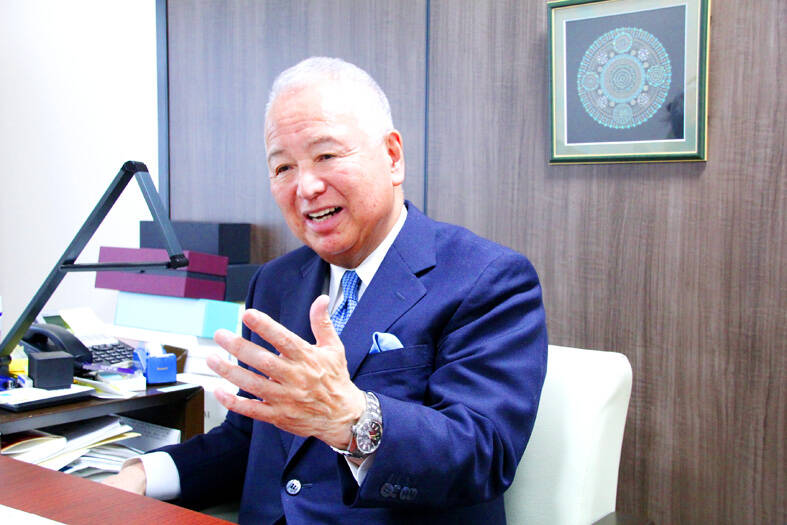
Photo: Chen Yu-fu, Taipei Times
However, if statements are made carelessly, they could instead cause difficulties for Taiwan or subject it to unnecessary tensions, he said, adding that it would be important to maintain a measured and appropriate tone in communication.
Amari added: “But I believe there is nothing wrong with Takaichi’s statement.”
The Taiwan-Japan relationship is one of the finest bilateral partnerships in the world and it is essential for Japan and Taiwan to work together to lead the world in maintaining global stability in the future, he said.
“Of course, staying at the global forefront means we cannot afford to relax for a single second in technology and research and development,” he said, “I remain convinced that it is vital for Japan and Taiwan to jointly uphold our leadership in the semiconductor field.”
Before Japan’s snap election last month, in which Takaichi led her party to a sweeping victory,
Taiwan Semiconductor Manufacturing Co (TSMC) chairman CC Wei (魏哲家) met with Takaichi in Japan and announced plans to make advanced 3-nanometer chips in Japan.
Amari said the future would be driven by semiconductors, as everything is powered by them, so if the world is divided into “those who can manufacture the most advanced chips” and “those who can only depend on supply by others,” Japan must stand on the same front as Taiwan and South Korea.
“For Japan, this is an industrial policy concerning national survival,” he added.
“Japan must be among those who supply semiconductors,” Amari said, adding that it is a long-held conviction of his that Japan must secure its position as a supplier at any cost or its survival would be threatened.
“This is precisely why the Taiwan-Japan partnership is so vital,” he said.
Leading Japan’s semiconductor policy with a focus on economic security strategy, Amari worked with TSMC as they stood up a subsidiary corporation in Japan. His contributions to the Taiwan-Japan industrial partnership were recognized by President William Lai (賴清德) last year who awarded Amari with the Professional Medal of the Ministry of Economic Affairs.
“Those who control semiconductors, control the world, “ Amari said.
Amari said Japan has the capacity to manufacture sensors, memory and power semiconductors, but lacks the ability to produce high-end logic semiconductors, a “missing piece of the puzzle” in Japan’s domestic production.
In Japan’s pursuit of a semiconductor revival, close-range access to world-class technology is essential, he said, adding that bringing the world’s foremost foundry to Japan provides stimulus and inspiration for Japan’s domestic industry.
The concentration of semiconductor manufacturing in Taiwan poses a global risk, because China has designs on Taiwan and any scenario where China gains control over Taiwan and TSMC would result in a total supply chain paralysis, he said.
“Establishing TSMC production sites outside of Taiwan can help deter Chinese aggression, while enhancing the stability of the global supply chain,” he said.
Regarding semiconductors, very few nations are capable of high-end manufacturing — essentially only Taiwan, Japan, the Netherlands and South Korea. If these countries fail to collaborate in leading technological development, the US might struggle to sustain the industry alone, Amari said.
The collaboration between Taiwan and Japan is deeply meaningful, as it not only provides stimulus for Japan’s industrial development but also contributes to the stability of global supply chains in the democratic world, he said.

FUKUOKA SITUATION: Japanese media reported that the pathogen is expected to be identified by the summer, while the CDC downplayed the idea that it was hMPV A “mysterious cold-like illness” reported in Japan’s Fukuoka Prefecture does not seem to be a new disease, but Japanese authorities have been asked about the situation, the Centers for Disease Control (CDC) said yesterday. The Fukuoka Prefectural Medical Association on Wednesday told a news conference that a “mystery cold” that has become a hot topic on social media is “highly likely to be caused by some kind of viral infection,” Japan’s KBC News reported. “Many people are experiencing symptoms starting with a sore throat, followed by a runny nose, phlegm and a severe cough,” KBC News reported, citing association officials. Health authorities are

Nvidia Corp CEO Jensen Huang (黃仁勳) arrived in Taiwan yesterday ahead of upcoming AI and technology events, saying he plans to meet with clients and Taiwan Semiconductor Manufacturing Co Chairman C.C. Wei (魏哲家) during his visit. After landing at Taipei Songshan Airport, Huang posed for photos with fans and handed out Yakult drinks to reporters and supporters waiting at the scene, saying he has “a lot to do” during the trip. Asked about reports that Nvidia’s planned headquarters site in Taipei’s Beitou Shilin Technology Park could break ground on May 27, Huang said that if the company holds an event, he would

The Ministry of Finance this afternoon announced the winning numbers for the March-April uniform invoice lottery. The winning number for the NT$10 million (US$318,060) special prize is 19531471, and the winning number for the NT$2 million grand prize is 85941329. Three numbers were drawn for the NT$200,000 first prize: 07225810, 20231230 and 83518781. Those with receipts matching the last seven digits of any of the first-prize numbers will win the NT$40,000 second prize, while those matching the last six digits will win the NT$10,000 third prize. Those whose receipts match the last five digits of the first-prize numbers can claim the NT$4,000 fourth prize,
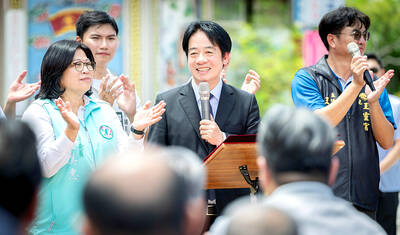
SIX SUBSIDIES: The monthly allowance for older farmers is to increase to NT$10,000, and NT$5,000 is to be given to homemakers under the national pension system, Lai said The government is to implement major welfare policies for disadvantaged groups, including raising the monthly allowance for older farmers to NT$10,000 and providing homemakers with NT$5,000 per month, President William Lai (賴清德) said yesterday. Lai made the remarks during a visit to Wangling Temple in Chiayi County, saying that the planned increases were being introduced amid economic growth and an increase in tax revenue. Touting a policy, in which the government plans to provide a monthly allowance of NT$5,000 for every child under the age of 18 in a bid to address Taiwan’s low birthrate, Lai said that if received for the


 RSS
RSS