


When Trinh Thi Anh first arrived in Yilan County from Vietnam at the age of 18, she found herself in a world of silence.
Moving to Taiwan to support her family after graduating high school, the factory worker realized that her lack of Mandarin was a wall between her and her new life.
“I truly couldn’t understand a single word,” she recalled. Whether she was shopping for groceries or working on the production line, communication was a game of charades.

Photo coutesy of Anh via CNA
She survived by saving photos of products on her phone to show clerks and often struggled with work instructions, leading to delays as she had to repeatedly confirm tasks.
Her breakthrough came from an unlikely source: Taiwanese television. A fan of actress Joe Chen (陳喬恩), she spent her evenings glued to the hit idol drama The Prince Who Turns Into a Frog (王子變青蛙).
By pairing the Mandarin dialogue with Vietnamese subtitles, her listening skills sharpened. “I just kept watching her shows and without realizing it, I improved,” she said.

Photo: CNA
After years of study, Anh gradually built up her language skills and decided to take the Test of Chinese as a Foreign Language (TOCFL).
“I wanted to prove my ability and give myself a clear goal,” she said.
The TOCFL is a proficiency test for non-native speakers of Chinese that categorizes language proficiency into four bands and eight levels.
Anh first sat the exam in early 2020 and obtained an A2 certificate, later earning a B2 certificate in 2023.
During more than 12 years in Taiwan, she not only learned Mandarin, but also gained a deep fondness for Taiwanese culture.
“I love night-market food, visiting temples and Taiwan’s queuing culture,” she said, noting that orderly lines are rare in Vietnam and that she finds them fascinating.
“People here are so polite,” she said. “They are always saying ‘excuse me’ and ‘thank you.’ It makes me feel warm.”
Now holding foreign technical worker status, Anh said she intends to continue her career development in Taiwan and continue to improve her Mandarin.
Anh’s journey reflects a growing trend among the nation’s foreign workforce. As Taiwan grapples with a chronic labor shortage, language proficiency has evolved from a convenience into a professional asset.
A Thai national going by the Chinese name Ko Chien-tai (柯建太) echoed this sentiment.
Ko said he moved to Taiwan after becoming interested in the local culture and lifestyle during a vacation, adding that life in Taiwan feels relaxed and less stressful and there is a strong sense of human warmth.
He said he came to Taiwan to study Mandarin after graduating college. Besides taking courses at a Mandarin training center and practicing tests, he regularly listens to songs, podcasts and news.
Despite starting from scratch, he passed the B2 reading test in less than a year. He said his goal is clear: to pursue a graduate degree in Mandarin and build a career in Taiwan.
For employers, the benefits are even clearer. According to labor brokers, employers see language ability as a big plus for migrant workers who wish to remain in Taiwan.
Chien Sheng-yuan (簡聖原), a supervisor at the Manpower Agencies Association, said that Mandarin is a “decisive factor” when companies decide whether to transition migrant workers into the foreign technical personnel category, which allows for longer stays and higher pay.
If several workers have similar technical skill sets, the one with better Mandarin would always be promoted first, a rubber manufacturer said, adding that efficiency in Mandarin is a competitive edge as it is needed for on-site instructions and management communication.
Karen Hsu (徐瑞希), chairperson of the Global Workers’ Organization, which has long offered Mandarin classes for migrant workers, said that many companies have invited the association to provide on-site Mandarin courses. Some even request advanced classes aligned with TOCFL preparation.
Under labor shortage pressures, employers hope that migrant workers can move beyond basic labor roles and take on supervisory positions, help train new employees, manage certain tasks, or even participate in technical work, Hsu said.
Many Taiwanese companies have operations in Southeast Asia and getting a grasp of Mandarin can benefit workers even if they do not stay in Taiwan, as they could be recruited as local managers, sales staff or technical personnel for overseas branches when they return to their home countries, she said.
Different industries — and even different positions — have different language needs, said Chen Po-hsi (陳柏熹), chief executive of the Steering Committee for the Test of Proficiency-Huayu.
From a migrant worker’s perspective, having language skills opens up more job opportunities, just as Taiwanese working in Southeast Asia or Europe benefit from knowing local languages, he said.
He said that companies collaborate with university Mandarin centers to design short-term courses tailored to specific industries, such as professional vocabulary and common workplace dialogues, helping migrant workers learn Mandarin in a group setting while adapting to Taiwanese workplaces.
The Mandarin Training Center at National Taiwan Normal University is one of the major destinations for foreigners learning Chinese. The center offers nine levels of courses, with materials covering industry-specific Mandarin, business applications, multimedia and other fields based on students’ interests, director Tsai Ya-hsun (蔡雅薰) said.
Courses integrate cultural activities and company visits, allowing students to gain a deeper understanding of Taiwan and interact more with native speakers, while helping those interested in staying in Taiwan better understand the local industrial landscape, she said.

The military has spotted two Chinese warships operating in waters near Penghu County in the Taiwan Strait and sent its own naval and air forces to monitor the vessels, the Ministry of National Defense (MND) said. Beijing sends warships and warplanes into the waters and skies around Taiwan on an almost daily basis, drawing condemnation from Taipei. While the ministry offers daily updates on the locations of Chinese military aircraft, it only rarely gives details of where Chinese warships are operating, generally only when it detects aircraft carriers, as happened last week. A Chinese destroyer and a frigate entered waters to the southwest
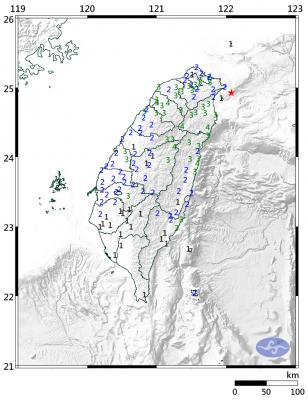
A magnitude 6.1 earthquake struck off the coast of Yilan County at 8:39pm tonight, the Central Weather Administration (CWA) said, with no immediate reports of damage or injuries. The epicenter was 38.7km east-northeast of Yilan County Hall at a focal depth of 98.3km, the CWA’s Seismological Center said. The quake’s maximum intensity, which gauges the actual physical effect of a seismic event, was a level 4 on Taiwan’s 7-tier intensity scale, the center said. That intensity level was recorded in Yilan County’s Nanao Township (南澳), Hsinchu County’s Guansi Township (關西), Nantou County’s Hehuanshan (合歡山) and Hualien County’s Yanliao (鹽寮). An intensity of 3 was

Japanese Prime Minister Sanae Takaichi’s comment last year on Tokyo’s potential reaction to a Taiwan-China conflict has forced Beijing to rewrite its invasion plans, a retired Japanese general said. Takaichi told the Diet on Nov. 7 last year that a Chinese naval blockade or military attack on Taiwan could constitute a “survival-threatening situation” for Japan, potentially allowing Tokyo to exercise its right to collective self-defense. Former Japan Ground Self-Defense Force general Kiyofumi Ogawa said in a recent speech that the remark has been interpreted as meaning Japan could intervene in the early stages of a Taiwan Strait conflict, undermining China’s previous assumptions
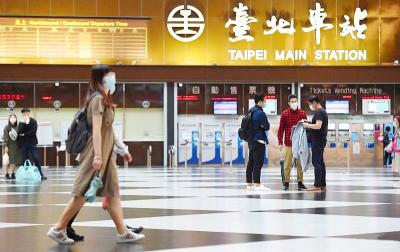
Taiwan Railways Corp (TRC) today announced that Shin Kong Mitsukoshi has been selected as the preferred bidder to operate the Taipei Railway Station shopping mall, replacing the current operator, Breeze Development Co Ltd. Among eight qualified firms that delivered presentations and were evaluated by a review committee, Shin Kong Mitsukoshi was ranked first, while Breeze was named the runner-up, the rail company said in a statement. Contract negotiations are to proceed in accordance with regulations, it said, adding that if negotiations with the top bidder fail, it could invite the second-ranked applicant to enter talks. Breeze in a statement today expressed doubts over


 RSS
RSS