


Academics hailed the nation’s first experimental school that teaches courses in Hoklo (commonly known as Taiwanese), while calling for more teachers and state funding the support the program.
Beiling Primary School in Kaohsiung’s Lujhu District (路竹) in September last year started the experimental program for elementary students learning subjects in Hoklo.
Most Taiwanese language advocates prefer the endonym Taigi over Hoklo.
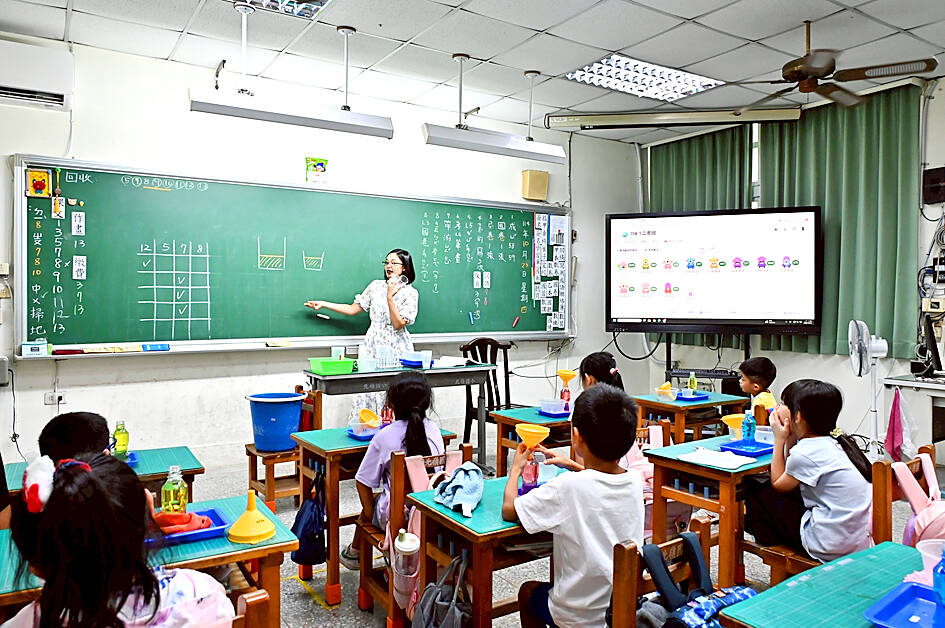
Photo: Lee Hui-chou, Taipei Times
The school, located at the intersection of Lujhu and Gangshan (岡山) districts, is near the Kaohsiung Science Park and Benjhou Industrial Park, and borders Provincial Highway No. 1 and other access roads. Despite its convenient transportation links, it almost got shut down more than a decade ago.
With an aging population and low birthrate, Beiling faced declining enrollment and government officials discussed its possible closure. It averted a shutdown after children from a baseball team in the mountain area relocated and boosted its enrollment.
In 2023, Taiwanese advocacy group TW South (台灣南社) asked Kaohsiung Mayor Chen Chi-mai (陳其邁) to set up a Taigi experimental school in the city, noting that Kaohsiung already has two experimental schools for teaching Hakka and indigenous languages, Beiling School principal Su Heng-chin (蘇恆欽) said.
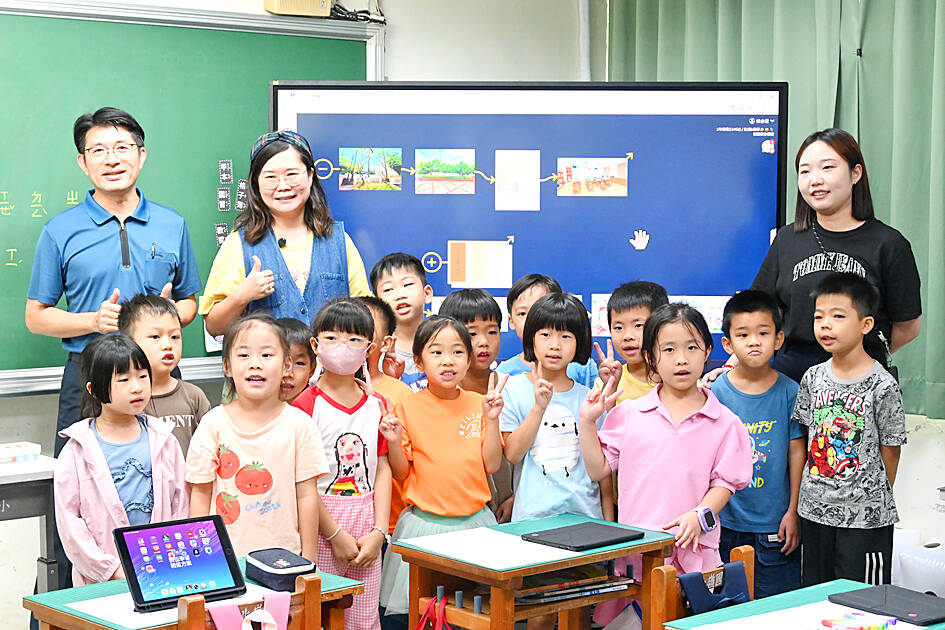
Photo: Su Fu-nan, Taipei Times
Chen agreed and instructed the city’s Education Bureau to draft plans and set up preparatory works over the course of a year for Beiling to commence the new Taigi education program, he added.
The school’s name was derived from an older name for the area, called “Pak-nia-kinn” in Taigi (北嶺墘, north ridge’s margin), with Taigi being the mother tongue of residents of the local communities, Su said.
“Therefore we decided to transform this school as the first for a Taigi education program,” he said.
“However, we had to face queries by some parents who were afraid that learning in Taigi could affect their children’s academic performance,” Su said.
The program called for teaching most courses in Taigi, including math, natural sciences and arts, Su said, adding that the only exceptions are Mandarin Chinese and English-language courses.
The school currently has 66 students — more than half of them came from other elementary-school jurisdictions, indigenous children from Atayal, Paiwan, Amis, Bunun and Sediq groups, as well as students whose parents are Japanese, German and other nationalities, Su said.
“Our school staff and teachers have worked diligently to create a multilingual environment for diverse languages to coexist. As a Taigi experimental school, we encourage teachers and students to speak and discuss in Taigi,” Su said.
“However, we respect the rights of all students to speak their mother tongue,” he said, citing as an example a Sediq student who chose to learn their native tongue, with the school hiring an expert to teach in Sediq.
“Right now we have four certified teachers of Taigi, two of whom are assistant teachers. They work with the course’s main instructors to prepare lessons before class, translating materials from Mandarin to Taigi, and join them in class to assist in teaching,” Su said.
“Most teachers in our school are bilingual. They are capable of teaching in Taigi and Mandarin. All the seven major courses are being taught, and the curriculum has not been affected by teaching in Taigi,” he said.
The language used in teaching subjects such as mathematics does not affect learning outcomes, Su said, adding that the key is whether students have learned the subject matter.
The teachers use a variety of assessment methods to check students’ learning outcomes and provide timely feedback to ensure learning quality, he said.
“Our teachers support students, and use leading questions, to encourage them to speak Taigi or their mother tongue,” he said.
“We have created a special environment for teaching courses in Taigi and have adopted a multidisciplinary approach for education, being the first of its kind in Taiwan,” he added.
“First-grade enrollment this year increased by 40 percent. We have parents residing in Ciaotou District (橋頭) enroll their children in our school. As such, Beiling is bucking the trend of a declining birthrate and dwindling students. This shows that the demand is there to have more Taigi experimental schools,” he said.
While Beiling faced the twin problems of lacking qualified teachers and insufficient funding, the program was still launched due to the full support of the Kaohsiung Education Bureau, Su said.
“However, we are not sure if subsidies from the city government would continue in the future,” he added.
To encourage and promote Taigi education, the Hoat-Ki Taigi Foundation has set up a “Taiwanese Language Scholarship” at Beiling. Each semester, scholarships are awarded to the top three students in each grade and class in Taigi. In addition, rewards are given to students who placed in the top three in school, city and national Taiwanese language competitions and to those who receive outstanding scores in Taigi proficiency certifications.
“Most certified teachers of Taigi and other native languages are paid by the hour. They have no guaranteed wages, and are not paid during the summer and winter holidays,” said Chiung Wi-vun (蔣為文), the foundation’s director and professor of Taiwanese literature at National Cheng Kung University in Tainan.
A majority of elementary-school assistant teachers are paid NT$336 per hour and given the 20 hours per week cap on teaching hours, they receive about NT$26,880 for a month’s work, which is lower than the minimum wage of NT$29,500, Chiung said.
“The salary is too low, so schools cannot retain good language teachers. Moreover, assistant teachers are only given one-year contracts, so their job prospects are not steady,” Chiung said. “The government should provide more financial subsidies for the program.”
“Taigi education cannot survive on personal enthusiasm alone or short-term investment. It needs a comprehensive support system, professionally trained language teachers and long-term investment for it to succeed,” he said.
Chiung said the Ministry of Education and government officials have been negligent in implementing the Development of National Languages Act (國家語言發展法), which was promulgated in 2019, but Taiwan still has no dedicated government agency for the development and rejuvenation of Taigi.
“Under the act, all indigenous languages, Mandarin, Hakka, Taigi and sign languages are enshrined as official languages ... so Taigi speakers should not be discriminated or restricted, as it is the mother tongue or 70 to 80 percent of Taiwanese,” he said. “However, the government has provided very little funding and fewer resources for Taigi-language programs.”

FUKUOKA SITUATION: Japanese media reported that the pathogen is expected to be identified by the summer, while the CDC downplayed the idea that it was hMPV A “mysterious cold-like illness” reported in Japan’s Fukuoka Prefecture does not seem to be a new disease, but Japanese authorities have been asked about the situation, the Centers for Disease Control (CDC) said yesterday. The Fukuoka Prefectural Medical Association on Wednesday told a news conference that a “mystery cold” that has become a hot topic on social media is “highly likely to be caused by some kind of viral infection,” Japan’s KBC News reported. “Many people are experiencing symptoms starting with a sore throat, followed by a runny nose, phlegm and a severe cough,” KBC News reported, citing association officials. Health authorities are

Nvidia Corp CEO Jensen Huang (黃仁勳) arrived in Taiwan yesterday ahead of upcoming AI and technology events, saying he plans to meet with clients and Taiwan Semiconductor Manufacturing Co Chairman C.C. Wei (魏哲家) during his visit. After landing at Taipei Songshan Airport, Huang posed for photos with fans and handed out Yakult drinks to reporters and supporters waiting at the scene, saying he has “a lot to do” during the trip. Asked about reports that Nvidia’s planned headquarters site in Taipei’s Beitou Shilin Technology Park could break ground on May 27, Huang said that if the company holds an event, he would

The Ministry of Finance this afternoon announced the winning numbers for the March-April uniform invoice lottery. The winning number for the NT$10 million (US$318,060) special prize is 19531471, and the winning number for the NT$2 million grand prize is 85941329. Three numbers were drawn for the NT$200,000 first prize: 07225810, 20231230 and 83518781. Those with receipts matching the last seven digits of any of the first-prize numbers will win the NT$40,000 second prize, while those matching the last six digits will win the NT$10,000 third prize. Those whose receipts match the last five digits of the first-prize numbers can claim the NT$4,000 fourth prize,

SIX SUBSIDIES: The monthly allowance for older farmers is to increase to NT$10,000, and NT$5,000 is to be given to homemakers under the national pension system, Lai said The government is to implement major welfare policies for disadvantaged groups, including raising the monthly allowance for older farmers to NT$10,000 and providing homemakers with NT$5,000 per month, President William Lai (賴清德) said yesterday. Lai made the remarks during a visit to Wangling Temple in Chiayi County, saying that the planned increases were being introduced amid economic growth and an increase in tax revenue. Touting a policy, in which the government plans to provide a monthly allowance of NT$5,000 for every child under the age of 18 in a bid to address Taiwan’s low birthrate, Lai said that if received for the


 RSS
RSS