


Thousands of people took part in an annual march in Taipei yesterday to remember those killed during the 228 Incident, with speakers urging Taiwanese not to compromise on their sovereignty and to safeguard their homeland.
Organized by a coalition of civil society groups, the theme of the march was “keeping memories alive, resisting foreign incursion.”
This year is the 79th anniversary of 228 Incident, which began in Taipei’s Datong District (大同) and sparked a series of protests against the then-Chinese Nationalist Party (KMT) regime’s treatment of residents.
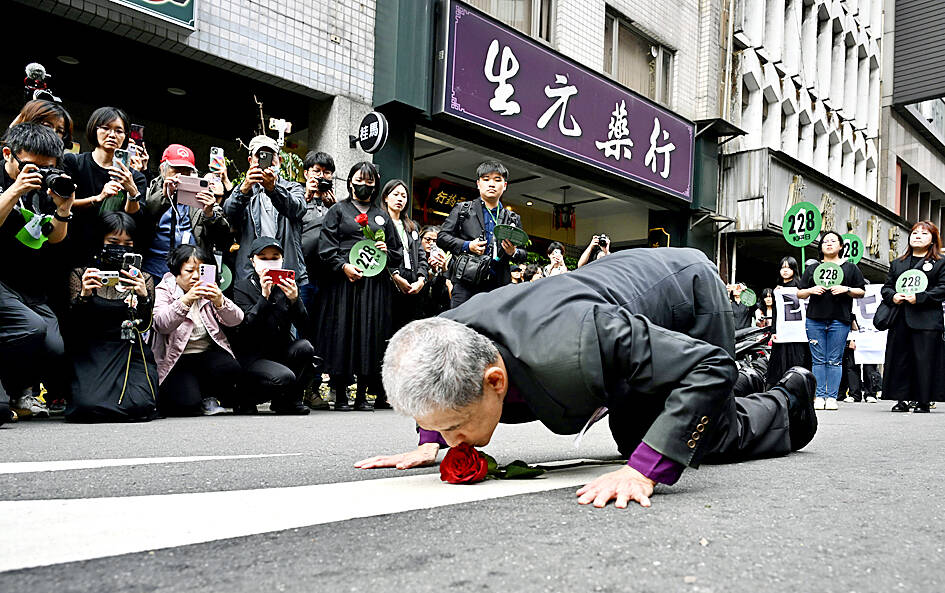
Photo: Lo Pei-de, Taipei Times
The 228 Incident was a series of ruthless crackdowns on protesters in the weeks and months following the brutal beating of a tobacco vendor in Taipei by government agents on Feb. 27, 1947, starting what came to be known as the White Terror.
Estimates place the resulting death toll as high as 28,000.
“We want participants to walk with us for renewed examination of history and people’s memories of the 228 Incident,” the organizers, including the Presbyterian Church in Taiwan, the Nylon Cheng Liberty Foundation and the Tsai Jui-yueh Dance Research Institute, said in a news release.
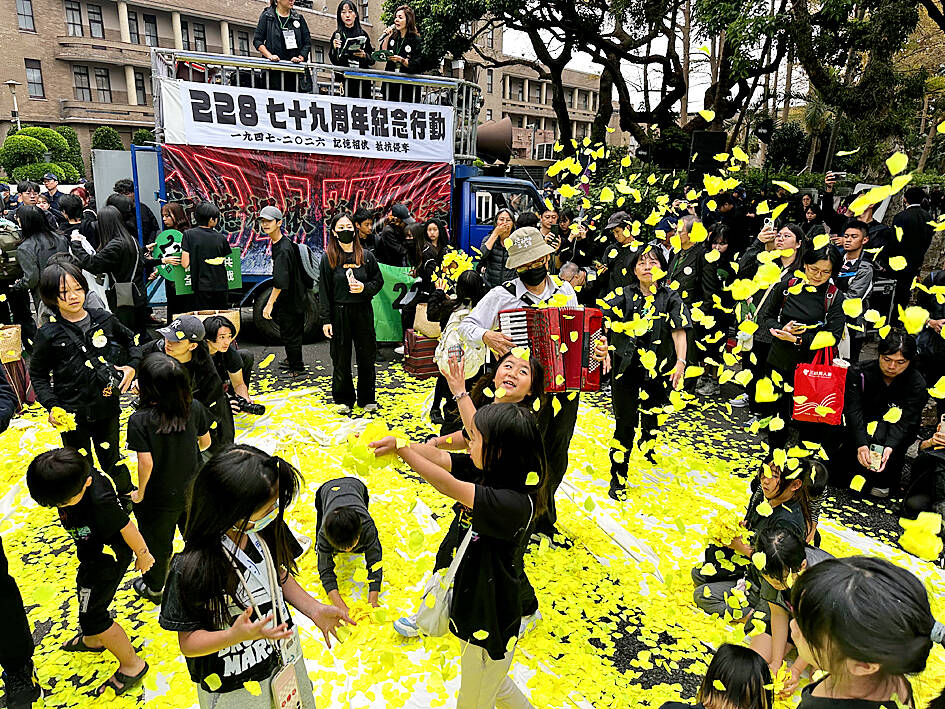
Photo: Bonnie White, Taipei Times
“Society must face its past and continue to push for transitional justice. It must also reflect upon the many challenges that Taiwan’s democracy is facing now. All citizens must not remain silent, but take up active public participation and ask questions,” it said.
“We must keep the memories alive and pass on history to future generations to assert Taiwan’s sovereignty and safeguard this homeland of ours. We must resist incursion by foreign forces, to tell those intending a hostile invasion that Taiwanese would not accept another outcome of surrender and subjugation under a foreign regime,” it said.
More than 80 civil groups and an estimated 2,000 people joined organizers as they walked toward the Tianma Tea House (天馬茶房), where the initial violence took place in 1947.
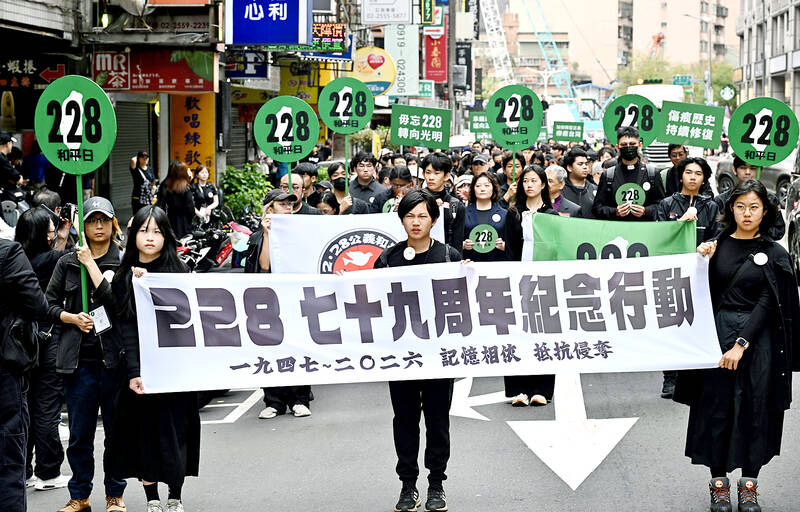
Photo: Lo Pei-de, Taipei Times
Leonard Lin (林宗正), a Presbyterian pastor, led the marchers, with young people in the front carrying a banner reading “79th anniversary remembrance action” and green placards.
In front of the memorial plaque, Lin knelt down to kiss the ground, laying a bouquet of flowers and scattering rose petals to commemorate the victims of Incident.
In a prayer, he reminded people not to forget the pain and suffering of the victims and their families, saying the flowers represent love to push fear away.
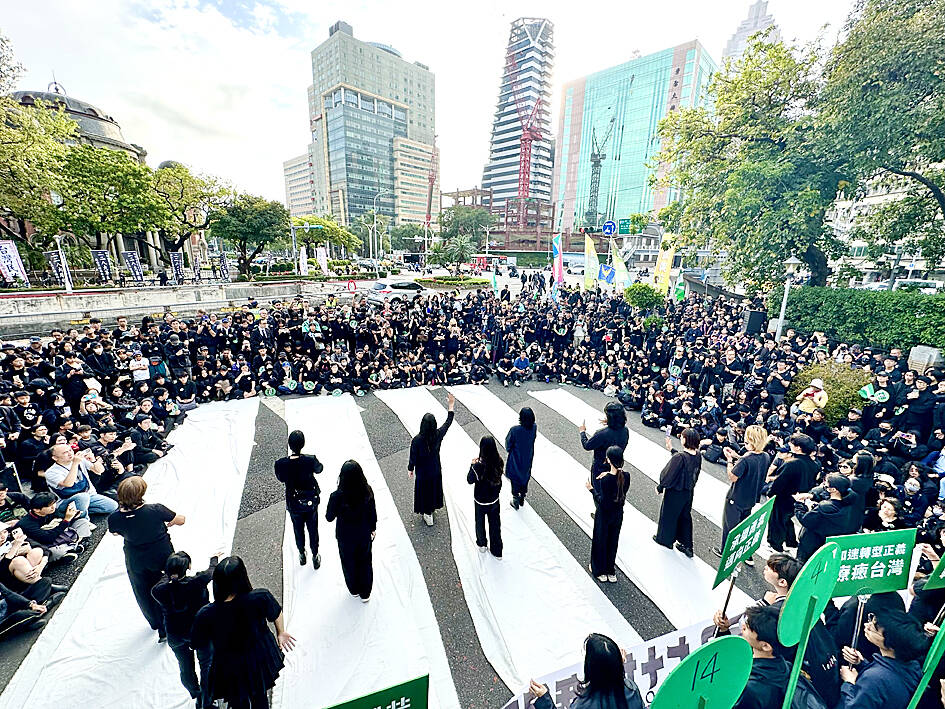
Photo: Lo Pei-de, Taipei Times
Lin is one of the original trio who began commemorating the 228 Incident.
Together with Taiwan’s “freedom fighter” Deng Nan-jung (鄭南榕) and democracy activist Huang Chao-kai (黃昭凱), the three organized the first march on Feb. 15, 1987, in Tainan, when Taiwan was still under martial law, going against the KMT regime’s prohibition against any commemoration.
Participants marched to other important sites of the Incident in the area as well as the Taipei 228 Peace Park, finishing in front of the Executive Yuan compound, formerly the office of the governor-
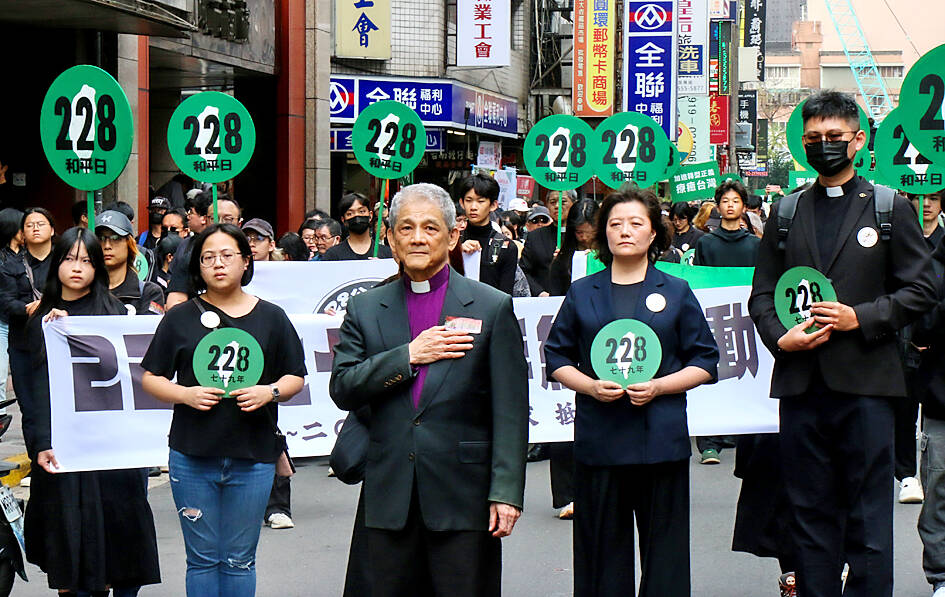
Photo: Bonnie White, Taipei Times
general who ordered the 1947 crackdown.
“Today’s march is not about hatred, but is for peace, and to strive for society to make progress. We must speak out on our memories when we still can, to tell the younger generations,” said Deng Chu-mei (鄭竹梅), daughter of Deng Nan-jung.
“Taiwan’s future must be decided by Taiwanese and we must not permit any compromise on Taiwan’s sovereignty,” she said. “We all must stand up to safeguard our freedom and independence.”
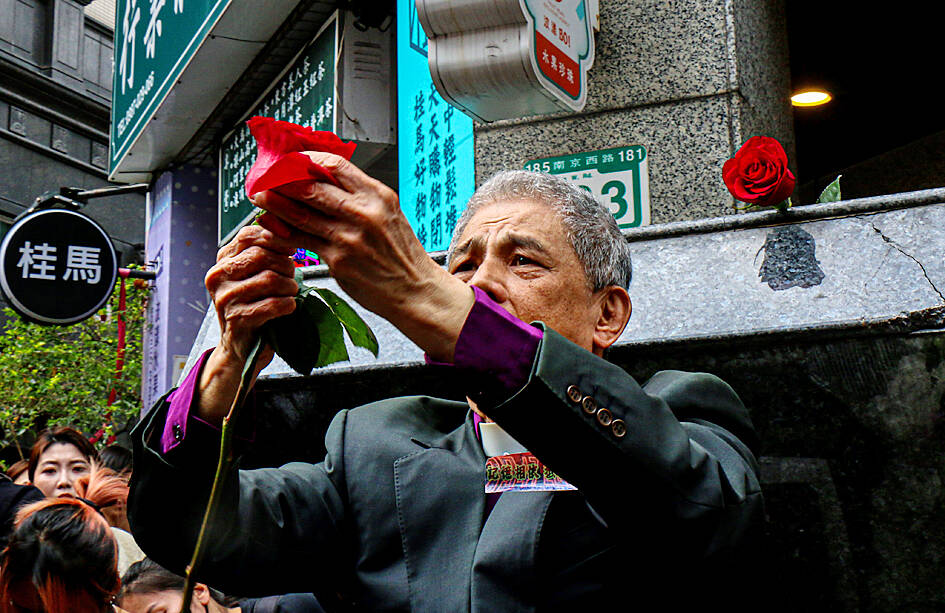
Photo: Bonnie White, Taipei Times
Chang Chia-en (張嘉恩), deputy head of a 228 commemoration team, said that the high level of youth participation reflects a campaign started last year to pass Taiwan’s history to the next generation.
“The organizers used to be predominantly middle-aged, but we have begun actively engaging young people to help them understand what happened on this land,” Chang said.
When the current head, who is in their 40s, steps down next year and Chang assumes leadership, the entire team would be 25 or younger, she said.
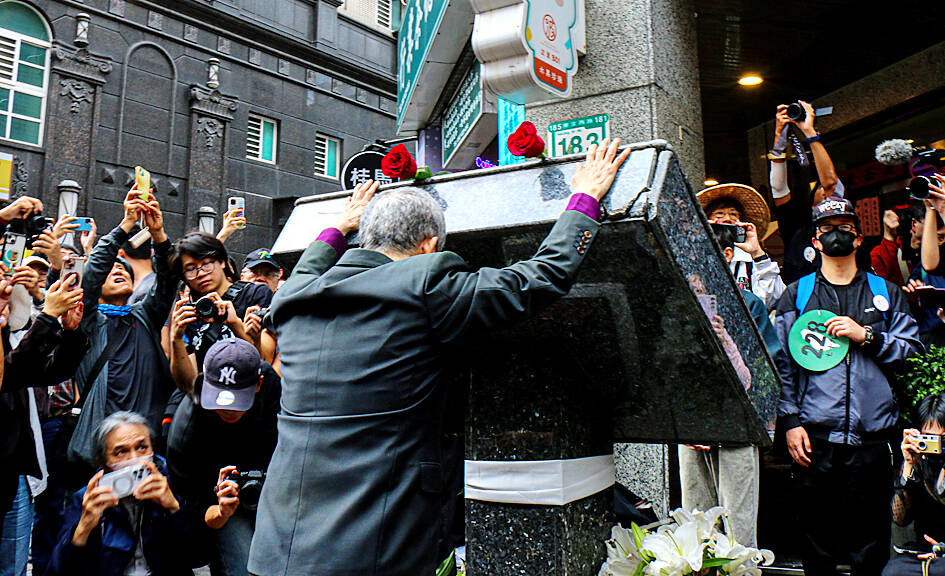
Photo: Bonnie White, Taipei Times
Chang said that seeing young people performing sign language outside the Cabinet and scattering flowers in tribute shows that the torch of justice has been passed to a new generation.
Now in its 10th year, the rally has seen participants grow from 28 groups to more than 70 this year.
TODAY’S EVENTS
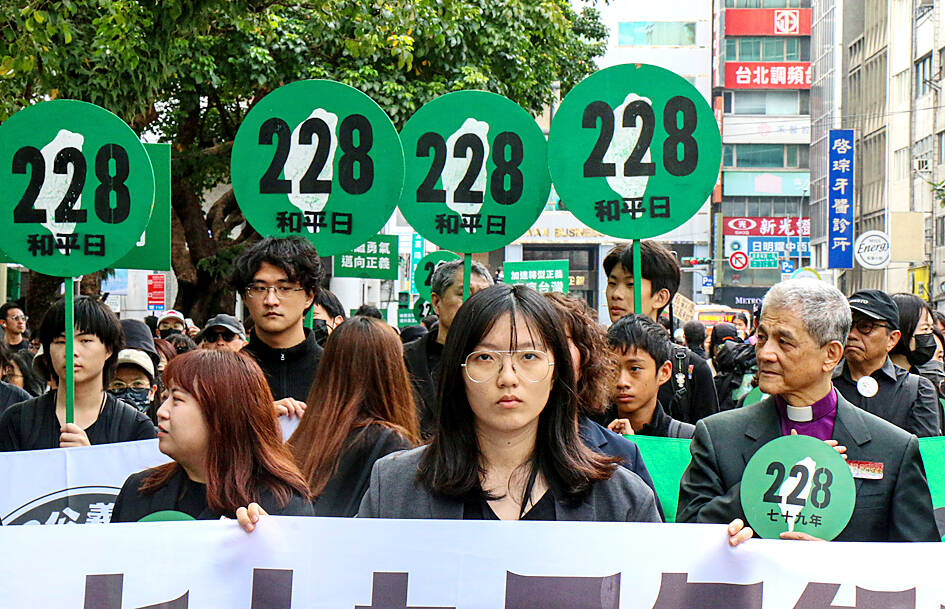
Photo: Bonnie White, Taipei Times
The official 228 remembrance event, to be attended by major political leaders and government officials, is to take place today in Kaohsiung, together with a series of activities and exhibitions.
Civil groups together with the Taiwan Statebuilding Party have organized their own commemoration activities today, including music and cultural performances, starting at 10am in front of Chiang Kai-shek Memorial Hall in Taipei.
The annual 228 Music Festival is also to take place at Liberty Square today, featuring musical performances, cultural activities, a street market and other programs organized by the Taiwan Gong Sheng Youth Association and other organizations.
Additional reporting by CNA
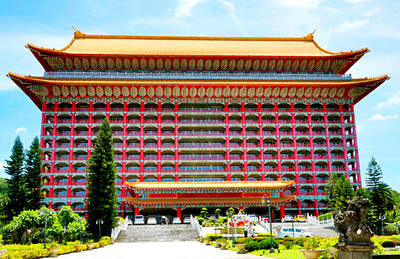
The Grand Hotel Taipei on Saturday confirmed that its information system had been illegally accessed and expressed its deepest apologies for the concern it has caused its customers, adding that the issue is being investigated by the Ministry of Justice Investigation Bureau. The hotel said that on Tuesday last week, it had discovered an external illegal intrusion into its information system. An initial digital forensic investigation confirmed that parts of the system had been accessed, it said, adding that the possibility that some customer data were stolen and leaked could not be ruled out. The actual scope and content of the affected data

DO THEY BITE IT? Cats have better memories than people might think, but their motivation is based entirely around the chance of getting fed Cats can remember the identity of the people who fed them the day before, Taipei-based veterinarians said on Friday, debunking a popular myth that cats have a short memory. If a stray does not recognize the person who fed them the previous day, it is likely because they are not carrying food and the cat has no reason to recognize them, said Wu Chou Animal Hospital head Chen Chen-huan (陳震寰). “When cats come to a human bearing food, it is coming for the food, not the person,” he said. “The food is the key.” Since the cat’s attention is on the food, it

‘LIKE-MINDED PARTNER’: Tako van Popta said it would be inappropriate to delay signing the deal with Taiwan because of China, adding he would promote the issue Canadian senators have stressed Taiwan’s importance for international trade and expressed enthusiasm for ensuring the Taiwan-Canada trade cooperation framework agreement is implemented this year. Representative to Canada Harry Tseng (曾厚仁) in an interview with the Central News Agency (CNA) said he was increasingly uneasy about Ottawa’s delays in signing the agreement, especially as Ottawa has warmed toward Beijing. There are “no negotiations left. Not only [is it] initialed, we have three versions of the text ready: English, French and Mandarin,” Tseng said. “That tells you how close we are to the final signature.” Tseng said that he hoped Canadian Prime Minister Mark Carney

President William Lai (賴清德) yesterday bestowed one of Taiwan’s highest honors on Saint Vincent and the Grenadines (SVG) Ambassador Andrea Clare Bowman in recognition of her contributions to bilateral ties. “By conferring the Order of Brilliant Star with Grand Cordon on Ambassador Bowman today, I want to sincerely thank her, on behalf of the Taiwanese people, for her outstanding contribution to deepening diplomatic ties between Taiwan and SVG,” Lai said at a ceremony held at the Presidential Office in Taipei. He noted that Bowman became SVG’s first ambassador to Taiwan in 2019 and


 RSS
RSS