


Nearly eight decades after the 228 Incident, civic groups are breathing new life into the preservation of a collective memory as part of a concerted effort to resist the erosion of history.
The 228 Incident refers to an anti-government uprising that began on Feb. 28, 1947, after the brutal beating of a tobacco vendor in Taipei by government agents a day earlier.
The protests initially reflected pent-up dismay at the heavy-handed methods of the Chinese Nationalist Party (KMT) regime, reflected in its treatment of the tobacco vendor, but later erupted into nationwide demonstrations against the government that were met with lethal violence in the weeks and months following.
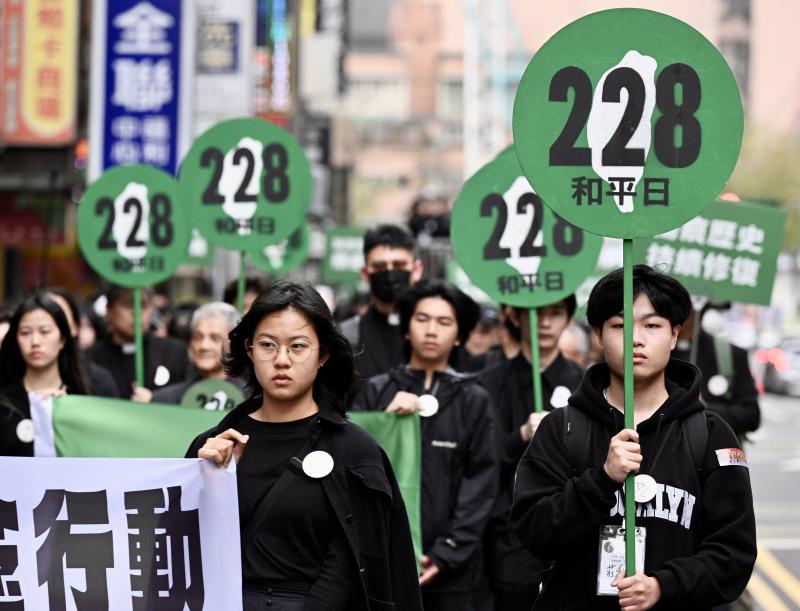
Photo: Lo Pei-de, Taipei Times
Estimates place the resulting death toll as high as 28,000.
This afternoon, on the eve of the Incident's 79th anniversary, hundreds of people dressed in black gathered outside Taipei Municipal Rixin Elementary School for a rally organized by non-governmental organizations, and most participants were in their 20s.
Chang Chia-en (張嘉恩), deputy CEO of a 228 commemoration team, said that the high level of participation by young people reflects a campaign that was started last year to pass Taiwan's history on to the next generation.
"The organizers used to be predominantly middle-aged, but we have begun actively engaging young people to help them understand what happened on this land," said 22-year-old Chang, a senior in National Taiwan Normal University's sociology department.
Participants in the "228.0 Memorial Action" march departed from Rixin Elementary School at 1:50pm and headed toward the former site of the Tianma Tea House in Datong District (大同), where the Incident was sparked 79 years ago.
The procession continued on to several significant historical sites, including the Taipei 228 Memorial Museum — formerly a radio station that broadcast news of the uprising — and concluded at the Executive Yuan, the site of the former Chief Executive's Office that ordered the 1947 crackdown.
During the march, the names of victims were read aloud in Hoklo (commonly known as Taiwanese) and Hakka to honor their memory, Chang said.
The youth-led nature of the event was striking: Reception staff were as young as 17 and guides were roughly 20.
Chang said that when the commemoration team’s CEO, who is in their 40s, steps down next year and she assumes leadership, the entire team would consist of members aged 25 or younger.
Describing this involvement as "bringing new energy and imagination to the rally," Chang said that seeing young people performing sign language outside the Executive Yuan and scattering flowers in tribute shows that the torch of transitional justice has been passed to a new generation.
Now in its 10th year, the rally has seen its list of co-organizers grow from 28 civic groups to more than 70.
Of the 500 people who registered for this year's march, about one-third were expected to be aged 25 or under, Chang said.
Among the participants were 120 members of the Association of Parent Participating Education in Taiwan.
One member, a mother surnamed Chang (張), brought her two sons — a second grader and a fifth grader — for a second consecutive year.
"There are few opportunities for our children to learn about the 228 Incident in their daily lives," she said. "We want them to understand what occurred through this annual activity."
However, when asked about the event, her second-grade son responded in shy silence.
Meanwhile, 28-year-old Chang Yu-chieh (張瑀婕), who spoke on behalf of the younger generation at a pre-rally press conference, said that despite growing up in Datong District, she remained ignorant of the Incident's true history until she was 20.
She expressed gratitude to those who in the past fought to preserve the history of the Incident.
"If people hadn't fought for this, generation after generation, it would be impossible to see so many young people standing up today to let these flowers blossom,” she said.

FUKUOKA SITUATION: Japanese media reported that the pathogen is expected to be identified by the summer, while the CDC downplayed the idea that it was hMPV A “mysterious cold-like illness” reported in Japan’s Fukuoka Prefecture does not seem to be a new disease, but Japanese authorities have been asked about the situation, the Centers for Disease Control (CDC) said yesterday. The Fukuoka Prefectural Medical Association on Wednesday told a news conference that a “mystery cold” that has become a hot topic on social media is “highly likely to be caused by some kind of viral infection,” Japan’s KBC News reported. “Many people are experiencing symptoms starting with a sore throat, followed by a runny nose, phlegm and a severe cough,” KBC News reported, citing association officials. Health authorities are

Nvidia Corp CEO Jensen Huang (黃仁勳) arrived in Taiwan yesterday ahead of upcoming AI and technology events, saying he plans to meet with clients and Taiwan Semiconductor Manufacturing Co Chairman C.C. Wei (魏哲家) during his visit. After landing at Taipei Songshan Airport, Huang posed for photos with fans and handed out Yakult drinks to reporters and supporters waiting at the scene, saying he has “a lot to do” during the trip. Asked about reports that Nvidia’s planned headquarters site in Taipei’s Beitou Shilin Technology Park could break ground on May 27, Huang said that if the company holds an event, he would

The Ministry of Finance this afternoon announced the winning numbers for the March-April uniform invoice lottery. The winning number for the NT$10 million (US$318,060) special prize is 19531471, and the winning number for the NT$2 million grand prize is 85941329. Three numbers were drawn for the NT$200,000 first prize: 07225810, 20231230 and 83518781. Those with receipts matching the last seven digits of any of the first-prize numbers will win the NT$40,000 second prize, while those matching the last six digits will win the NT$10,000 third prize. Those whose receipts match the last five digits of the first-prize numbers can claim the NT$4,000 fourth prize,
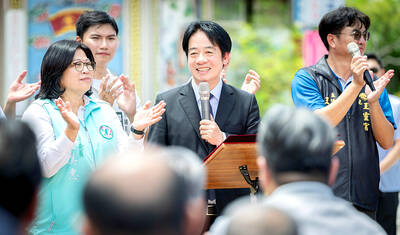
SIX SUBSIDIES: The monthly allowance for older farmers is to increase to NT$10,000, and NT$5,000 is to be given to homemakers under the national pension system, Lai said The government is to implement major welfare policies for disadvantaged groups, including raising the monthly allowance for older farmers to NT$10,000 and providing homemakers with NT$5,000 per month, President William Lai (賴清德) said yesterday. Lai made the remarks during a visit to Wangling Temple in Chiayi County, saying that the planned increases were being introduced amid economic growth and an increase in tax revenue. Touting a policy, in which the government plans to provide a monthly allowance of NT$5,000 for every child under the age of 18 in a bid to address Taiwan’s low birthrate, Lai said that if received for the


 RSS
RSS