


A US think tank has urged Taiwan to adopt a "hellscape" strategy that would flood the Taiwan Strait with drones and other uncrewed systems to deter a potential invasion by China.
In the report "Hellscape for Taiwan: Rethinking Asymmetric Defense" published yesterday, the Center for a New American Security said that Taipei's asymmetric defense approach — often described as a "porcupine strategy" — needs to evolve to keep pace with the growing capabilities of the Chinese People's Liberation Army.
The concept of a "hellscape," a term used by US military leaders in the past few years, envisions saturating the air and waters around Taiwan with thousands of drones and other uncrewed platforms capable of striking invading forces from multiple areas at once.
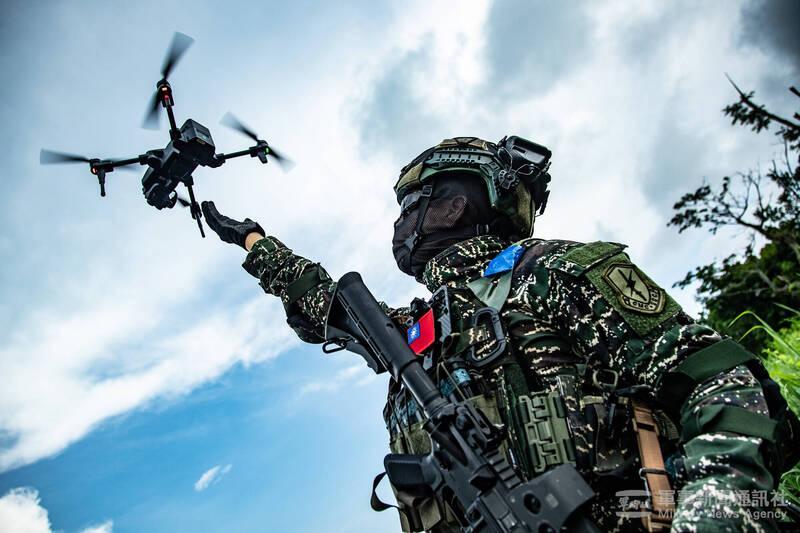
Photo courtesy of the Military News Agency
Under the approach outlined in the study, long-range aerial, surface and undersea drones would target Chinese ships and aircraft well before they reach Taiwan's shores.
As invading forces moved closer, additional layers of mines, loitering munitions and short-range systems would further disrupt and weaken by attrition troops attempting amphibious landings, the report says.
The goal would be to deny China air and sea superiority and to impose such heavy losses that an invasion would become prohibitively costly, it says.
Taiwan must be prepared to defend itself even in the early stages of a cross-strait conflict, when outside assistance could be delayed or contested, the report says.
Rather than relying primarily on high-end, limited-number platforms, such as advanced fighter jets or large surface ships, the hellscape concept emphasizes quantity, dispersion and resilience.
The study calls for the mass production of affordable drones — including long-range strike systems and first-person view drones — that can operate in contested communications environments.
It also recommends building domestic manufacturing capacity and integrating uncrewed systems into a coherent doctrine that links sensors, shooters and command networks.
While China has rapidly modernized its navy, air force and missile forces over the past two decades, significant uncertainties remain about its ability to execute and sustain such a large-scale operation, especially in the face of Taiwanese counterattacks and possible US intervention, the study says.
The government has devised plans consistent with the report's recommendations for the use of drones in deterring or repelling a Chinese invasion.
Most recently, as part of a proposed NT$1.25 trillion (US$40 billion) eight-year special defense budget, Taiwan wants to purchase more than 200,000 uncrewed aerial vehicles and 1,000-plus uncrewed surface vehicles, with many of them produced domestically.
The report also outlines several scenarios China might consider, rather than launching an immediate, all-out invasion.
One option is a quarantine or blockade designed to choke off Taiwan's trade and energy supplies, pressuring its government into political concessions without a risky amphibious assault, the report says.
Another is a limited seizure of Taiwan’s outlying islands, testing international resolve while avoiding the enormous costs of invading the main island, it says.
A full invasion would likely come only if Chinese leaders assessed that peaceful unification was no longer plausible and that military conditions — including readiness, logistics and deterrence of outside powers — were favorable, the report says.

LOUD AND PROUD Taiwan might have taken a drubbing against Australia and Japan, but you might not know it from the enthusiasm and numbers of the fans Taiwan might not be expected to win the World Baseball Classic (WBC) but their fans are making their presence felt in Tokyo, with tens of thousands decked out in the team’s blue, blowing horns and singing songs. Taiwanese fans have packed out the Tokyo Dome for all three of their games so far and even threatened to drown out home team supporters when their team played Japan on Friday. They blew trumpets, chanted for their favorite players and had their own cheerleading squad who dance on a stage during the game. The team struggled to match that exuberance on the field, with
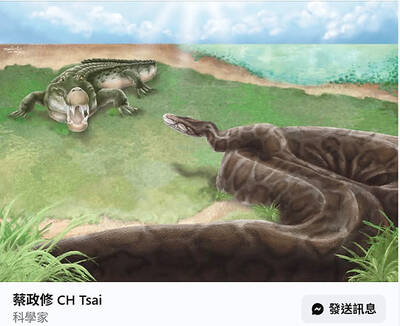
Taiwanese paleontologists have discovered fossil evidence that pythons up to 4m long inhabited Taiwan during the Pleistocene epoch, reporting their findings in the international scientific journal Historical Biology. National Taiwan University (NTU) Institute of Ecology and Evolutionary Biology associate professor Tsai Cheng-hsiu (蔡政修) led the team that discovered the largest snake fossil ever found in Taiwan. The single trunk vertebra was discovered in Tainan at the Chiting Formation, dated to between 400,000 and 800,000 years ago in the Middle Pleistocene, the paper said. The area also produced Taiwan’s first avian fossil, as well as crocodile, mammoth, saber-toothed cat and rhinoceros fossils, it said. Discoveries

Taiwanese paleontologists have discovered fossil evidence that pythons up to 4m long inhabited Taiwan during the Pleistocene epoch, reporting their findings in the international scientific journal Historical Biology. National Taiwan University (NTU) Institute of Ecology and Evolutionary Biology associate professor Tsai Cheng-hsiu (蔡政修) led the team that discovered the largest snake fossil ever found in Taiwan. A single trunk vertebra was discovered in Tainan at the Chiting Formation, dated to between 800,000 to 400,000 years ago in the Middle Pleistocene, the paper said. The area also produced Taiwan’s first avian fossil, as well as crocodile, mammoth, sabre-toothed cat and rhinoceros fossils, it said. Discoveries

Whether Japan would help defend Taiwan in case of a cross-strait conflict would depend on the US and the extent to which Japan would be allowed to act under the US-Japan Security Treaty, former Japanese minister of defense Satoshi Morimoto said. As China has not given up on the idea of invading Taiwan by force, to what extent Japan could support US military action would hinge on Washington’s intention and its negotiation with Tokyo, Morimoto said in an interview with the Liberty Times (sister paper of the Taipei Times) yesterday. There has to be sufficient mutual recognition of how Japan could provide


 RSS
RSS