


With the final indictments issued in December, the Criminal Investigation Bureau (CIB) today identified a 2024 phishing syndicate as the largest-ever dismantled in Taiwan both in terms of financial losses and number of suspects.
A CIB investigator told reporters by phone that 19 suspects were indicted in December, including two previously charged alongside five others in late 2024, bringing the total number of people indicted in the case to 24.
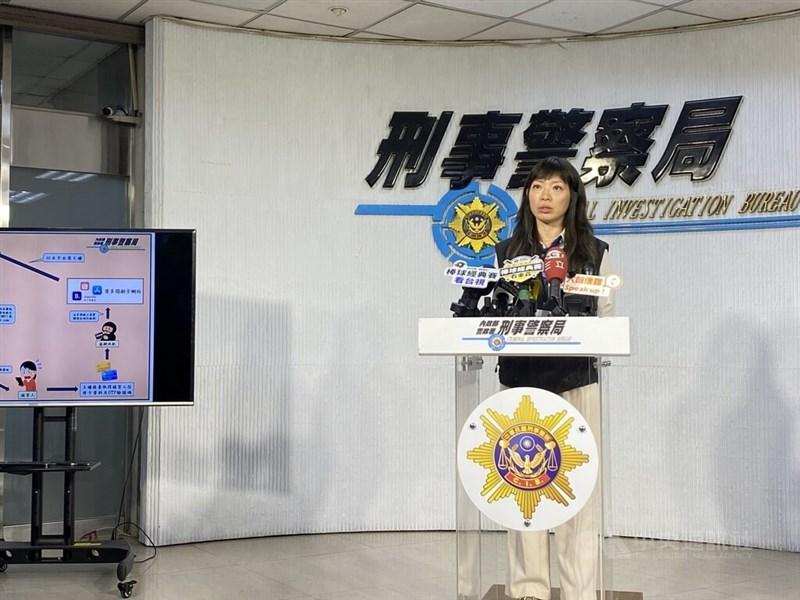
Photo: CNA
The 24 suspects were charged with fraud-related crimes under the Fraud Crime Hazard Prevention Act (詐欺犯罪危害防制條例) and other laws for defrauding at least 107 people out of NT$4.5 million (US$144,119) through phishing text messages, the investigator said.
The number of suspects and amount of money involved make this the largest phishing syndicate ever dismantled in Taiwan, they said.
The CIB under the National Police Agency held a news conference yesterday to disclose details of the investigation, following a review of the indictments issued against the final 19 suspects which the bureau received last month.
The ring allegedly sent out text messages impersonating utility providers and businesses, such as Taiwan Water Corp and Far Eastern Electronic Toll Collection Co, Chang Wei-lun (張瑋倫), deputy head of the police telecommunications investigation unit, said at the event.
The messages contained links to fraudulent Web sites designed to mirror those of the impersonated companies, tricking victims into providing credit card details and verification codes the scammers then used to make online purchases, Chang said.
Among the most notable cases was that of a man whose credit card was fraudulently charged 60 times and a woman who lost NT$200,000 to the scam, he added.
The 24 suspects — led by an person surnamed Chang (張) and a member of the Bamboo Union gang surnamed Kuo (郭) — were apprehended in 11 cities and counties across Taiwan in various operations, from August 2024 to June last year, the CIB said.
According to the CIB investigator, the scams took place over about six months from April to September 2024.
Chang is currently serving a prison sentence for unrelated offenses, while the other 23 indicted suspects, who are not currently in custody, are awaiting trial, he said.
The CIB said the primary suspect, Chang, consulted with a China-based engineer on how to establish a phishing operation prior to the syndicate's formation, although officials did not specify whether the engineer was a Taiwanese or Chinese national.

FUKUOKA SITUATION: Japanese media reported that the pathogen is expected to be identified by the summer, while the CDC downplayed the idea that it was hMPV A “mysterious cold-like illness” reported in Japan’s Fukuoka Prefecture does not seem to be a new disease, but Japanese authorities have been asked about the situation, the Centers for Disease Control (CDC) said yesterday. The Fukuoka Prefectural Medical Association on Wednesday told a news conference that a “mystery cold” that has become a hot topic on social media is “highly likely to be caused by some kind of viral infection,” Japan’s KBC News reported. “Many people are experiencing symptoms starting with a sore throat, followed by a runny nose, phlegm and a severe cough,” KBC News reported, citing association officials. Health authorities are

Nvidia Corp CEO Jensen Huang (黃仁勳) arrived in Taiwan yesterday ahead of upcoming AI and technology events, saying he plans to meet with clients and Taiwan Semiconductor Manufacturing Co Chairman C.C. Wei (魏哲家) during his visit. After landing at Taipei Songshan Airport, Huang posed for photos with fans and handed out Yakult drinks to reporters and supporters waiting at the scene, saying he has “a lot to do” during the trip. Asked about reports that Nvidia’s planned headquarters site in Taipei’s Beitou Shilin Technology Park could break ground on May 27, Huang said that if the company holds an event, he would

The Ministry of Finance this afternoon announced the winning numbers for the March-April uniform invoice lottery. The winning number for the NT$10 million (US$318,060) special prize is 19531471, and the winning number for the NT$2 million grand prize is 85941329. Three numbers were drawn for the NT$200,000 first prize: 07225810, 20231230 and 83518781. Those with receipts matching the last seven digits of any of the first-prize numbers will win the NT$40,000 second prize, while those matching the last six digits will win the NT$10,000 third prize. Those whose receipts match the last five digits of the first-prize numbers can claim the NT$4,000 fourth prize,

SIX SUBSIDIES: The monthly allowance for older farmers is to increase to NT$10,000, and NT$5,000 is to be given to homemakers under the national pension system, Lai said The government is to implement major welfare policies for disadvantaged groups, including raising the monthly allowance for older farmers to NT$10,000 and providing homemakers with NT$5,000 per month, President William Lai (賴清德) said yesterday. Lai made the remarks during a visit to Wangling Temple in Chiayi County, saying that the planned increases were being introduced amid economic growth and an increase in tax revenue. Touting a policy, in which the government plans to provide a monthly allowance of NT$5,000 for every child under the age of 18 in a bid to address Taiwan’s low birthrate, Lai said that if received for the


 RSS
RSS