


A doctor yesterday reminded people not to take certain types of drugs before getting a stool antigen test for Helicobacter pylori amid a one-time government-funded testing program for people aged 45 to 74.
Shu-Tien Clinic gastroenterologist Kang Pen-chu (康本初) said a woman in her 40s, surnamed Wang (王), often took over-the-counter (OTC) medicine to relieve her stomach discomfort, but it remained intermittently.
Wang had sought treatment for stomach ulcer and H. pylori infection a few years earlier, so she was suspicious that her condition was a relapse of the previous infection, but a recent health check that included a H. pylori stool antigen test came back negative, Kang said.
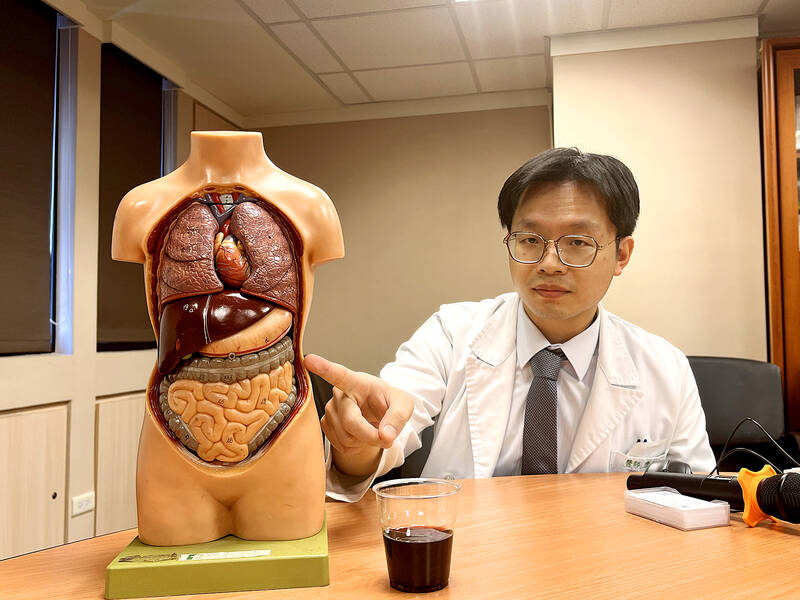
Photo: Tsai Ssu-pei, Taipei Times
Kang said that as Wang’s stomach discomfort continued, she sought treatment at the clinic, and he asked if she was taking medication before the screening test as it could affect the test results.
Wang later underwent a gastroscopy, which confirmed that she was infected with H. pylori.
H. pylori infection is closely associated with several stomach diseases, including chronic gastritis, gastric ulcers, duodenal ulcers and gastric cancer, Kang said, adding that H. pylori is deemed a Group 1 carcinogen by the WHO’s International Agency for Research on Cancer.
Most infections cause no symptoms, but some could experience gastrointestinal symptoms such as stomach pain, indigestion, nausea, vomiting and bloating, Kang said.
If a chronic infection is left untreated, the risk of developing gastric cancer increases over time, he said.
Studies have also suggested that a H. pylori infection is significantly associated with anemia, vitamin B12 deficiency, immune thrombocytopenia and metabolic syndrome, he said.
Kang said that common H. pylori screening tests include stool antigen test, urea breath test and gastroscopy biopsy, and that the first two are non-invasive and more convenient methods, but a gastroscopy can examine the upper digestive tract and take tissue samples for microscopic examination.
However, if the person is taking certain medications, including antibiotics, proton pump inhibitors or antacids, bacterial activity can be suppressed, causing the test results to come back “false negative,” he said.
For more accurate result, people should undergo H. pylori screening tests after they stop taking such drugs for at least a month, Kang said.
H. pylori treatment typically consists of a course of oral antibiotics for seven to 14 days, but people should be aware of potential relapse, especially those with family history of chronic infection or those with chronic stomach discomfort, he said.
Recurrent stomach discomfort is not necessarily caused by stomach ulcer, so instead of buying OTC drugs to relieve the symptoms, people should seek medical attention and undergo tests to clarify the cause, he added.

FUKUOKA SITUATION: Japanese media reported that the pathogen is expected to be identified by the summer, while the CDC downplayed the idea that it was hMPV A “mysterious cold-like illness” reported in Japan’s Fukuoka Prefecture does not seem to be a new disease, but Japanese authorities have been asked about the situation, the Centers for Disease Control (CDC) said yesterday. The Fukuoka Prefectural Medical Association on Wednesday told a news conference that a “mystery cold” that has become a hot topic on social media is “highly likely to be caused by some kind of viral infection,” Japan’s KBC News reported. “Many people are experiencing symptoms starting with a sore throat, followed by a runny nose, phlegm and a severe cough,” KBC News reported, citing association officials. Health authorities are

Nvidia Corp CEO Jensen Huang (黃仁勳) arrived in Taiwan yesterday ahead of upcoming AI and technology events, saying he plans to meet with clients and Taiwan Semiconductor Manufacturing Co Chairman C.C. Wei (魏哲家) during his visit. After landing at Taipei Songshan Airport, Huang posed for photos with fans and handed out Yakult drinks to reporters and supporters waiting at the scene, saying he has “a lot to do” during the trip. Asked about reports that Nvidia’s planned headquarters site in Taipei’s Beitou Shilin Technology Park could break ground on May 27, Huang said that if the company holds an event, he would

The Ministry of Finance this afternoon announced the winning numbers for the March-April uniform invoice lottery. The winning number for the NT$10 million (US$318,060) special prize is 19531471, and the winning number for the NT$2 million grand prize is 85941329. Three numbers were drawn for the NT$200,000 first prize: 07225810, 20231230 and 83518781. Those with receipts matching the last seven digits of any of the first-prize numbers will win the NT$40,000 second prize, while those matching the last six digits will win the NT$10,000 third prize. Those whose receipts match the last five digits of the first-prize numbers can claim the NT$4,000 fourth prize,

SIX SUBSIDIES: The monthly allowance for older farmers is to increase to NT$10,000, and NT$5,000 is to be given to homemakers under the national pension system, Lai said The government is to implement major welfare policies for disadvantaged groups, including raising the monthly allowance for older farmers to NT$10,000 and providing homemakers with NT$5,000 per month, President William Lai (賴清德) said yesterday. Lai made the remarks during a visit to Wangling Temple in Chiayi County, saying that the planned increases were being introduced amid economic growth and an increase in tax revenue. Touting a policy, in which the government plans to provide a monthly allowance of NT$5,000 for every child under the age of 18 in a bid to address Taiwan’s low birthrate, Lai said that if received for the


 RSS
RSS