


Taiwan is to work with the US to ensure the beneficial terms it has already agreed to do not change despite ructions following a US Supreme Court ruling striking down US President Donald Trump’s emergency tariffs, Vice Premier Cheng Li-chiun (鄭麗君) said yesterday.
Trump on Monday warned countries against backing away from trade deals negotiated with the US, saying that he would hit them with much higher duties under different trade laws.
Taipei has struck two deals with the White House to lower tariffs on Taiwanese goods to 15 percent from 20 percent.
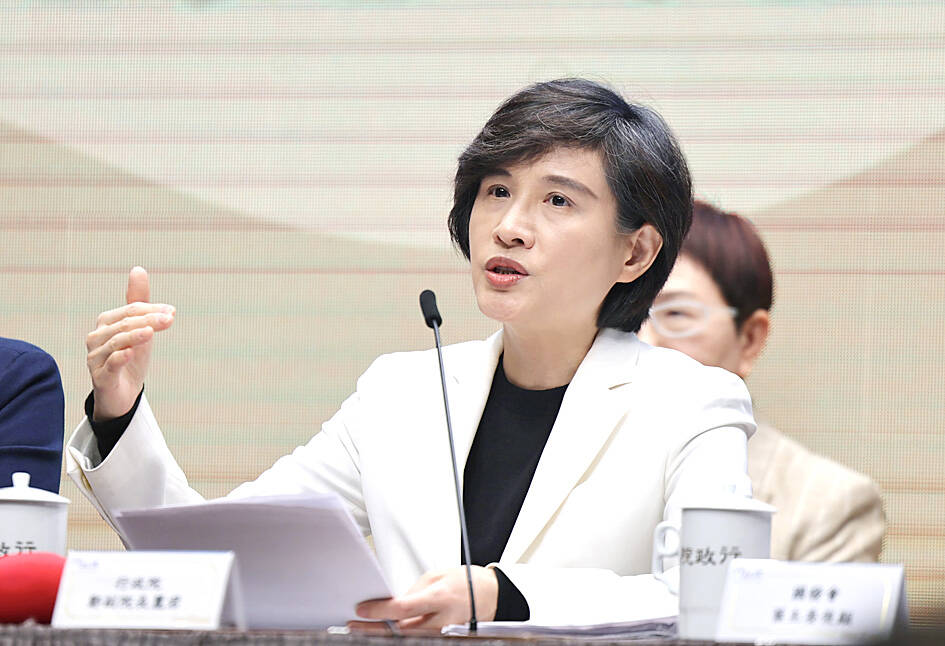
Photo: CNA
Under last month’s agreement, Taiwan companies are to invest US$250 billion to boost production of semiconductors, energy and artificial intelligence in the US, while Taiwan would also guarantee an additional US$250 billion in credit to facilitate further investment.
The second deal, reached this month that confirmed the tariff cut to 15 percent without stacking them on existing rates, commits Taiwan to a schedule for eliminating or lowering tariffs on nearly all US goods, and to significantly boost purchases of US goods such as natural gas.
Cheng, who led the talks with the US, said the government has been in touch with Washington, although it did not say with whom.
“I think our contacts so far have also been positive. The US side understands that this is an agreement that benefits both sides. I believe we can achieve this objective, and we are confident that we can do so,” she told reporters, referring to last month’s Taiwan-US Agreement on Reciprocal Trade.
This is not a reopening of negotiations, and Taipei would seek to engage with the US to understand how Taiwanese companies would continue to receive the best treatment possible under that deal, even as the White House looks at other tariffs, she said.
Countries that have already signed agreements with the US should have a “relatively advantageous foundation when facing any future alternative tools the US might adopt through new legal avenues,” she said.
Preferential tariff treatment for Taiwan’s semiconductor exports already agreed with the US would also not change, but Taiwan’s high trade surplus with the US is a risk going forward, Cheng added.
The deal with the US includes 2,072 types of tariff-exempt goods for Taiwan, Cheng said.
Should the US apply Section 122 measures on Taiwan, it would negatively affect GDP, total export volume and employment, she said.
Taipei is monitoring whether the Trump administration would impose tariffs under Section 301 of the Trade Act and Section 338 of the Tariff Act, she said.
Taiwan’s auto parts exports should not be affected, as they are protected by last month’s deal under Section 232 of the Trade Expansion Act, Minister of Economic Affairs Kung Ming-hsin (龔明鑫) said.
Chemicals, construction materials, textiles and machinery could be negatively affected compared with the 2024 tariff regime, he said.
Taiwan is looking at 0.08 percent GDP growth under the current tariff regime, while reviving Section 232 advantages would boost the number to 0.18 percent, National Development Council Minister Yeh Chun-hsien (葉俊顯) said.
Additional reporting by CNA

FUKUOKA SITUATION: Japanese media reported that the pathogen is expected to be identified by the summer, while the CDC downplayed the idea that it was hMPV A “mysterious cold-like illness” reported in Japan’s Fukuoka Prefecture does not seem to be a new disease, but Japanese authorities have been asked about the situation, the Centers for Disease Control (CDC) said yesterday. The Fukuoka Prefectural Medical Association on Wednesday told a news conference that a “mystery cold” that has become a hot topic on social media is “highly likely to be caused by some kind of viral infection,” Japan’s KBC News reported. “Many people are experiencing symptoms starting with a sore throat, followed by a runny nose, phlegm and a severe cough,” KBC News reported, citing association officials. Health authorities are

Nvidia Corp CEO Jensen Huang (黃仁勳) arrived in Taiwan yesterday ahead of upcoming AI and technology events, saying he plans to meet with clients and Taiwan Semiconductor Manufacturing Co Chairman C.C. Wei (魏哲家) during his visit. After landing at Taipei Songshan Airport, Huang posed for photos with fans and handed out Yakult drinks to reporters and supporters waiting at the scene, saying he has “a lot to do” during the trip. Asked about reports that Nvidia’s planned headquarters site in Taipei’s Beitou Shilin Technology Park could break ground on May 27, Huang said that if the company holds an event, he would

The Ministry of Finance this afternoon announced the winning numbers for the March-April uniform invoice lottery. The winning number for the NT$10 million (US$318,060) special prize is 19531471, and the winning number for the NT$2 million grand prize is 85941329. Three numbers were drawn for the NT$200,000 first prize: 07225810, 20231230 and 83518781. Those with receipts matching the last seven digits of any of the first-prize numbers will win the NT$40,000 second prize, while those matching the last six digits will win the NT$10,000 third prize. Those whose receipts match the last five digits of the first-prize numbers can claim the NT$4,000 fourth prize,

SIX SUBSIDIES: The monthly allowance for older farmers is to increase to NT$10,000, and NT$5,000 is to be given to homemakers under the national pension system, Lai said The government is to implement major welfare policies for disadvantaged groups, including raising the monthly allowance for older farmers to NT$10,000 and providing homemakers with NT$5,000 per month, President William Lai (賴清德) said yesterday. Lai made the remarks during a visit to Wangling Temple in Chiayi County, saying that the planned increases were being introduced amid economic growth and an increase in tax revenue. Touting a policy, in which the government plans to provide a monthly allowance of NT$5,000 for every child under the age of 18 in a bid to address Taiwan’s low birthrate, Lai said that if received for the


 RSS
RSS