


Domestic travel during the Lunar New Year holiday more than doubled from last year, thanks to favorable weather and a strong economy, Minister of Transportation and Communications Chen Shih-kai (陳世凱) said.
Average daily visits to tourist attractions reached 730,000 over the holiday, up 109 percent from 350,000 per day last year, Chen told the Ministry of Transportation and Communications’ Lunar New Year gathering.
He also thanked staff for their efforts in managing holiday transportation operations, adding that public satisfaction was high.
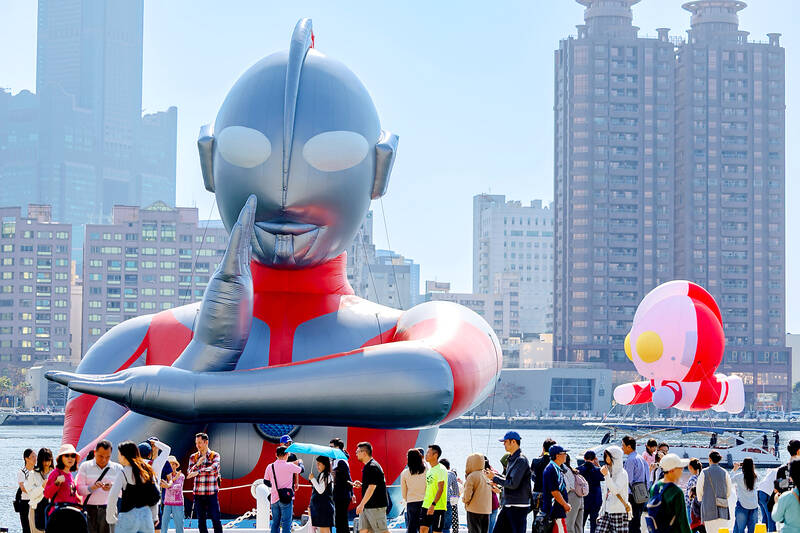
Photo Courtesy of Kaohsiung City Government’s Tourism Bureau
From Tuesday last week to Sunday, national scenic areas recorded 3.87 million visits, averaging 645,314 per day — a 125 percent increase from last year’s daily average of 286,765. Visits peaked on Thursday with a total of 843,096 visits in a single day.
Theme parks, a popular choice for families, attracted 526,372 visitors over the same six-day period, averaging 87,729 per day — up 32 percent from a year earlier. Daily attendance exceeded 100,000 on Thursday and Friday.
Travel demand was highest between Tuesday and Friday, when more than 2.98 million visits were logged — more than two-thirds of the six-day total, the Tourism Administration said.
On the final day of the holiday, about 300,000 people were still traveling, reflecting increasingly flexible travel patterns, it added.
Mountain and coastal destinations, such as Alishan, northern coastal scenic areas, Sun Moon Lake and the Yunlin-Chiayi-Tainan region, saw strong crowds, the agency said.
Many visitors opted for mountain trails, seaside landscapes and historic old streets, providing a boost to local businesses and related industries, it said.
“With Taiwan’s economy performing well, both international and domestic travel were brisk over the holiday,” Chen said, adding that rail services handled a total of 9 million passenger trips during the period.
Although he did not take a vacation himself, Chen said he made one round trip on the Taiwan High Speed Rail and drove on freeways between Taichung and Taipei twice.
Traffic felt heavier than usual due to the extended holiday and heavy travel demand, but congestion did not last long and remained within acceptable limits, he said.
“Transportation is not built on the minister’s expertise alone, but on the professionalism of everyone,” Chen said, thanking ministry personnel for their efforts.
He also expressed hope that travelers feel tangible improvements in traffic safety and convenience.
At Taiwan Taoyuan International Airport, passenger volume reached 169,000 on Feb. 14, setting a new single-day record for Taiwan’s airports and surpassing pre-COVID-19 pandemic levels. On the final day of the holiday, the airport handled 162,000 passengers, close to its pre-pandemic high.
Despite challenges, such as heavy fog in some areas, the Civil Aviation Administration and the Maritime and Port Bureau promptly activated contingency transport plans to ensure travelers were able to return to work smoothly, Chen said.
He also credited the Central Weather Administration for providing accurate daily forecasts, which helped travelers plan ahead and contributed to the surge in domestic tourism.

FUKUOKA SITUATION: Japanese media reported that the pathogen is expected to be identified by the summer, while the CDC downplayed the idea that it was hMPV A “mysterious cold-like illness” reported in Japan’s Fukuoka Prefecture does not seem to be a new disease, but Japanese authorities have been asked about the situation, the Centers for Disease Control (CDC) said yesterday. The Fukuoka Prefectural Medical Association on Wednesday told a news conference that a “mystery cold” that has become a hot topic on social media is “highly likely to be caused by some kind of viral infection,” Japan’s KBC News reported. “Many people are experiencing symptoms starting with a sore throat, followed by a runny nose, phlegm and a severe cough,” KBC News reported, citing association officials. Health authorities are

Nvidia Corp CEO Jensen Huang (黃仁勳) arrived in Taiwan yesterday ahead of upcoming AI and technology events, saying he plans to meet with clients and Taiwan Semiconductor Manufacturing Co Chairman C.C. Wei (魏哲家) during his visit. After landing at Taipei Songshan Airport, Huang posed for photos with fans and handed out Yakult drinks to reporters and supporters waiting at the scene, saying he has “a lot to do” during the trip. Asked about reports that Nvidia’s planned headquarters site in Taipei’s Beitou Shilin Technology Park could break ground on May 27, Huang said that if the company holds an event, he would

The Ministry of Finance this afternoon announced the winning numbers for the March-April uniform invoice lottery. The winning number for the NT$10 million (US$318,060) special prize is 19531471, and the winning number for the NT$2 million grand prize is 85941329. Three numbers were drawn for the NT$200,000 first prize: 07225810, 20231230 and 83518781. Those with receipts matching the last seven digits of any of the first-prize numbers will win the NT$40,000 second prize, while those matching the last six digits will win the NT$10,000 third prize. Those whose receipts match the last five digits of the first-prize numbers can claim the NT$4,000 fourth prize,

SIX SUBSIDIES: The monthly allowance for older farmers is to increase to NT$10,000, and NT$5,000 is to be given to homemakers under the national pension system, Lai said The government is to implement major welfare policies for disadvantaged groups, including raising the monthly allowance for older farmers to NT$10,000 and providing homemakers with NT$5,000 per month, President William Lai (賴清德) said yesterday. Lai made the remarks during a visit to Wangling Temple in Chiayi County, saying that the planned increases were being introduced amid economic growth and an increase in tax revenue. Touting a policy, in which the government plans to provide a monthly allowance of NT$5,000 for every child under the age of 18 in a bid to address Taiwan’s low birthrate, Lai said that if received for the


 RSS
RSS